Celebrities with Spanish Roots
 Bruno MarsGreat-great-grandfather from Segovia
 Pedro PascalPaternal grandmother from Mallorca
No celebrity matches your search.
Genetic layers of the Iberian Peninsula
In 2019 a study in Science presented genome-wide data from 271 ancient Iberians spanning 8,000 years. In the Bronze Age, ancestry linked to the Pontic-Caspian steppe appeared throughout Iberia. By about 2000 BCE, the authors find “the replacement of 40% of Iberia’s ancestry and nearly 100% of its Y-chromosomes by people with Steppe ancestry”. This points to more men than women among the newcomers. From at least the Roman period onward, gene flow from North Africa and the eastern Mediterranean changed the population again. Present-day Basques resemble a typical Iron Age population and lack the later admixture that reached the rest of the peninsula.[5]
A second study from 2019, in Nature Communications, analyzed 1,413 people from across Spain. Its authors found the main genetic differences running from east to west, while people in the north and the south were genetically very similar. They link this to the Reconquista, when Christian-ruled territory in the north moved south and settlers followed. Ancestry from north-west Africa ranges from 0 to 11% and is highest in the west, including Galicia, which in its present borders was never under Muslim rule. The researchers date the mixing to 860–1120 CE and see “clear genetic impacts of population movements associated with both the Muslim conquest and the subsequent Reconquista”.[6]
Al-Andalus and the Christian kingdoms
In 711 Ṭāriq ibn Ziyād, the Muslim ruler of Tangier, defeated the Visigothic king, and within a few years Muslim forces ruled most of the peninsula.[7] Córdoba became the capital of an emirate in the 8th century and in 929 the seat of an independent caliphate. Its Great Mosque was built in the 8th century over the remains of a Visigothic basilica and enlarged over the next three centuries.[8]
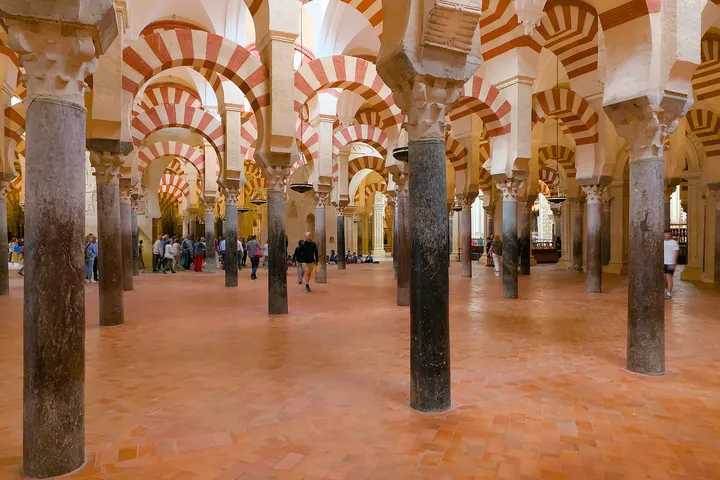
The Christian kingdoms of the north pushed south in a long series of campaigns known as the Reconquista, and by 1250 most of Spain was under Christian control. Castile took Córdoba in 1236.[7] The same year, the mosque became a cathedral.[8] Ferdinand and Isabella, whose marriage in 1469 united the crowns of Aragon and Castile, completed the conquest of Granada in 1492.[7]
Muslim communities that surrendered to Christian rulers were usually guaranteed freedom of religion by treaty, a policy abandoned in the late 15th century. In 1502 the Muslims of Granada had to choose between baptism and exile, and in 1526 those of Valencia and Aragon were forced to convert. A royal order of September 22, 1609, decreed the deportation of these converts and their descendants, the Moriscos. An estimated 300,000 resettled, mainly in Algeria, Tunisia and Morocco.[9] Burials from the Muslim period carry more North African ancestry than people in southern Iberia today, and the 2019 Science study sees the expulsion of the Moriscos and the resettlement of the south from the north as a plausible reason.[5]
Castilian and the co-official languages
Article 3 of the 1978 constitution reads, “Castilian is the official Spanish language of the State. All Spaniards have the duty to know it and the right to use it.” The other Spanish languages are official in their autonomous communities as each region’s statute provides.[1]
Six statutes of autonomy grant that status. Basque is official in the Basque Country and Navarre, Catalan in Catalonia and the Balearic Islands, Valencian in the Valencian Community, Galician in Galicia, and Aranese Occitan in Catalonia. Around 40% of Spain’s population lives in a region with more than one official language. The statutes of Aragon, Asturias and Castile and León recognize and protect the languages spoken there without making them official.[2]
Two surnames, archives and Spanish nationality
Spanish children receive two surnames, the first surname of each parent. Under the Civil Registry Act of 2011, the parents agree on the order before the birth is registered. Without agreement, the registrar decides in the best interest of the child. This rule has applied since June 30, 2017, and the order chosen for the first child applies to all later children of the same parents.[10]
The Royal Spanish Academy defines a patronymic as a surname formerly given to a son and formed from his father’s name, such as Fernández from Fernando or Martínez from Martín.[11] Eight of the ten most frequent first surnames end in -ez, as these two do.[12]
Source: INE[12]
Spain’s civil registry began on January 1, 1871, when a provisional law and its regulations took effect on the mainland, the adjacent islands and the Canary Islands.[13] For ancestors who sailed to the Americas in colonial times, the General Archive of the Indies holds passenger licenses. These applications record the family members who traveled, their places of origin and their destinations.[14] For later emigrants, the Ministry of Culture’s Migratory Movements portal gathers records from archives in Spain and Latin America, such as the passenger lists of the Spanish consulate in Veracruz.[15]
The Democratic Memory Law of 2022 deals with the coup of 1936, the Civil War and the Franco dictatorship. It allowed people born outside Spain to opt for Spanish nationality if a parent or grandparent had been Spanish by origin and had lost or renounced that nationality in exile for political or ideological reasons, their beliefs or their sexual orientation or identity. Children born abroad to Spanish women who lost their nationality by marrying a foreigner before the 1978 constitution also qualified.[16] The law gave applicants two years from October 21, 2022.[16] In July 2024 the government added a third year, so the window stayed open until October 2025.[17]
An earlier law, from 2015, offered nationality to Sephardic Jews of Spanish origin, descendants of the Jews expelled from Spain from 1492 onward. Its deadline, extended by one year, ran out on October 1, 2019.[18]
Spanish settlement in what is now the United States
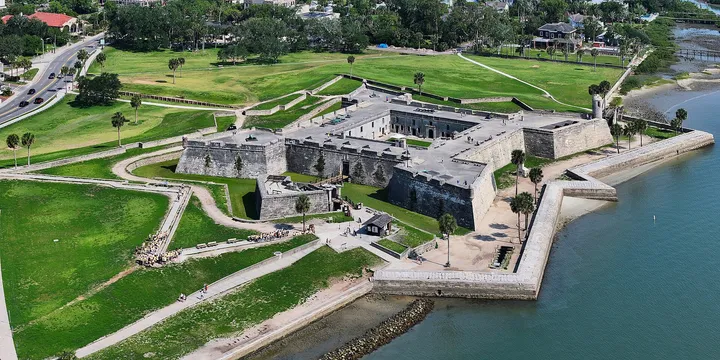
Spain founded St. Augustine in Florida in 1565, on land of the Timucua people, 42 years before the English settled Jamestown. It is the oldest continuously occupied European settlement in the continental United States. Work on its stone fortress, the Castillo de San Marcos, began in 1672.[19]
In the spring of 1610, Governor Pedro de Peralta laid out Santa Fe around a central plaza, on a site the local Tewa called ogaponge. It is the oldest capital city in the United States.[20] In 1821 the Kingdom of New Mexico, which then took in what became New Mexico, Arizona, Colorado and Utah, was the most densely populated part of northern Mexico. Some 28,500 of its residents called themselves Spaniards, alongside 10,000 Pueblo Indians. California counted 3,400 Spaniards and 23,000 mission Indians.[21]
Today New Mexico has the highest share of residents who give their Hispanic origin as Spanish, 4.4% in 2024, followed by Hawaii with 1.6%.[4]
Spanish, Hispanic or Latino
Merriam-Webster defines Hispanic as relating to people from Spanish-speaking Latin America and their descendants, and also to the people, speech or culture of Spain.[22] A Latino is a person from Latin America or of Latin American origin living in the United States.[23]
Federal statistics combine both terms in a single category, Hispanic or Latino. The definition in the federal standard revised in 2024 reads, “Includes individuals of Mexican, Puerto Rican, Salvadoran, Cuban, Dominican, Guatemalan, and other Central or South American or Spanish culture or origin.” Spaniard is one of the examples the standard gives for other groups.[24] Census Bureau surveys usually recode people who report origins in Brazil, Portugal or the Philippines as not Hispanic.[25]
The census tables keep Spaniard, Spanish and Spanish American as separate origins. Of the estimated 68 million Hispanics in 2024, 39 million gave a Mexican origin and 6.1 million a Puerto Rican one.[4]
Self-identification fades over the generations. According to Pew Research Center, nearly all immigrants from Latin America or Spain identify as Hispanic. Among Americans whose grandparents were all born in the United States, only half of those with Hispanic ancestry do.[25]
Spaniards in the United States
Of the roughly one million people of Spaniard origin in 2024, 153,000 lived in California, 130,000 in Texas and 90,000 in Florida.[4]
- 1513
Ponce de León claims Florida for Spain during an expedition to the peninsula.[19]
- 1769
On July 16, the Franciscan friar Junípero Serra and two fellow priests raise and bless a cross at San Diego to found the first mission in Alta California.[26]
- 1821
The United States gains control of Florida. St. Augustine has about 2,000 residents at the end of Spanish rule, nearly half of them enslaved.[19]
- 1886
Vicente M. Ybor moves his cigar factory from Key West to Tampa. The new district of Ybor City becomes home to many immigrants from Cuba, Spain and Italy, most of whom work in its cigar factories.[27]
- 1907
The steamship Heliopolis, which left Málaga with 2,246 emigrants, reaches Honolulu on April 26 with workers for Hawaii’s sugar plantations. Between 1899 and 1913, seven voyages bring about 8,000 Spaniards to the islands, and many later move on to California.[28]
- 1910–1919
A total of 53,262 immigrants whose last residence was Spain gain permanent residence, the highest figure for any decade between 1820 and 2019.[29]
- 1924
Under the new Immigration Act, Spain’s quota for the year beginning July 1 is set at 131 immigrants.[30]
- 2024
About 2 million people give their Hispanic origin as Spaniard, Spanish or Spanish American, close to 3% of all Hispanics in the country.[4]
Sources
- Congreso de los Diputados: The Spanish Constitution, English edition of the Boletín Oficial del Estado (updated November 13, 2024)
- Boletín Oficial del Estado: Real Decreto 798/2025, creating the Council of Official Languages and the Office for Official Languages (September 26, 2025)
- INE: Continuous Population Statistics, 1 July 2026, provisional data (August 6, 2026)
- U.S. Census Bureau: American Community Survey 2024, 1-year estimates, Table B03001, Hispanic or Latino Origin by Specific Origin
- Iñigo Olalde et al.: The genomic history of the Iberian Peninsula over the past 8000 years, Science (March 2019)
- Clare Bycroft et al.: Patterns of genetic differentiation and the footprints of historical migrations in the Iberian Peninsula, Nature Communications (February 2019)
- Encyclopaedia Britannica: Reconquista
- UNESCO World Heritage Centre: Historic Centre of Cordoba
- Encyclopaedia Britannica: Morisco
- Ley 20/2011, de 21 de julio, del Registro Civil, Article 49 and Final Provision 10, consolidated text, Boletín Oficial del Estado
- Real Academia Española: patronímico, Diccionario de la lengua española
- INE: Apellidos más frecuentes, annual population census of January 1, 2025 (April 2026)
- Gaceta de Madrid no. 348: Decree of December 13, 1870, on the entry into force of the Civil Registry Law (December 14, 1870)
- Yale University, Economic Growth Center: Bridging the Atlantic, Migrations and Their Legacies, Sources and Methods
- Spanish Ministry of Culture, State Archives: Migratory Movements portal, Presentation
- Ley 20/2022, de 19 de octubre, de Memoria Democrática, Article 1 and Eighth Additional Provision, consolidated text, Boletín Oficial del Estado
- Consulate General of Spain in Monterrey: Ampliación de plazo para optar a la nacionalidad española en virtud de la Ley de Memoria Democrática (September 9, 2024)
- Boletín Oficial del Estado: Orden PRA/325/2018, publishing the Council of Ministers agreement that extends the deadline under Law 12/2015 for Sephardic Jews of Spanish origin (March 27, 2018)
- National Park Service: St. Augustine Town Plan Historic District, St. Augustine, Florida
- National Park Service: Santa Fe Plaza
- Ramón A. Gutiérrez, National Park Service: The Latino Crucible, Its Origins in 19th-Century Wars, Revolutions, and Empire, American Latino Theme Study
- Merriam-Webster: Hispanic
- Merriam-Webster: Latino
- Office of Management and Budget: Revisions to OMB’s Statistical Policy Directive No. 15, Federal Register (March 29, 2024)
- Pew Research Center: Who is Hispanic?, by Mark Hugo Lopez, Joseph Copeland and Jeffrey S. Passel (September 15, 2026)
- California Office of Historic Preservation: Mission San Diego de Alcalá, California Historical Landmark No. 242
- City of Tampa: Historic Ybor
- Miguel Alba Trujillo, Universidad de Málaga: La agridulce emigración andaluza a Hawái, TSN Transatlantic Studies Network no. 7 (January–June 2019), via Dialnet
- U.S. Department of Homeland Security: 2019 Yearbook of Immigration Statistics, Table 2, Persons obtaining lawful permanent resident status by country of last residence, 1820 to 2019
- Calvin Coolidge: Proclamation 1703, Establishing Nationality Quota of Aliens Allowed Entry During Fiscal Year 1924-1925 (June 30, 1924), via The American Presidency Project
More from Europe
British 4Italian 4German 3English 2Irish 2Albanian 1Basque 1Bosnian 1French 1Hungarian 1Kosovo Albanian 1Portuguese 1