Celebrities with Basque Roots
 Pedro PascalGrandfather was Basque, he has said
Seven territories on both sides of the Pyrenees
The Basque Country, Euskal Herria in Basque, has seven historical territories: Araba, Bizkaia, Gipuzkoa and Navarre in Spain, and Lapurdi, Lower Navarre and Zuberoa in France.[1] It lies along the Bay of Biscay and the western foothills of the Pyrenees.[5] Roman authors recorded a people called the Vascones in lands that roughly match today’s Navarre.[5]
Under the Statute of Autonomy of 1979, Araba, Bizkaia and Gipuzkoa form the autonomous community of Euskadi, the Basque Country, within Spain. The statute gives Navarre the right to join.[6] Navarre is a separate region, which a law of 1982 defines as a Comunidad Foral with its own institutions.[7] In France, the Basque area lies in the department of Pyrénées-Atlantiques.[5]
Euskara, a language with no known relatives
The Basque word for a Basque person, euskaldun, means “possessor of the Basque language”. Linguists have suggested links to Georgian, to the Berber languages of Africa and even to Quechua. None of them has been proven, and most experts agree that Euskara forms a language family of its own.[1]
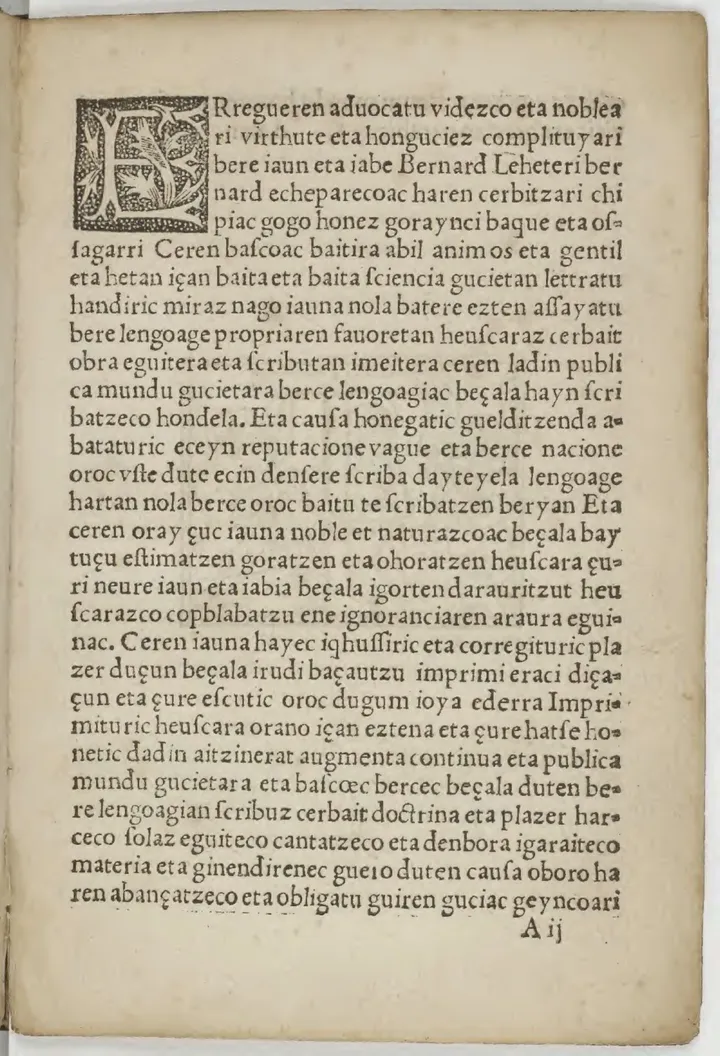
The first book printed in Basque, Linguae Vasconum Primitiae, appeared in Bordeaux in 1545. Its author, Bernat Etxepare, was a priest from Lower Navarre. His motto “Euskara, jalgi hadi mundura” means “Basque, go out into the world”. The only surviving copy belongs to the National Library of France.[8]
Euskaltzaindia, the Royal Academy of the Basque Language, dates from 1919. Its congress in Arantzazu in 1968 produced the first structured set of rules for a unified written language, euskara batua.[9] The Statute of 1979 calls Basque the “lengua propia del Pueblo Vasco”, the Basque people’s own language, and makes it official in Euskadi alongside Spanish.[6] In Navarre it has official status in the Basque-speaking areas.[7]
In 2021, 30.2% of people aged 16 and over in the seven territories spoke Basque well or quite well. The share was highest in Gipuzkoa, at 51.8%, and lowest in Navarre, at 14.1%. Among those aged 16 to 24, the share was 22.5% in 1991.[2]
Source: Basque Government, Seventh Sociolinguistic Survey[2]
What DNA studies say about Basque origins
Basques have long been considered a linguistic and genetic isolate going back to the hunter-gatherers of the Mesolithic. In 2015 a study analyzed the remains of eight people from the El Portalón cave at Atapuerca in Spain, who lived 5,500 to 3,500 years ago. Those from the Copper Age were genetically closest to present-day Basques. The authors suggest that Basques and their language may be linked with the spread of farming.[10]
A 2019 study of ancient DNA traced how ancestry from the Pontic-Caspian steppe spread across the Iberian Peninsula in the Bronze Age, a change the Spanish hub describes. By the Iron Age it had also reached regions where non-Indo-European languages were spoken. The authors conclude that “present-day Basques are best described as a typical Iron Age population without the admixture events that later affected the rest of Iberia.”[11]
A 2021 study added samples from 190 people at 18 places in the Basque area. It found Basques clearly distinct from their neighbors, with nearby groups that do not speak Basque in an intermediate position. The authors trace this to “genetic continuity since the Iron Age, characterized by periods of isolation and lack of recent gene flow that might have been reinforced by the language barrier.”[12] The North African ancestry found in most of the Iberian Peninsula is missing in Basques, and so are traces of Roman-era migrations, says David Comas, who led the study. Within the Basque Country, the genetic differences match the dialects.[13]
Fueros, the Tree of Gernika and the ikurriña
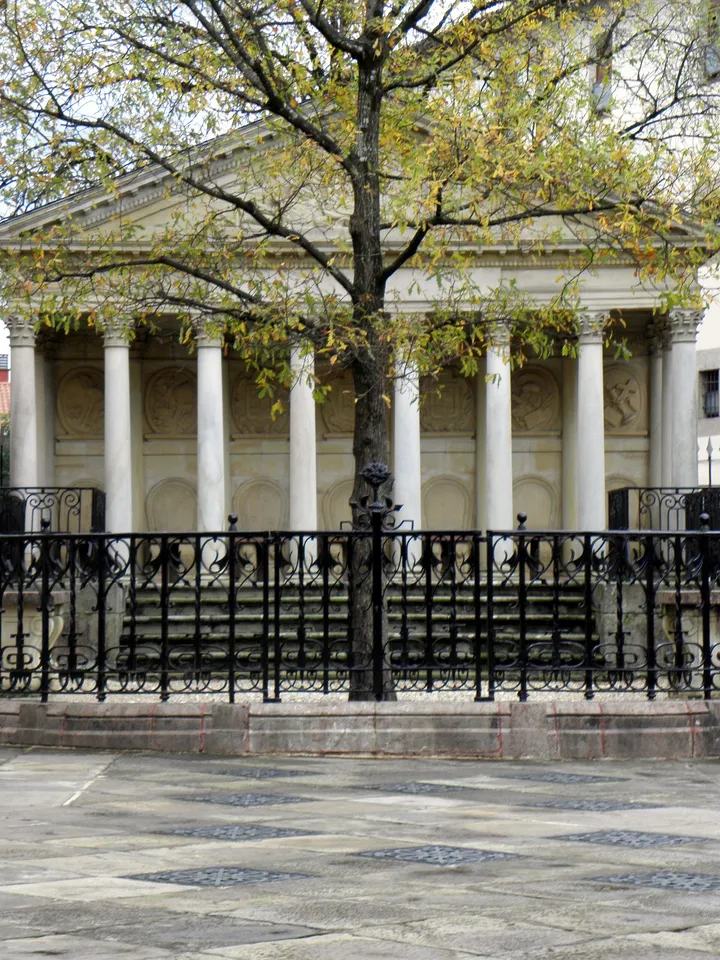
Under traditional laws known as fueros, the Basque territories kept a large degree of self-rule in trade, taxes and military service. The fueros also set the rights of the popular assemblies and the rules of inheritance.[5] In Bizkaia, representatives of the towns and the countryside met under an oak in Gernika from the 15th century on. Their assemblies lasted until a law of 1876 abolished the fueros and their institutions. They were restored between 1977 and 1979.[14]
On April 26, 1937, during the Spanish Civil War, aircraft of the German Condor Legion and the Italian air force bombed Gernika under Franco’s command.[15] In 2024 the new lehendakari, the president of the Basque Government, took his oath of office beside the tree. The wording kept almost unchanged the formula of Lehendakari Agirre from 1936, which includes the words “Gernikako zuhaitzpean”, under the tree of Gernika.[16]
The Statute of 1979 describes the flag of the Basque Country as a green saltire with a white cross over it on a red field.[6] This flag, the ikurriña, was first raised in Bilbao on July 14, 1894. The brothers Sabino and Luis Arana designed it. It flew at the opening of the Euzkeldun Batzokija, the society from which the Basque Nationalist Party grew a year later. After the Civil War the flag was banned in Spain. Tolerated by the government after Franco’s death, it was raised in public in San Sebastián on January 19, 1977.[17]
Herders in the American West
The first Basques in the United States came to California during the gold rush, after a first stay in Argentina or Chile. As the mining towns needed food, they turned to raising cattle and later sheep.[18] The largest wave of Basque herders arrived between 1900 and 1930. A band of sheep usually numbered 2,000 to 2,500 animals and grazed on public land. Many herders took their pay in sheep to build flocks of their own. In winter the men stayed at Basque boardinghouses in town, where they spoke Basque and heard news from home.[18]
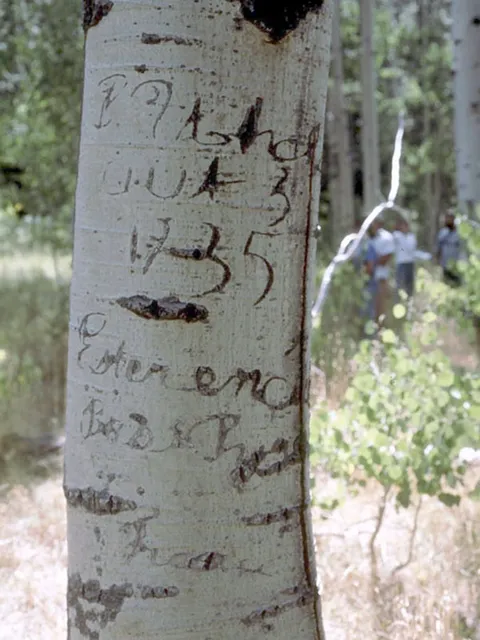
In spring and summer the herders drove their sheep into the high mountains and returned to the valleys in the fall. Into the bark of aspen trees they carved verses, drawings, political slogans and the names of their hometowns, in Basque, Spanish, French and English. About 25,000 of these arborglyphs, lertxun-marrak in Basque, have been documented.[19]
Basques dominated the sheep industry in the United States for about a century. In the 1970s wages rose in the Basque Country, and American ranchers began to recruit herders in Peru and Mexico.[18]
Basque surnames and family records
Studies of rural family life in Bizkaia describe house names that served as surnames. A farming family typically took the name of the house it owned and lived in, and the name passed from one generation to the next.[20] A traditional rule of inheritance kept the farm whole by passing it to a single heir or heiress.[5] The surname Etxeberria joins etxe, “house”, and berri, “new”.[21][22]
Families in Spain pass on surnames under the national civil registry law.[23] The Spanish hub explains the naming system. The law also lets people adapt the spelling of a surname to an official language of their place of origin or residence. A Basque name recorded in Spanish spelling can thus be registered in Basque spelling.[23]
For Euskadi, the Basque Historical Archive has indexed all baptisms, marriages and deaths in the parish books of the dioceses of Bilbao, San Sebastián and Vitoria up to 1900. The online index begins in 1490 and holds about 5.6 million entries.[24] For the three territories in France, the French hub describes the parish and civil registers.
Basques in North America
In the American Community Survey for 2020–2024, about 8,300 Idaho residents report Basque ancestry. That is 0.4% of the state, the highest share in the country. California has the largest number, about 17,800, and Nevada the second-highest share.[4]
- 1530s
Basque whalers set up a station at Red Bay in Labrador, which they call Gran Baya. For some 70 years they hunt whales there in summer and ship the oil to Europe for lighting. In 2013 the station becomes a UNESCO World Heritage Site.[25]
- 1873
Pedro and Bernardo Altube from Oñati in Gipuzkoa, who reached California by way of Argentina in the 1850s, establish the Spanish Ranch in Independence Valley near Elko, Nevada.[18]
- 1934
The Taylor Grazing Act ties grazing rights on federal range to privately owned base property, which shuts out itinerant herders without land of their own.[18]
- 1950
Congress passes the “Sheepherder Bills”, steered by Nevada’s senator and representative. Ranchers may now bring in skilled herders on three-year contracts when no one in the United States can fill the job.[18]
- 1954
President Dwight D. Eisenhower signs another such law, “one of a series of bills enacted by the Congress over the years to provide relief of the sheep raising industry by making available special nonquota immigrant visas to skilled alien sheepherders”.[26]
- 1957–1970
The ranchers’ range association receives 5,495 applications for herding jobs, 95% of them from Basques in Navarre and Bizkaia. The Western Range Association, founded in 1960, recruits through an office at the American consulate in Bilbao.[18]
- 1967
The anthropologist William A. Douglass takes charge of the young Basque Studies Program at the University of Nevada, Reno. In 2015 the program, by then the Center for Basque Studies, is renamed in his honor.[27]
- 1980
The census lets Americans report Basque ancestry regardless of their birthplace. Until then, in Douglass’s words, “Basques were masked under Spanish nationals and French nationals in the final census reports”.[28]
- 2024
The American Community Survey counts 62,551 people with Basque ancestry, as their only ancestry or alongside a second one.[3][29]
Sources
- University of Nevada, Reno, William A. Douglass Center for Basque Studies: Learn more about Basque Studies, The Basques: Origins and language
- Basque Government, Department of Culture and Language Policy: Seventh Sociolinguistic Survey 2021 (July 1, 2024)
- U.S. Census Bureau: American Community Survey 2024, 1-year estimates, Table B04006, People Reporting Ancestry
- U.S. Census Bureau: American Community Survey 2020–2024, 5-year estimates, Table B04006, People Reporting Ancestry, by state
- Encyclopaedia Britannica: Basque, people
- Agencia Estatal Boletín Oficial del Estado: Ley Orgánica 3/1979, de 18 de diciembre, de Estatuto de Autonomía para el País Vasco
- Agencia Estatal Boletín Oficial del Estado: Ley Orgánica 13/1982, de 10 de agosto, de reintegración y amejoramiento del Régimen Foral de Navarra
- Etxepare Basque Institute: The first book published in Basque on display in Bayonne (2025)
- Basque Government: El euskera unificado (euskara batua)
- Torsten Günther et al.: Ancient genomes link early farmers from Atapuerca in Spain to modern-day Basques, PNAS (September 2015)
- Iñigo Olalde et al.: The genomic history of the Iberian Peninsula over the past 8000 years, Science (March 2019)
- André Flores-Bello et al.: Genetic origins, singularity, and heterogeneity of Basques, Current Biology (May 2021)
- Universitat Pompeu Fabra via EurekAlert: The origin and uniqueness of Basque genetics revealed (March 26, 2021)
- Basque Government, Department of Culture: Conjunto de la Casa de Juntas de Bizkaia (Gernika-Lumo)
- University of Nevada, Reno, University Libraries: Documenting the bombing of Gernika
- Basque Government: Imanol Pradales jura su cargo como Lehendakari ante el Árbol de Gernika (June 22, 2024)
- Deia: Ikurriña, 126 años de la historia vasca (April 7, 2020)
- Gloria Totoricagüena Egurrola, Center for Basque Studies: Ethnic Industries for Migrants, Basque Sheepherding in the American West, Euskonews no. 212, Eusko Ikaskuntza (2003)
- John Bieter, Cheryl Oestreicher and Iñaki Arrieta Baro: Arborglyphs, Basque immigrant sheepherders left their marks on aspen trees in the American West, The Conversation (June 20, 2024)
- Labayru Fundazioa, Basque ethnography at a glance: The traditional rural family in Bizkaia
- Elhuyar: Basque–English dictionary, entry etxe
- Elhuyar: Basque–English dictionary, entry berri
- Agencia Estatal Boletín Oficial del Estado: Ley 20/2011, de 21 de julio, del Registro Civil, Articles 49 and 53
- Basque Historical Archive, Basque Government: What are sacramental records?
- UNESCO World Heritage Centre: Red Bay Basque Whaling Station
- The American Presidency Project: Dwight D. Eisenhower, Statement upon signing bill making available special nonquota immigrant visas to skilled alien sheepherders (September 3, 1954)
- University of Nevada, Reno, Nevada Today: High honor for contributors to 40 years of Basque publishing, preserving culture and history (2015)
- William A. Douglass: Calculating Ethnicity Through the U.S. Census, The Basque Case, BOGA: Basque Studies Consortium Journal 4, no. 1 (2016)
- U.S. Census Bureau: American Community Survey and Puerto Rico Community Survey 2024 Subject Definitions, Ancestry
More from Europe
British 4Italian 4German 3English 2Irish 2Spanish 2Albanian 1Bosnian 1French 1Hungarian 1Kosovo Albanian 1Portuguese 1