Celebrities with German Roots
Mother’s side 3
 Jason MomoaMother’s Iowa family has German roots
 Olivia RodrigoWisconsin-born mother of German descent
 ZendayaMother’s family traced to Germany
No celebrity matches your search.
Where German ancestry comes from
Early farmers appeared in what is now Germany 8,000 to 7,000 years ago. A study of DNA from 69 ancient Europeans, published in 2015, found them closely related to the first farmers of Hungary and Spain and distinct from the hunter-gatherers who lived there before. About 4,500 years ago, the people of the Corded Ware culture in Germany traced three quarters of their ancestry to the Yamnaya, herders from the steppe of what is now Russia. The authors see this as evidence of “a massive migration into the heartland of Europe from its eastern periphery.” Steppe ancestry persisted in all the Central Europeans they sampled until at least 3,000 years ago, and it is found throughout Europe today.[5]
The population of eastern Germany changed again in the early Middle Ages. In 2025 a team that analyzed 555 ancient genomes reported that migrants from Eastern Europe replaced more than 80% of the local gene pool in eastern Germany, Poland and Croatia during the 6th to 8th centuries. Today German speakers in Saxony carry around 40% of this Eastern European ancestry. Among the Sorbs of Upper Lusatia, a Slavic-speaking minority, the share is 88%, about the same as among Poles. The authors think the lower share among German speakers is probably connected with the Frankish conquest and with German-speaking settlement east of the Elbe and Saale rivers from the 12th century onward.[6]
From many states to one Germany
After the Holy Roman Empire was dissolved in 1806, the Congress of Vienna created the German Confederation in 1815. It began with 35 sovereign principalities and four free cities. Austria and Prussia belonged to it only with the lands that had been part of the old empire.[7]
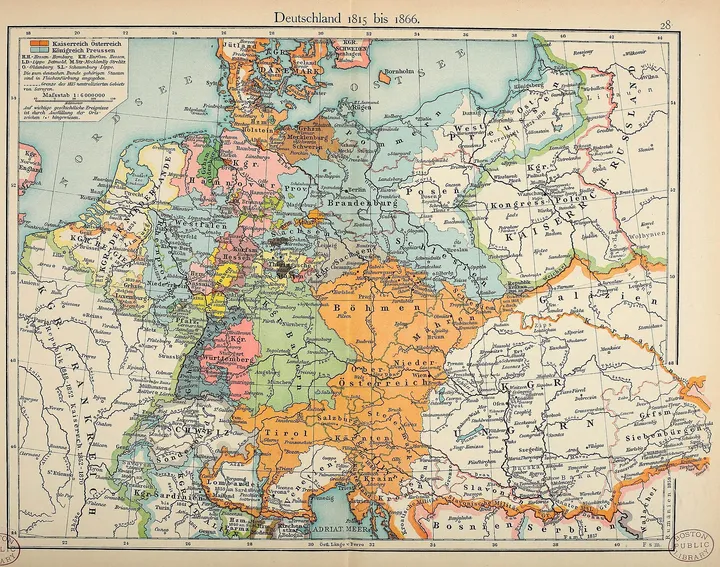
The German Empire was proclaimed on January 18, 1871. Its constitution, passed on April 16, lists 25 member states, from Prussia, Bavaria, Saxony and Württemberg to the cities of Lübeck, Bremen and Hamburg.[8] Today the Federal Republic is made up of 16 states, the Länder.[1]
How black, red and gold became the national colors
Where the colors come from cannot be traced with certainty. After 1815 they were linked to the black uniforms with red trim and gold buttons of the Lützow Free Corps, a unit that had fought against Napoleon. Their national appeal came mainly from the mistaken belief that they had been the colors of the old empire. Many participants at the Hambach Festival of 1832 carried black, red and gold flags. The colors became a symbol of national unity and civil liberty and were almost everywhere during the revolution of 1848–49.[9]
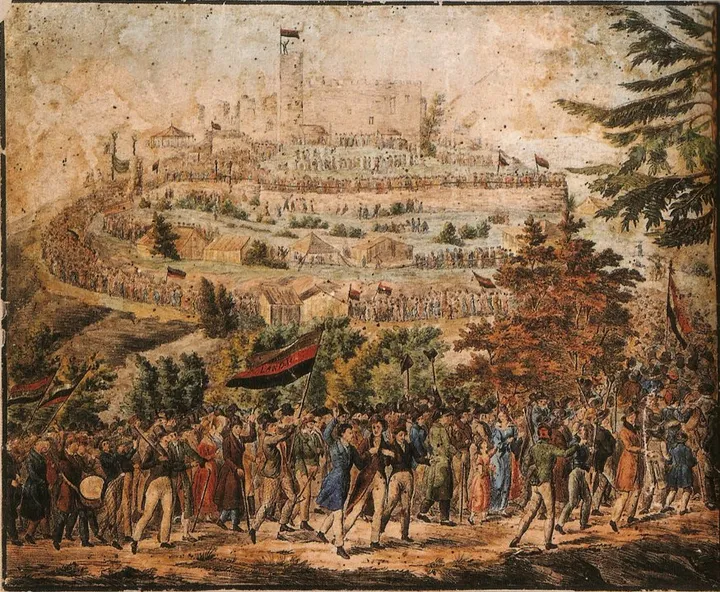
In 1848 the Federal Diet in Frankfurt and the National Assembly declared black, red and gold the colors of the German Confederation and of the empire they meant to found. The empire of 1871 chose black, white and red, the colors of Prussia with the red of the Hanseatic cities. The National Assembly in Weimar made black, red and gold the colors of the Reich in 1919. Thirty years later the Parliamentary Council adopted them for the Federal Republic, with one vote against.[9] Article 22 of the Basic Law fixes them as the colors of the federal flag.[1] East Germany used the same colors and from 1959 added its emblem with hammer and compass. On October 3, 1990, the black, red and gold flag became the flag of reunified Germany.[9]
From Germantown to the Great Plains
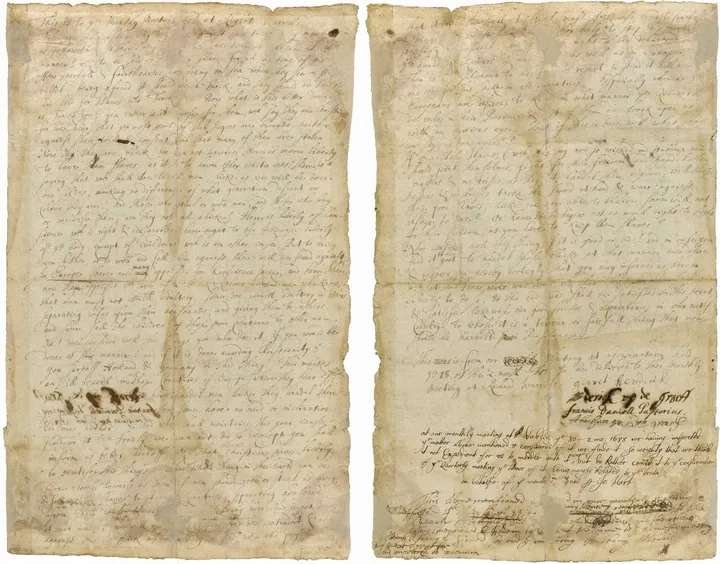
In 1688 four German Quakers in Germantown, Pennsylvania, wrote a petition against slavery to their monthly meeting. It was the first protest of its kind in the British North American colonies. They asked their fellow Quakers to treat others as they would want to be treated, “macking no difference of what generation, descent or Colour they are.”[10]
In the 18th century about 81,000 German speakers from Central Europe, Switzerland included, settled in southeastern Pennsylvania. Of these, 96% were Lutheran or German Reformed.[11] In 1751 Benjamin Franklin, worried by their numbers, asked why Pennsylvania, “founded by the English,” should “become a Colony of Aliens, who will shortly be so numerous as to Germanize us instead of our Anglifying them”.[12]
The language of these settlers, Pennsylvania Dutch, is closest to the dialects of the southeastern Palatinate near Mannheim.[11] The linguist Mark L. Louden traces the name to an older usage, in which “both Dutch and German could refer to speakers of what we would today call German.”[13] The Amish and Old Order Mennonites are the last groups who still pass the language on to their children.[11] In 2026 the Amish population of North America was estimated at 421,200.[14]
Most German immigrants arrived in the 19th century.[15] For Wisconsin, the Max Kade Institute for German-American Studies describes three waves. In the 1850s the newcomers came mainly from the south and west, from Bavaria, Baden, Württemberg, the Rhineland and the Palatinate, driven by hardship on the farms and overpopulation. Liberal intellectuals who fled after the failed revolutions of 1848–49 came with them. From 1865 to 1875 settlers arrived from Schleswig, Holstein, Hanover and Westphalia, many of them farmers hit by a slump caused by cheap American wheat. The largest wave, in the 1880s, brought farm laborers and craftsmen from Brandenburg and Pomerania in the north and east.[16]
Source: U.S. Department of Homeland Security[15]
Other German Americans came by way of Russia. In 1763 Catherine the Great invited Germans to settle her lands on the Volga, promising freedom from taxes and from military service. Between 1763 and 1768 more than 25,000 Germans founded 104 colonies along the Volga and Karaman rivers. In 1871 Tsar Alexander II revoked their exemption from military service. The first group left for Kansas in 1875 and settled on railroad land in Ellis and Rush counties.[17]
German in America and the First World War
On the eve of World War I, 8.7% of all Americans had been born in Germany or had at least one German-born parent.[18] Wisconsin alone had almost 100 German-language newspapers when the United States entered the war in 1917.[19] Most German Americans stood with their country, but anti-German sentiment spread. Schools stopped teaching German, place names were changed and German-language newspapers closed.[18]
In 1919 Nebraska banned teaching in any language other than English and allowed foreign languages as a subject only after the eighth grade. In 1920 a teacher at a Lutheran parochial school in Hamilton County taught a ten-year-old to read German from a collection of Bible stories and was convicted under the law. The Supreme Court reversed the conviction in Meyer v. Nebraska in 1923. “The protection of the Constitution extends to all, to those who speak other languages as well as to those born with English on the tongue,” the court wrote.[20]
Finding German ancestors in the records
The instructions for the 1870 US census read, “Instead of ‘Germany,’ specify the State, as Prussia, Baden, Bavaria, Wurttemburg, Hesse Darmstadt, etc.”[21] In Germany itself, register offices have recorded every birth, marriage and death since 1874 in Prussia and since 1876 in the rest of the empire.[22] German speakers of the 19th century wrote in Kurrent, an old form of cursive, and read print set in Fraktur.[23]
More than 7 million emigrants left Europe by ship through Bremen and Bremerhaven in the 19th and 20th centuries. Bremen kept its older passenger lists for only a few years for lack of space, and most were destroyed. Complete series survive only for 1907–08, 1913–14 and 1920–1939. The lists from Hamburg are better preserved and cover 1850 to 1934.[24]
Germans in the United States
About 2.7 million Pennsylvanians and 2.5 million Ohioans report German ancestry, more than in any other state. In Wisconsin, North Dakota and South Dakota, it is about one in three residents.[4]
- 1683
On October 6, thirteen families from Krefeld found Germantown, Pennsylvania.[25]
- 1710
About 3,000 Palatines, Germans from the Rhine Valley, sail from England to New York. Some 400 of them die at sea.[26]
- 1890
Germany-born residents reach their highest number in any census, 2,784,894 people or about 30% of all who were born abroad.[27]
- 1933–1939
After the Nazis come to power, about 282,000 Jews leave Germany by September 1939. Together with refugees from annexed Austria, some 95,000 reach the United States.[28]
- 1941
After the attack on Pearl Harbor, the FBI and other agencies arrest thousands of suspected enemy aliens, mostly people of German, Italian or Japanese ancestry. Many are released after hearings. Others are interned, in a few cases until after the end of the war.[29]
- 1950s
Immigration from Germany rises again.[15] Partly as a result of the Displaced Persons Act of 1948 and the Refugee Relief Act of 1953, German speakers come to Wisconsin once more, many of them Danube Swabians and East Prussians who had fled or been driven from their homes after the war.[16]
- 1987
Congress designates October 6, 1987, the 304th anniversary of the first German immigrants’ arrival in Philadelphia, as German-American Day.[30]
- 2024
German is the most common European ancestry in the American Community Survey, reported by 40.2 million people or 11.8% of the population. The survey tabulates up to two ancestries per person.[4][31]
Sources
- Federal Ministry of Justice, Gesetze im Internet: Basic Law for the Federal Republic of Germany, English translation, Preamble and Article 22
- Federal Ministry of Justice, Gesetze im Internet: Verwaltungsverfahrensgesetz (Administrative Procedure Act), Section 23, Amtssprache
- Statistisches Bundesamt (Destatis): Bevölkerung Deutschlands sinkt im Jahr 2025 um 0,1 %, press release No. 203 (June 16, 2026)
- U.S. Census Bureau: American Community Survey 2024, 1-year estimates, Table DP02, Selected Social Characteristics, national and state data
- Wolfgang Haak et al.: Massive migration from the steppe was a source for Indo-European languages in Europe, Nature 522 (June 2015)
- Joscha Gretzinger et al.: Ancient DNA connects large-scale migration with the spread of Slavs, Nature (September 3, 2025)
- Deutsches Historisches Museum, LeMO: Arnulf Scriba, Der Deutsche Bund (September 15, 2014)
- German Historical Institute Washington, German History in Documents and Images: Constitution of the German Empire (April 16, 1871)
- Deutscher Bundestag: Die Bundesflagge
- National Park Service, Independence National Historical Park: Germantown Friends’ First Protest Against Slavery, 1688 (March 19, 2025)
- Young Center for Anabaptist and Pietist Studies, Elizabethtown College: Amish Studies, Language
- Founders Online, National Archives: Benjamin Franklin, Observations Concerning the Increase of Mankind (1751)
- Mark L. Louden, padutch.net: What is Pennsylvania Dutch? (November 2025)
- Young Center for Anabaptist and Pietist Studies, Elizabethtown College: Amish Population Profile 2026
- U.S. Department of Homeland Security: 2022 Yearbook of Immigration Statistics, Table 2, Persons Obtaining Lawful Permanent Resident Status by Region and Selected Country of Last Residence, Fiscal Years 1820 to 2022
- Max Kade Institute for German-American Studies, University of Wisconsin–Madison: 100 Years of Immigration, exhibit Neighbors Past and Present
- Kansas Historical Society, Kansapedia: Germans from Russia in Kansas (December 2017)
- Max Kade Institute for German-American Studies, University of Wisconsin–Madison: In Times of War, exhibit Neighbors Past and Present
- Max Kade Institute for German-American Studies, University of Wisconsin–Madison: Published in German, exhibit Neighbors Past and Present
- Legal Information Institute, Cornell Law School: Meyer v. Nebraska, 262 U.S. 390 (June 4, 1923)
- IPUMS USA, University of Minnesota: 1870 Census, Instructions to Assistant Marshals (May 1, 1870)
- Staatsarchiv Hamburg: Standesämter, Bestand 332-5
- Max Kade Institute for German-American Studies, University of Wisconsin–Madison: Language, exhibit Neighbors Past and Present
- Staatsarchiv Bremen: Leitfaden zu den Auswanderungsquellen im Staatsarchiv Bremen (February 27, 2026)
- The American Presidency Project, UC Santa Barbara: Ronald Reagan, Proclamation 5014, Tricentennial Anniversary Year of German Settlement in America (January 20, 1983)
- National Park Service, Fort Stanwix National Monument: The Palatine Germans (October 8, 2022)
- U.S. Census Bureau: Campbell J. Gibson and Emily Lennon, Historical Census Statistics on the Foreign-born Population of the United States, 1850–1990, Working Paper No. 29 (February 1999)
- United States Holocaust Memorial Museum: German Jewish Refugees, 1933–1939, Holocaust Encyclopedia
- National Archives: World War II Enemy Alien Control Program Overview
- The American Presidency Project, UC Santa Barbara: Ronald Reagan, Proclamation 5719, German-American Day, 1987 (October 2, 1987)
- U.S. Census Bureau: About Ancestry
More from Europe
British 4Italian 4English 2Irish 2Spanish 2Albanian 1Basque 1Bosnian 1French 1Hungarian 1Kosovo Albanian 1Portuguese 1