Celebrities with French Roots
 Timothée ChalametFather born in France
Where French ancestry comes from
A study published in 2020 analyzed ancient DNA from 243 people who lived in what is now France over a span of 7,000 years. The earliest were hunter-gatherers from a cave in Charente, dated to about 7100 BC. The farmers in the sample, from about 5300 BC onward, carried ancestry from Anatolia and had mixed with local hunter-gatherers to varying degrees. At the start of the Bronze Age came substantial gene flow from people who derived part of their ancestry from the Pontic steppe. Clear evidence of the paternal lineage R1b in France goes back to around 2500 BC. It belonged to 11 of 13 Bronze Age men and 7 of 10 Iron Age men in the study.[4]
The Gauls of the Iron Age are often presented as the direct ancestors of the French. In 2022 researchers published 49 Iron Age genomes from six regions and found no genetic break between the Bronze Age and the Iron Age. Regional groups with different archaeological cultures were genetically very similar, which the authors link to mobility between regions and to gene flow with neighbors in England and Spain.[5]
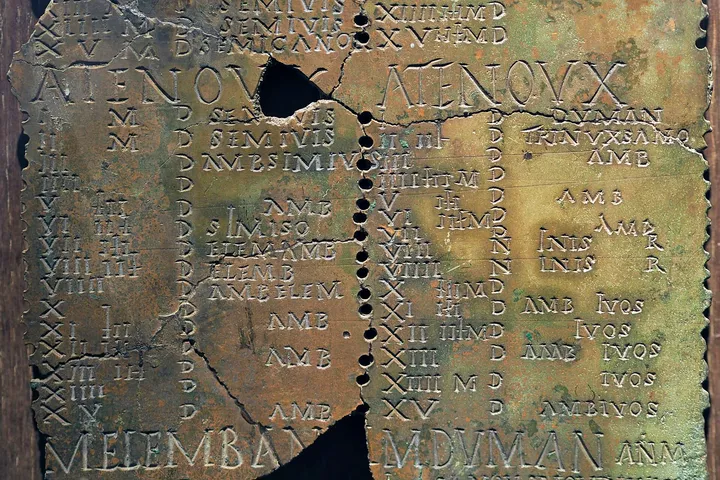
Julius Caesar opened his account of the Gallic War with the words “All Gaul is divided into three parts”. The Belgae lived in one and the Aquitani in another. The third belonged to the people “who in their own language are called Celts, in our Gauls”, and the Garonne separated them from the Aquitani.[6] A bronze calendar from the 1st century AD, found at Coligny in the Ain department in 1897, preserves about 600 words in the Celtic language of Gaul. It covers five years, and its months bear names such as samon, giamon and equos.[7]
France takes its name from the Franks, a Germanic-speaking people who invaded the Western Roman Empire in the 5th century. Clovis I became ruler of the Salian Franks in 481 or 482, brought the other Frankish tribes under his authority and subdued the Visigoths in southern Gaul in 507. He converted to Catholicism. The adoption of Catholic Christianity helped unite the Franks into one people and won them the support of the clergy and the Gallo-Roman population.[8]
For the present-day population, a 2020 study of 2,184 people born in France identified six clusters that “correspond closely to geographic, historical, and linguistic divisions of France”. The differences between them are small. Their borders follow the Loire and the Garonne, and the south-west stands apart most clearly. The authors note that this region matches Caesar’s Aquitania and that part of its distinct ancestry may reflect a Basque origin. Brittany forms a cluster of its own. The DNA also records a marked population bottleneck that began in the 14th century, the time of the Black Death. It appears mainly in the north.[9]
One language for the law, many regional languages
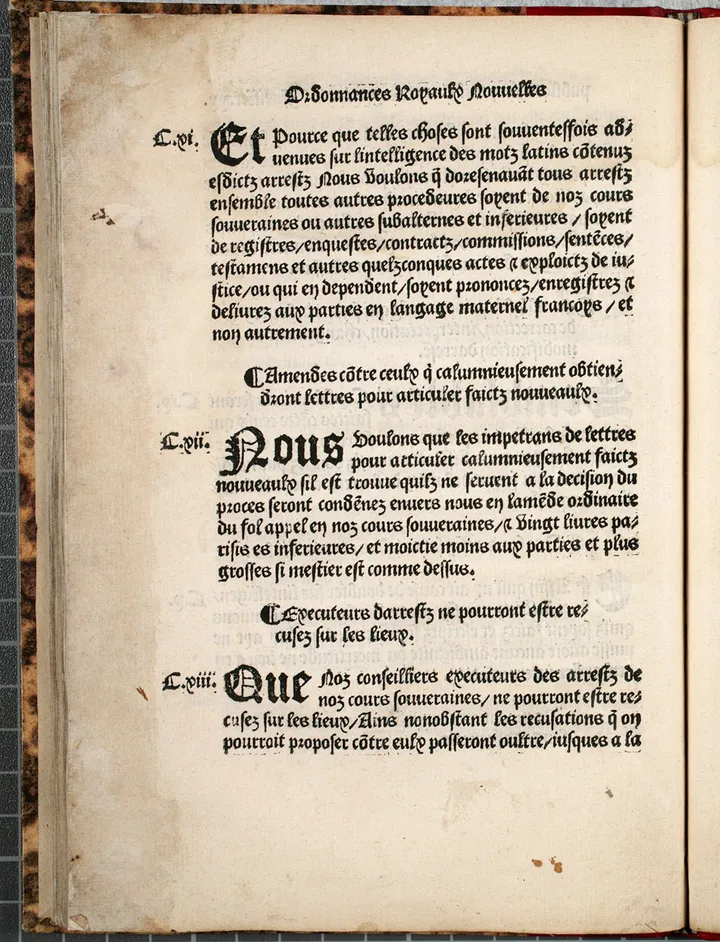
The ordinance of Villers-Cotterêts of August 1539 dealt with the administration of justice. Its article 111 requires that court rulings, registers, contracts, wills and all other legal acts be pronounced, recorded and delivered “en langage maternel françois et non autrement”, in the French mother tongue and in no other way. The article explains that the Latin words in court rulings had often caused doubts about their meaning. Légifrance, the official database of French law, still lists it as in force.[10]
The constitution states, “The language of the Republic shall be French.”[1] An article added in 2008 reads, “Regional languages are part of France’s heritage.”[1][11] The Ministry of Culture sorts the regional languages by family. Breton is Celtic. Alsatian, West Flemish and Lorraine Franconian are Germanic. Occitan, Catalan, Corsican, Franco-Provençal and the langues d’oïl, among them Picard, Norman and Gallo, are Romance languages. Basque is a language isolate. Overseas, the list includes several creoles, Tahitian and the languages of New Caledonia.[12]
The Huguenot exile
Huguenots are French Calvinists. Their name probably comes from the Swiss German Eidgenossen, “confederates”.[13] From 1562 to 1598 the Catholic majority and the Protestant minority fought the Wars of Religion.[13][14] In the St. Bartholomew’s Day massacre of August 1572, an estimated 4,000 Protestants were killed in Paris and at least 10,000 people in the provinces.[14] The Edict of Nantes of 1598 restored peace and guaranteed the Huguenots religious and civil rights.[13]
Louis XIV revoked the edict in October 1685 and made Calvinism illegal. Of nearly 800,000 Huguenots, about 600,000 recanted, hoping to practice their faith in secret.[13] Emigration was forbidden, and men caught leaving were sent to the galleys, women to prison.[15] Even so, between 160,000 and 200,000 Huguenots fled.[13][15] Most went to Protestant countries nearby: about 60,000 to the Netherlands, 50,000 to England, 40,000 to the German states and 25,000 to the Swiss cantons.[13]
About 2,500 reached British North America. New York received 800, Virginia 700, South Carolina 500 and New England 300. In Charleston a Huguenot congregation was founded in 1680 and built its church in 1687.[13] In Virginia, Huguenot refugees settled in 1700 at Manakin Town on the James River, an abandoned Monacan site.[16] In South Carolina most of the second generation had stopped speaking French by the 1730s and 1740s, and many had married into families of British origin.[13]
France in North America
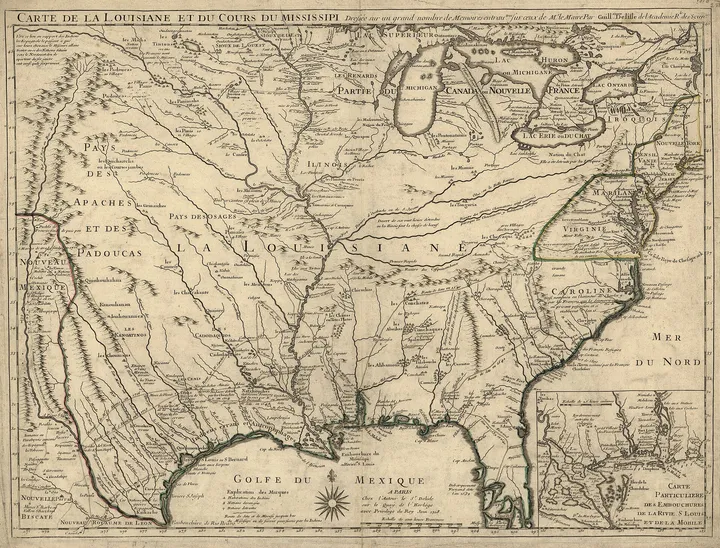
In April 1682 the explorer Robert Cavelier de La Salle claimed the land on both sides of the Mississippi for France and named it Louisiana after King Louis XIV. The territory reached up through the continent, beyond today’s border with Canada.[17] In 1699 Pierre Le Moyne d’Iberville went up the river to a place where a red post marked the boundary between Native nations. The city there is Baton Rouge, French for “red stick”.[17]
The Acadians, settlers from western France, had farmed and fished in Acadia, today Nova Scotia, since 1604. In 1755 the British began to expel them. By the early 1800s nearly 4,000 Acadians had settled in south Louisiana, where they became the Cajuns.[18] Between 1840 and 1930 nearly a million French speakers from Canada, most of them from Quebec, moved to the United States. Most settled in New England, where the largest group worked in the textile mills.[19] Families with roots in French Canada are listed under Canadian heritage.
In the American Community Survey, the share of residents who report French ancestry is highest in northern New England and in Louisiana.[20]
Source: U.S. Census Bureau[20]
The tricolor and a Republic without ethnic categories
The blue, white and red flag was born in the French Revolution. It joins the white of the king with the blue and red of the city of Paris. According to tradition, the Marquis de Lafayette handed King Louis XVI a tricolor cockade three days after the storming of the Bastille. On February 15, 1794, the National Convention gave the flag its final form, three vertical bands with blue nearest the pole, then white and red.[21] The constitution names the tricolor as the national emblem, La Marseillaise as the anthem and “Liberty, Equality, Fraternity” as the motto.[1]
Article 1 commits the Republic to “the equality of all citizens before the law, without distinction of origin, race or religion”.[1] In 2007 the Constitutional Council held that, under this article, studies on the diversity of origin may not “be based on ethnicity or race”.[22] French public statistics record origins mainly as nationality at birth and country of birth, for people, their parents and occasionally their grandparents. The public statistics service takes care to avoid any “ethno-racial” framework.[23]
Tracing French ancestors
The ordinance of Villers-Cotterêts was also the first royal law on parish registers. It ordered every parish priest to keep a yearly register of baptisms that gave each child’s date of birth. An ordinance of 1579 added marriages and burials, and from 1667 the registers had to be kept in two copies. The early rules were poorly followed, and the south lagged behind the north.[24]
An edict of 1787 created civil registration for everyone who did not profess the Catholic faith. Since a law of September 1792, town halls have recorded births, marriages and deaths.[24]
Almost all departmental archives have put the parish registers of their communes online, together with civil registers more than a century old. The scans come from microfilms that the Genealogical Society of Utah made in partnership with French archives, and they include Protestant and Jewish registers.[24]
The French in the United States
California has the most residents of French ancestry, about 481,000 in 2024. Louisiana and Texas follow with about 420,000 each.[3]
- 1564
With help from the Timucua-speaking Mocama people, 200 French soldiers and artisans build La Caroline near the mouth of the St. Johns River in Florida, France’s first attempt at a permanent settlement in North America. Admiral Gaspard de Coligny, the most powerful Huguenot, had proposed the colony also as a refuge for Protestants.[25]
- 1718
Jean-Baptiste Le Moyne de Bienville founds La Nouvelle-Orléans, New Orleans, near the mouth of the Mississippi. In 1722 it becomes the capital of French Louisiana.[17]
- 1778
France and the United States sign a Treaty of Alliance on February 6. Its aim, in the words of article 2, is “to maintain effectually the liberty, Sovereignty, and independance absolute and unlimited of the said united States”.[26][27]
- 1781
French troops and the French navy help force the British surrender at Yorktown, Virginia.[27]
- 1803
The United States buys Louisiana from France, 828,000 square miles west of the Mississippi, for $15 million. At roughly 4 cents an acre, the country doubles in size.[28]
- 1809
Refugees from Saint-Domingue, the French colony whose revolution created the independent nation of Haiti, are expelled from Cuba and sail to New Orleans. By early 1810 more than 10,000 have arrived, and the city’s population has doubled. White people, free people of African descent and enslaved people each make up about a third.[29]
- 1886
President Grover Cleveland dedicates the Statue of Liberty in New York on October 28, a gift from the people of France.[30]
- 2024
About 6.1 million people, 1.8% of the population, report French ancestry. The American Community Survey lists French Canadian (1.6 million), Cajun (91,641) and Basque (62,551) as separate ancestries.[3]
Sources
- Constitutional Council: Constitution of October 4, 1958, English translation, Articles 1, 2 and 75-1
- Insee: Hélène Thélot, Bilan démographique 2025, Insee Première no. 2087 (January 13, 2026)
- U.S. Census Bureau: American Community Survey 2024, 1-year estimates, Table B04006, People Reporting Ancestry
- Samantha Brunel et al.: Ancient genomes from present-day France unveil 7,000 years of its demographic history, PNAS (June 2020)
- Claire-Elise Fischer et al.: Origin and mobility of Iron Age Gaulish groups in present-day France revealed through archaeogenomics, iScience (April 2022)
- Julius Caesar: The Gallic War, Book 1, translated by W. A. McDevitte and W. S. Bohn (1869), Perseus Digital Library, Tufts University
- Lugdunum, Musée et théâtres romains, Lyon: Le calendrier gaulois de Coligny
- Encyclopaedia Britannica: Frank, people
- Aude Saint Pierre et al.: The genetic history of France, European Journal of Human Genetics (2020)
- Légifrance: Ordonnance du 25 août 1539 sur le fait de la justice (dite ordonnance de Villers-Cotterêts), Articles 110 and 111
- Légifrance: Constitution du 4 octobre 1958, Article 75-1, created by constitutional law no. 2008-724 of July 23, 2008
- French Ministry of Culture, DGLFLF: Panorama des langues de France
- Bertrand Van Ruymbeke: Huguenots, South Carolina Encyclopedia, University of South Carolina, Institute for Southern Studies (2016, updated 2022)
- Musée protestant: St. Bartholomew’s Day (24th August 1572)
- Musée protestant: The Huguenot Refuge
- Library of Virginia, Dictionary of Virginia Biography: Benjamin de Joux
- National Park Service, Jean Lafitte National Historical Park and Preserve: Early Europeans in Louisiana
- National Park Service, Jean Lafitte National Historical Park and Preserve: From Acadian to Cajun
- David Vermette: Franco-Americans, The Canadian Encyclopedia, Historica Canada (August 6, 2024)
- U.S. Census Bureau: American Community Survey 2020–2024, 5-year estimates, Table DP02, Selected Social Characteristics, by state
- Élysée: Le drapeau français
- Constitutional Council: Decision no. 2007-557 DC of November 15, 2007, English translation
- Insee blog: Sylvie Le Minez, Oui, la statistique publique produit des statistiques ethniques ! (July 31, 2020)
- Archives nationales: Gildas Bernard, Danièle Neirinck and Ségolène de Dainville-Barbiche, Guide des recherches sur l’histoire des familles (January 2018)
- National Park Service, Timucuan Ecological and Historic Preserve: A Foothold in Florida
- The Avalon Project, Yale Law School: Treaty of Alliance Between The United States and France (February 6, 1778)
- Office of the Historian, U.S. Department of State: French Alliance, French Assistance, and European Diplomacy during the American Revolution, 1778–1782
- National Archives: Louisiana Purchase Treaty (1803)
- 64 Parishes, Louisiana Endowment for the Humanities: Elizabeth Clark Neidenbach, Refugee Revolution (May 29, 2020)
- National Park Service: Statue of Liberty National Monument
More from Europe
British 4Italian 4German 3English 2Irish 2Spanish 2Albanian 1Basque 1Bosnian 1Hungarian 1Kosovo Albanian 1Portuguese 1