Celebrities with Albanian Roots
 Dua LipaBoth parents are Kosovo Albanians
Albanians in the Balkans and abroad
At the start of the 21st century there were an estimated seven million ethnic Albanians, and fewer than half of them lived in Albania. The largest communities outside the country are in Kosovo, North Macedonia and Montenegro. There are also Albanian communities in Greece, Italy, Turkey, Bulgaria, Serbia and Romania. Since the 1970s many Albanians have emigrated to Western Europe and the United States.[6]
In Albania’s census of 2023, 91.0% of residents declared Albanian ethnicity. The statistics office adds that ethnicity “should not be confused with citizenship, country of birth or nationality”. Between the censuses of 2011 and 2023 the population fell by around 420,000. The decline began in 1990 and is mainly caused by emigration.[2]
In Kosovo, the census of 2024 put the number of Kosovo Albanians at 1,454,999, or 90.8% of the population.[3] In North Macedonia, 24.30% of the resident population declared themselves Albanian in 2021.[7]
Illyrians, DNA and the question of origins
Albanians first appear in historical records in the 11th century CE.[8] Their name is older. In the 2nd century the geographer Ptolemy listed Albanopolis as the town of the Albanoi, an Illyrian tribe, in the Roman province of Macedonia. The site has never been securely identified.[9]
The ancient Illyrians, whose lands Rome conquered in the 2nd century BCE, are generally seen by Albanians as their ancestors.[10] Among linguists, both Illyrian and Dacian have been tentatively considered the ancestor or closest relative of Albanian.[1] The Austrian linguist Joachim Matzinger argues from the sound history of local place names that the ancestors of the Albanians moved into today’s Albanian-speaking lands from elsewhere. In his view, Albanian does not continue the ancient Illyrian language.[9] In 2024 Radu Crăciun rejected these arguments in Studime Filologjike, a journal of the Academy of Albanological Studies. He follows earlier scholars such as Eqrem Çabej and Eric Hamp, who saw in Albanian the continuation of an Illyrian dialect with a significant Thracian element.[11]
In 2026 a team of geneticists compared more than 6,000 ancient genomes from western Eurasia with those of 74 present-day Albanians. In early medieval Albania they detected a continuity of western Balkan ancestry from the Late Bronze and Iron Ages, to a greater degree than in neighboring regions. They conclude that “present-day Albanians predominantly descend from this remnant palaeo-Balkan group”. On average 10–20% of the ancestry of today’s Albanians comes from medieval groups related to Eastern Europeans, with differences between regions.[8]
According to an earlier study, people genetically similar to the Slavic speakers of Eastern Europe arrived in large numbers after Roman control ended. They contributed 30–60% of the ancestry of Balkan people. The authors describe today’s Balkan populations as having “relatively similar ancestry profiles”, while they speak languages from four families: Romance, Slavic, Albanian and Greek.[12]
The Albanian language and its names
Albanian is the only modern member of its own branch of the Indo-European languages. Its two main dialects, Gheg in the north and Tosk in the south, are divided roughly by the Shkumbin River. They have been diverging for at least a thousand years, and their less extreme forms are mutually intelligible.[1] Gheg is also spoken in Kosovo, North Macedonia, Montenegro and Serbia. The Albanian communities of Greece and Italy speak Tosk.[6]
The oldest known written Albanian is a baptismal formula from 1462.[1] Before 1908, publications in Albania used a mix of Latin, Greek, Turko-Arabic and Cyrillic alphabets.[6] That year Albanian leaders met in Monastir, today Bitola in North Macedonia, and adopted a national alphabet based mostly on the Latin script.[13]
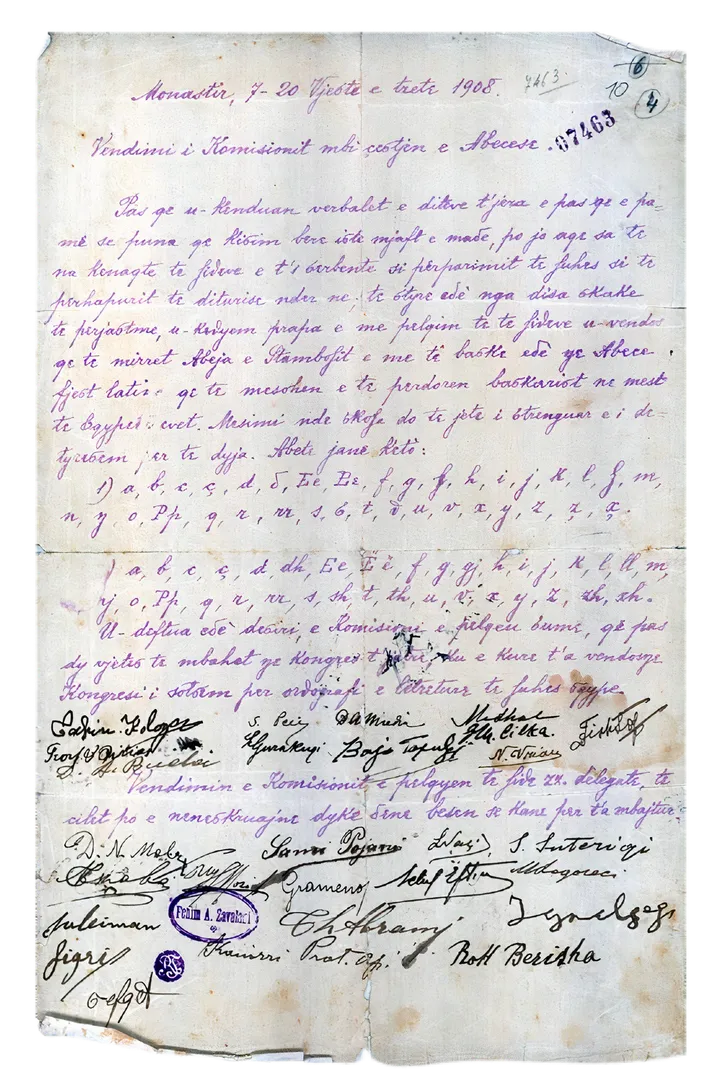
Until World War II the official language was based on the southern Gheg of Elbasan, and since then on Tosk.[1] A Congress of Orthography in Tirana set a unified standard in 1972.[6] Albanian speakers in Kosovo and North Macedonia have widely used the same spelling since 1974.[1]
Albanians call themselves shqiptarë and their country Shqipëria. The name is often taken to mean “sons of eagles”, though it may refer to those associated with shqip, the Albanian language.[10] In the oldest Albanian books, shqip means “clear, intelligible”. Its sense “Albanian” is first securely attested in 1685. In the 18th century shqiptar replaced the older name arbënesh or arbëresh, which goes back to the ancient Albanoi.[9] In the Albanian of Calabria in southern Italy the name is Arbresh, in modern Greek Arvanitis and in Turkish Arnaut.[1]
Albania’s civil status offices keep family books, or fundamental registers. They list the residents of each commune or municipality by family, with the names of father and mother and each person’s relation to the family head.[14]
Skanderbeg, the eagle and independence
The Ottomans invaded Albania in 1388 and completed the conquest around 1430.[15] Gjergj Kastrioti, born in 1405, was handed to the sultan as a hostage in his youth. He converted to Islam and received the name Iskander and the rank of bey, which made him Skanderbeg. In 1443 he left the Ottoman service and returned to Christianity. A year later a league of Albanian princes made him its commander.[16] From his stronghold at Krujë he held off the Ottoman armies for 25 years. After his death in 1468, Albanian resistance gradually collapsed, and by 1506 the Ottomans had retaken the country.[15]
A helmet made in Italy in the late 15th century, crowned with a goat’s head of gilt copper, has been associated with Skanderbeg since the late 16th century. First listed in an inventory of Ambras Castle near Innsbruck in 1593, it is now in the Imperial Armoury in Vienna.[17]
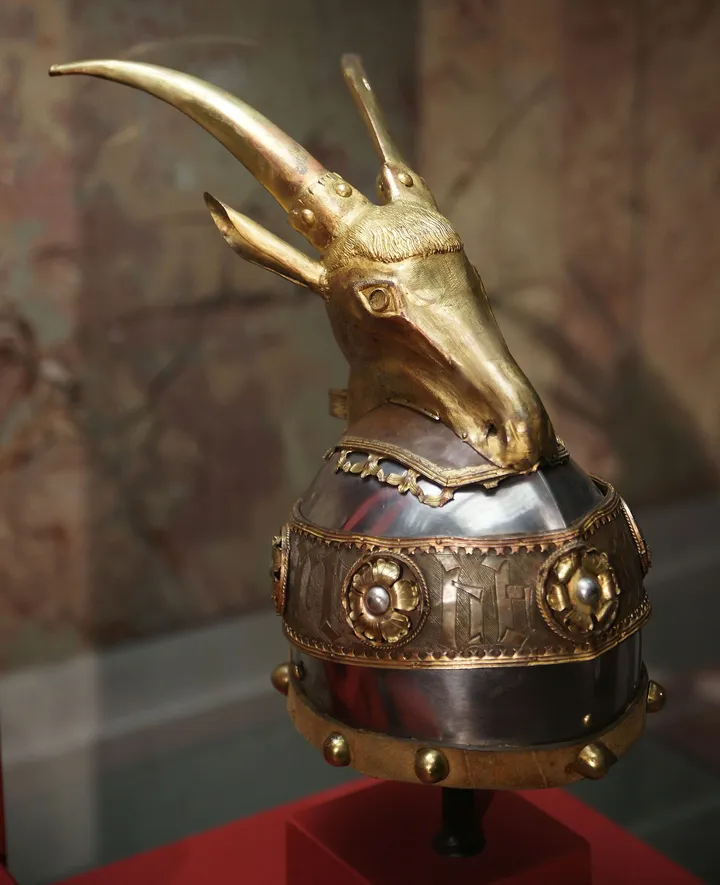
Skanderbeg flew a red flag with a black eagle. He raised it over the fortress of Krujë on November 28, 1443, and in the late 19th century Albanian emigrants in Brussels and Boston revived it as a rallying point for Albanians at home and abroad.[18] Albania’s constitution places the helmet of Skanderbeg in gold at the top of the national seal, above a black two-headed eagle on a red shield. The flag, it says, “is red with a two-headed black eagle in the centre”.[19]
In 1878 Albanians met in Prizren, a town in Kosovo, and founded the Albanian League. It sought to unite the Albanian lands, then split among four Ottoman provinces, into one autonomous state within the empire. In October 1912 Albania’s Balkan neighbors declared war on the Ottoman Empire, and Greek, Serbian and Montenegrin armies advanced into Albanian territory. A congress of delegates in Vlorë, led by the former Ottoman official Ismail Qemal, declared Albania independent on November 28, 1912.[13] The date is now Flag Day and the national holiday.[19]
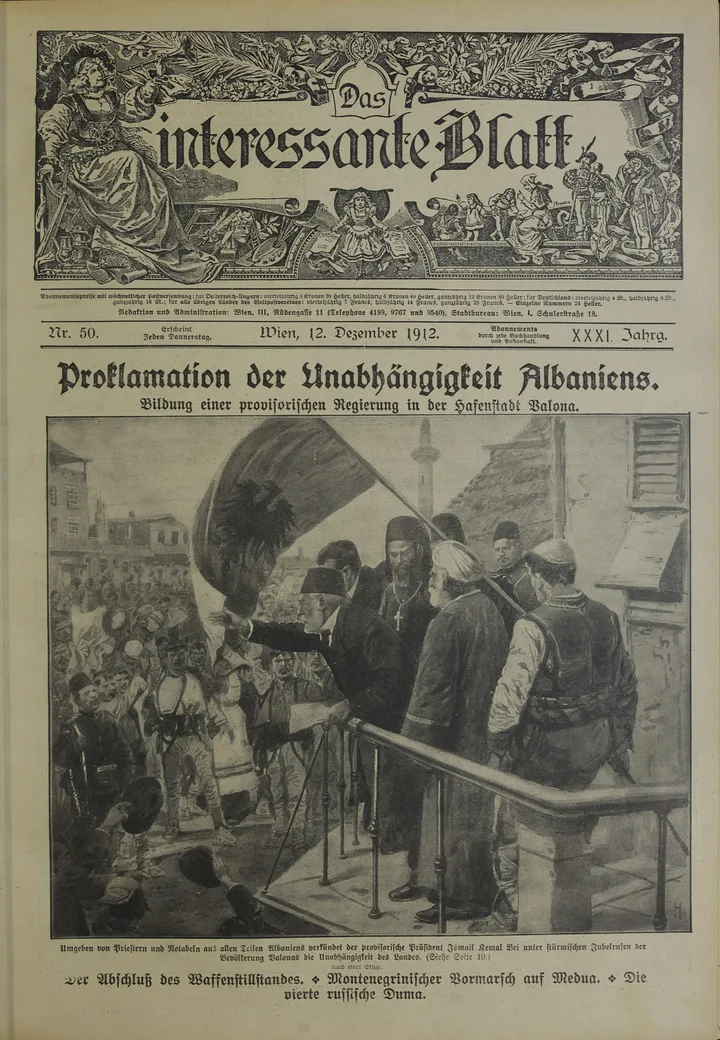
A conference of ambassadors of the great powers in London agreed to create the new state. The borders it drew left Kosovo to Serbia and most of the southern region of Çamëria to Greece.[13] Communist forces took power on November 29, 1944, and Enver Hoxha led the country until his death in 1985. Under his rule, only people on official business were allowed to travel abroad.[13][20] Independent parties were allowed in December 1990, and in March 1992 the anticommunist opposition won the election.[20]
Islam, Christianity and the Bektashi order
Religious divisions among Albanians date back to the Middle Ages. In the late 16th century the Ottomans began a systematic drive to convert the population to Islam, and by around 1700 two-thirds of the people had converted. To overcome the divisions, leaders of the national movement in the 19th century used the rallying cry “The religion of Albanians is Albanianism”.[15]
In 1967 the communist party declared Albania an atheist country, closed all churches and mosques and banned religious observance. Freedom of worship returned in 1990.[6] The constitution of 1998 states that “there is no official religion” and recognizes the equality of religious communities.[19] The state has agreements with five faith communities: the Sunni Albanian Muslim Community, the Sufi Muslim Bektashi community, the Catholic Church, the Albanian Autocephalous Orthodox Church and the Evangelical Brotherhood.[21]
In the census of 2023, answering the question on religion was optional. Before the results came out, the five communities doubted that the count would reflect the country’s religious makeup.[21]
Source: Albanian Institute of Statistics (INSTAT)[2]
Albanians in the United States
Most of the early Albanian immigrants settled in the industrial towns of Massachusetts.[5] Today the largest community lives in New York State, with 57,094 people of Albanian ancestry in 2024.[4]
- Late 1800s
The first known Orthodox Albanians arrive in the United States and settle in the Northeast.[22]
- 1908
Fan Noli celebrates the first liturgy in the Albanian language in Boston on March 22, four days after his ordination as a priest.[22]
- 1909
Noli founds the newspaper Dielli (The Sun) in Boston in February. It becomes the most influential Albanian-language paper of the diaspora.[5]
- 1912
The Pan-Albanian Federation Vatra is founded in April to unite the Albanian societies in America and is registered in Massachusetts on June 3. Dielli becomes its official paper.[5]
- 1920
The census counts 5,608 US residents born in Albania. By 1930 their number has grown to 8,814.[23]
- 1922
The United States recognizes Albania on July 28, and diplomatic relations follow on December 4.[24]
- 1929
Under the national-origins system, Albania is allotted the smallest quota the law permits, 100 immigrants a year.[25]
- 1946
The United States withdraws its informal mission from Albania in November. Under Enver Hoxha, Albania becomes one of the most diplomatically isolated nations in the world.[24]
- 1991
Albania and the United States resume diplomatic relations on March 15.[24]
- 2024
In the American Community Survey, 230,682 people in the United States report Albanian ancestry, and 117,128 residents give Albania as their country of birth.[4][26]
Sources
- Eric P. Hamp: Albanian language, Encyclopaedia Britannica (revised September 24, 2026)
- INSTAT (Albanian Institute of Statistics): Main Results of the Population and Housing Census 2023 (2024)
- Kosovo Agency of Statistics: Population and Housing Census in Kosovo 2024, First Final Results (December 2024)
- U.S. Census Bureau: American Community Survey 2024, 1-year estimates, table B04006, People Reporting Ancestry
- Ledia Dushku: A Homeland Beyond Borders, Diaspora Diplomacy and Transnational Nationalism in the Albanian State-Building Process (1912–1920), Istorija 20. veka 44, no. 1 (2026)
- Encyclopaedia Britannica: Albania, Languages and Religion
- State Statistical Office of North Macedonia: Census of Population, Households and Dwellings 2021, first dataset (March 30, 2022)
- Leonidas-Romanos Davranoglou et al.: Ancient DNA evidence for the history of the Albanians, Nature Human Behaviour 10 (published online May 4, 2026)
- Joachim Matzinger: Shqip bei den altalbanischen Autoren vom 16. bis zum frühen 18. Jahrhundert, Zeitschrift für Balkanologie 49, no. 1 (2013)
- Encyclopaedia Britannica: Albania
- Radu Crăciun: Prejardhja e gjuhës shqipe sipas gjuhëtarit Joachim Matzinger, Studime Filologjike, no. 1 (2024)
- Iñigo Olalde et al.: A genetic history of the Balkans from Roman frontier to Slavic migrations, Cell 186 (December 2023)
- Encyclopaedia Britannica: Albania, Albanian nationalism and Independent Albania
- Statistics Norway: Selected Documents on the Modernisation of the Civil Registration System in Albania, Vol. II, Documents 2005/14 (December 2005)
- Encyclopaedia Britannica: Albania, Medieval culture and the Ottoman Empire
- Encyclopaedia Britannica: Skanderbeg
- Kunsthistorisches Museum Vienna: The Skanderbeg Helmet and the Skanderbeg Sword, Imperial Armoury
- Whitney Smith: Flag of Albania, Encyclopaedia Britannica
- Constitute Project: Albania’s Constitution of 1998 with Amendments through 2016, Articles 10 and 14
- Encyclopaedia Britannica: Albania, Collapse of communism
- U.S. Department of State: 2023 Report on International Religious Freedom, Albania
- Albanian Orthodox Archdiocese in America: History
- U.S. Census Bureau: Campbell J. Gibson and Emily Lennon, Historical Census Statistics on the Foreign-born Population of the United States, 1850–1990, Working Paper No. 29, Table 4 (February 1999)
- Office of the Historian, U.S. Department of State: A Guide to the United States’ History of Recognition, Diplomatic, and Consular Relations, by Country, since 1776, Albania
- Herbert Hoover: Proclamation 1872, Limiting the Immigration of Aliens Into the United States on the Basis of National Origin (March 22, 1929), via The American Presidency Project
- U.S. Census Bureau: American Community Survey 2024, 1-year estimates, table B05006, Place of Birth for the Foreign-Born Population in the United States
More from Europe
British 4Italian 4German 3English 2Irish 2Spanish 2Basque 1Bosnian 1French 1Hungarian 1Portuguese 1Scottish 1