Celebrities with Portuguese Roots
 Keanu ReevesGreat-grandmother of Portuguese descent
Ancient genomes and island lineages
A 2017 study analyzed DNA from 14 people buried at eight archaeological sites in Portugal between the Middle Neolithic (4200–3500 BC) and the Middle Bronze Age (1740–1430 BC). Later Neolithic farmers in the sample carried a significant share of ancestry from local hunter-gatherers. For the Bronze Age the authors find “detectable, but comparatively modest, Steppe-related introgression”. They compare it with the much larger migrations from the Steppe into northern Europe. Of the present-day populations compared, Basques show the closest genetic affinity to these Bronze Age individuals, followed by Sardinians.[4]
A 2005 study of 553 Y chromosomes from mainland Portugal, the Azores and Madeira found haplogroup R1b, typical of many West European populations, in more than half of the male lineages of each group. In the diverse lineages of haplogroup E3b the authors see a likely pre-Arab component shared with North Africa or, at least in part, the influence of Sephardic Jews. Sub-Saharan African lineages are rare on the male side and more frequent on the female side, a sign of gene flow “most likely mediated by the Atlantic slave trade”.[5] On Madeira, about 13% of the maternal lineages come from sub-Saharan Africa, according to an earlier study of 155 people from Madeira and 179 from the Azores. Part of this ancestry seems to have reached the island directly from West Africa.[6]
From Lusitania to the kingdom of Portugal
The Lusitani, a Celtic federation in the west of the Iberian Peninsula, resisted Rome until their leader Viriathus was assassinated around 140 BCE. In 25 BCE Augustus founded Augusta Emerita, today’s Mérida, as the capital of Lusitania, a province that took in central Portugal. After 406 CE the Germanic Suebi settled in southern Galicia, with their rulers at or near Braga and Portucale. The Visigoths subdued them in 469. Muslim forces invaded in 711 and stationed Berber troops in central Portugal and Galicia. In 868 Vimara Peres organized the frontier territory of Portucale.[7]
Henry of Burgundy and his wife Teresa ruled the county of Portugal from 1095. Their son Afonso Henriques took over the county in 1128 and later began to call himself king. His cousin, King Alfonso VII, accepted his autonomy in 1143. In October 1147 Afonso took Lisbon with the help of English, French, German and Flemish crusaders on their way to Palestine. The royal title was formally recognized in 1179, when he placed Portugal under the direct protection of the Holy See.[7] Guimarães became the first capital of Portugal in the 12th century, and UNESCO links its early history to the rise of a Portuguese national identity and language.[8]
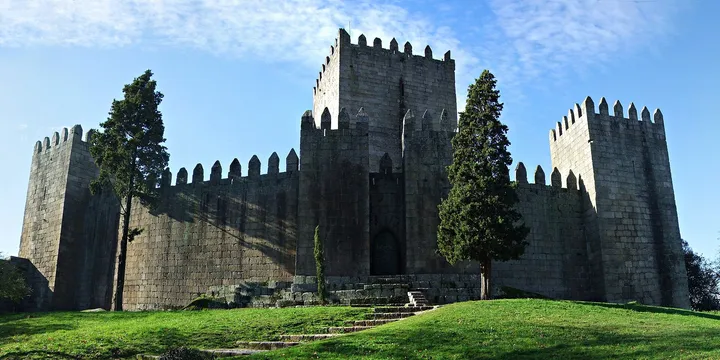
Afonso III completed the conquest of the Algarve and moved the capital from Coimbra to Lisbon. In 1297 the Treaty of Alcañices with Castile confirmed that the Algarve belonged to Portugal.[9] Two centuries later, King John II admitted many Jewish refugees after their expulsion from Spain in 1492. His successor Manuel I ordered all Jews to leave by October 1497. Some were allowed to go, and the others were converted by promises or by force.[10]
Sea voyages, empire and the slave trade
The conquest of Ceuta in North Africa in 1415 marks the beginning of Portuguese expansion.[10] From the mid-1420s Prince Henry, known in English as Henry the Navigator, promoted voyages along the West African coast. He sought a share of the trade in gold and enslaved people and helped found a colony on Madeira. His captains also began to settle the recently discovered Azores.[11] By the 1480s Portuguese ships were carrying enslaved Africans to the sugar plantations of Cape Verde and Madeira. Spanish conquistadors took enslaved Africans to the Caribbean after 1502. Portuguese merchants dominated the transatlantic slave trade for another century and a half, operating from bases in the Congo-Angola region.[12]
The Treaty of Tordesillas of June 7, 1494, set a new boundary between the Spanish and Portuguese crowns, “running from pole to pole, 370 leagues to the west of Cape Verde islands”. UNESCO credits this line with the birth of Brazil.[13]
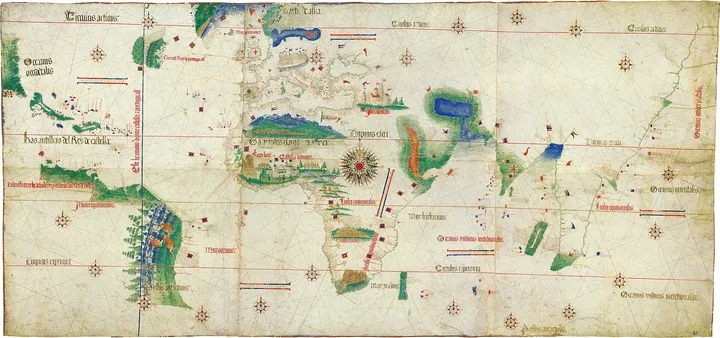
Portugal’s rule in Africa ended after the Revolution of the Carnations, the military coup of April 25, 1974, that brought down the dictatorship known as the New State. Guinea-Bissau became independent almost at once, and the other African territories followed in 1975. More than half a million people fled to Portugal from the former colonies.[14]
Leaving the Azores and Madeira
Portugal has one of the highest emigration rates in Europe. Before 1960 most emigrants went to Brazil and a few other Latin American countries. In the 1960s the population fell, its only decline in modern times, as workers left for jobs in Western Europe and young men emigrated to avoid conscription for the colonial wars. Azoreans left mainly for the United States, Madeirans mainly for South America.[15]
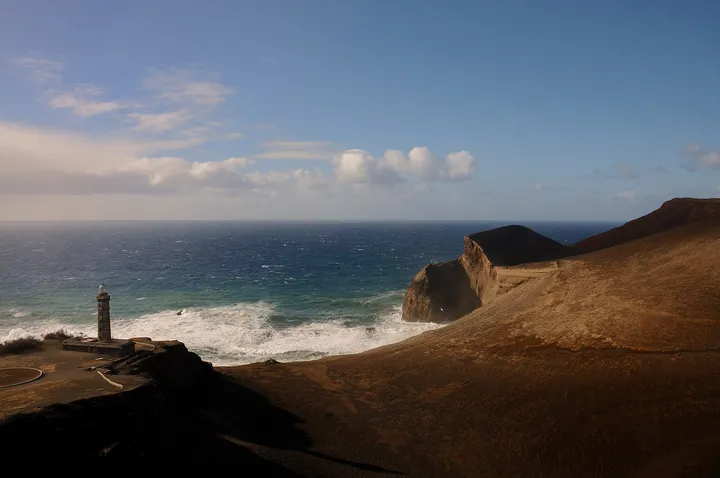
The nine major islands of the Azores lie in three groups about 1,000 miles (1,600 km) west of the mainland. A dense population and limited economic opportunities led to extensive emigration, mainly to the United States and Canada, from the late 19th century well into the 20th. Earthquakes and volcanic eruptions are frequent, and the Capelinhos eruption of 1957–58 enlarged Faial.[16]
Portuguese communities in the United States
Islanders from the Azores and Cape Verde were the first foreigners to work in the American whaling industry. A sizable community formed in New Bedford, Massachusetts, from the 1830s, when the city became the leading American whaling port. After the Civil War whaling declined and the cotton mills expanded, and the Portuguese population of the city began to grow quickly. To this day New Bedford is the American city most closely identified with Portuguese and Cape Verdeans.[17]
In California, many Azorean seamen left their whaling ships in the San Francisco area during the Gold Rush. Those who found no gold brought their experience with dairy cattle to the new ranches of Marin County, which by the 1880s was the state’s largest producer of fresh milk and butter. Every year the Azorean community of Sausalito held its Holy Ghost festa, with a procession through town, a mass and the crowning of a young girl.[18]
People from the Azores and Madeira also came to Hawaii to work in the sugarcane fields, after a treaty between the Hawaiian and Portuguese kings. Many stayed after their three-year contracts ended. According to the Hawaii State Archives, these immigrants created the ʻukulele by combining two instruments from home, the rajão and the machete.[19]
Immigration from Portugal reached its highest levels in the 1910s and again in the 1970s.[20]
Source: U.S. Department of Homeland Security[20]
Federal statistics define Hispanic or Latino by “Spanish culture or origin”. When survey respondents name Portugal or Brazil as their Hispanic origin, the Census Bureau usually recodes them as not Hispanic or Latino.[21]
Language, names and records
Portuguese is the official language.[1] Nine countries belong to the Community of Portuguese Language Countries, founded in Lisbon on July 17, 1996.[22] In 1999 a law recognized the linguistic rights of the Mirandese-speaking community in the far northeast.[23]
A child’s full name may have at most six words, only two of them given names. These must be Portuguese or adapted to Portuguese spelling and pronunciation, and an official list records the names accepted or refused.[24]
In the United States many family names changed. English speakers found Portuguese surnames hard to pronounce, and anglicized forms such as Perry and Sylvia became common among Azorean and Cape Verdean Americans. Some whalemen took the surname of their captain. In 19th-century censuses, people born in the Azores often appear as natives of the “Western Islands”.[17]
Digitarq, the online catalog of the Portuguese state archives, links more than 8 million entries to over 63 million images.[25] Since 2026 the Hawaii State Archives also hold the Portuguese consulate’s arrival logs for 1878 to 1934.[19]
Portuguese immigration to the United States
In 2024 California had the most residents of Portuguese ancestry, 300,507, ahead of Massachusetts with 244,064. No state has a larger share than Rhode Island, where 7.3% of residents report Portuguese ancestry.[3]
- 1760s
American whalers begin to cruise the waters around the Azores and Cape Verde. The islands soon become their first ports of call for provisions and extra crew.[17]
- 1820s
Azoreans and Cape Verdeans begin to command and own whaling ships sailing from New Bedford.[17]
- 1878
Portuguese immigration to the Kingdom of Hawaii begins, with people from the Azores and Madeira.[19]
- 1910
The census counts 22,301 Portuguese in the Territory of Hawaii, nearly 12% of its 191,909 residents.[26]
- 1924
A proclamation of June 30 sets Portugal’s quota under the new Immigration Act at 503 people for the twelve months from July 1.[27]
- 1958
Congress authorizes 1,500 special visas for Portuguese citizens who, “because of natural calamity in the Azores Islands subsequent to September 1, 1957”, cannot return to their homes on the islands.[28]
- 2024
About 1.37 million people in the United States name Portuguese among their ancestries in the American Community Survey.[3]
Sources
- Assembleia da República: Constitution of the Portuguese Republic, Seventh Revision (2005), English translation, Articles 6 and 11
- Statistics Portugal (INE): Estimates of Resident Population, 2025 (June 22, 2026)
- U.S. Census Bureau: American Community Survey 2024, 1-year estimates, Table B04006, People Reporting Ancestry, United States and states
- Rui Martiniano et al.: The population genomics of archaeological transition in west Iberia, Investigation of ancient substructure using imputation and haplotype-based methods, PLoS Genetics 13 (July 2017)
- R. Gonçalves et al.: Y-chromosome lineages from Portugal, Madeira and Açores record elements of Sephardim and Berber ancestry, Annals of Human Genetics 69 (July 2005)
- A. Brehm, L. Pereira, T. Kivisild and A. Amorim: Mitochondrial portraits of the Madeira and Açores archipelagos witness different genetic pools of its settlers, Human Genetics 114 (December 2003)
- Encyclopaedia Britannica: Portugal, History
- UNESCO World Heritage Centre: Historic Centre of Guimarães and Couros Zone
- Encyclopaedia Britannica: Portugal, The kingdom and the Reconquista
- Encyclopaedia Britannica: Portugal, The house of Aviz, 1383–1580
- Encyclopaedia Britannica: Henry the Navigator
- Encyclopaedia Britannica: Transatlantic slave trade
- UNESCO Memory of the World: Treaty of Tordesillas
- Encyclopaedia Britannica: Portugal, The New State after Salazar
- Encyclopaedia Britannica: Portugal, Settlement patterns
- Encyclopaedia Britannica: Azores
- Russell G. Handsman, Kathryn Grover and Donald Warrin, National Park Service: New Bedford Communities of Whaling, People of Wampanoag, African, and Portuguese Island Descent, 1825–1925 (2021)
- National Park Service, Golden Gate National Recreation Area: Portuguese Dairy Farmers
- Hawaii Department of Accounting and General Services: DAGS Receives Records of Portuguese Arrivals in Hawaiʻi (February 21, 2026)
- U.S. Department of Homeland Security: 2019 Yearbook of Immigration Statistics, Table 2, Persons obtaining lawful permanent resident status by region and selected country of last residence, 1820 to 2019
- Pew Research Center: Who is Hispanic?, by Mark Hugo Lopez, Joseph Copeland and Jeffrey S. Passel (September 15, 2026)
- Comunidade dos Países de Língua Portuguesa: Histórico, como surgiu?
- RTP Notícias: Parlamento aprovou mirandês como segunda língua oficial de Portugal há 25 anos (September 15, 2023)
- gov.pt, Instituto dos Registos e do Notariado: Pedir a atribuição de nome no nascimento
- Direção-Geral do Livro, dos Arquivos e das Bibliotecas: Digitarq, online catalog of the Portuguese state archives
- U.S. Census Bureau: Thirteenth Census of the United States Taken in the Year 1910, Volume 3, Population, Hawaii
- Calvin Coolidge: Proclamation 1703, Establishing Nationality Quota of Aliens Allowed Entry During Fiscal Year 1924-1925 (June 30, 1924), via The American Presidency Project
- Public Law 85-892, For the relief of certain distressed aliens, 72 Stat. 1712 (September 2, 1958), via GovInfo
More from Europe
British 4Italian 4German 3English 2Irish 2Spanish 2Albanian 1Basque 1Bosnian 1French 1Hungarian 1Kosovo Albanian 1