Celebrities with Kosovo Albanian Roots
 Dua LipaParents fled Kosovo for London in 1992
Kosovo and its Albanian majority
Kosovo’s most recent census ran from April 5 to May 24, 2024, the first since 2011. In the four northern municipalities, where Serbs form the majority, much of the Serb community stayed away after Serbian political groups called for a boycott. The statistics agency estimated the population there with international experts.[2]
Source: Kosovo Agency of Statistics[2]
Albanians in Kosovo speak a variety of the Gheg dialect of Albanian, known as kosovarce. Written texts, radio and television use standard literary Albanian. Albanian is also the language of the Ashkali and the Egyptians, two communities that are often counted among the Roma and regard themselves as distinct.[5] The constitution makes Albanian and Serbian the official languages, and Turkish, Bosnian and Roma have official status at the municipal level.[1]
From Ottoman province to part of Serbia
The name Kosovo comes from a Serbian place name meaning “field of blackbirds”. In the Middle Ages the region was the center of a Serbian empire. The Ottomans ruled it from the mid-15th to the early 20th century. In those centuries Islam gained ground and the number of Albanian speakers grew.[5]
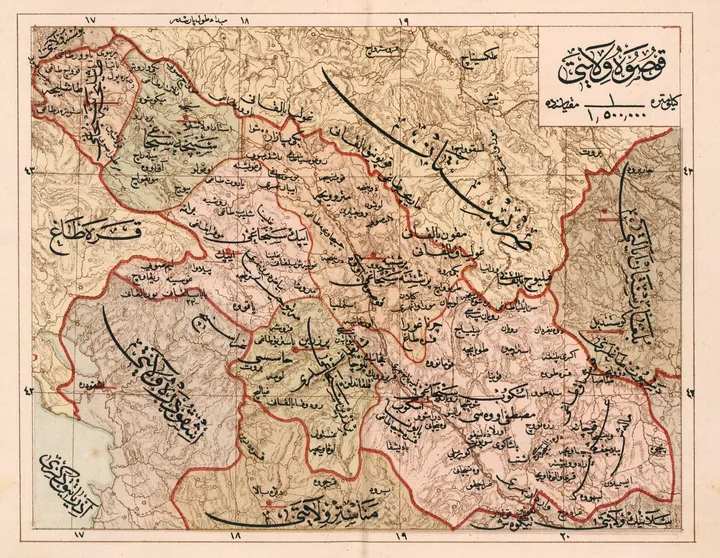
Serbs and Albanians both base their claim to Kosovo on history. Serbs regard Kosovo as their Holy Land and recall that medieval Serbian kings were crowned there. Many Serbian Orthodox shrines stand in Kosovo, among them the patriarchate of the Serbian Orthodox Church. The defeat of Serbian forces by the Ottomans at Kosovo Polje in 1389 is the central event of Serbian national tradition. Albanians see themselves as descendants of the Illyrians, the ancient people of the region. They also point out that they have formed the vast majority of Kosovo’s population since at least the 18th century.[6]
After a war with Russia, the Ottoman Empire signed the Treaty of San Stefano on March 3, 1878. It assigned lands with Albanian populations to Serbia, Montenegro and Bulgaria. On June 10, about 80 delegates from the four Ottoman provinces where Albanians lived met in Prizren, most of them Muslim religious leaders and clan chiefs. They founded the League of Prizren, which worked for Albanian autonomy under Ottoman rule. In April 1881 an Ottoman army of 10,000 men took Prizren and suppressed the league.[7]
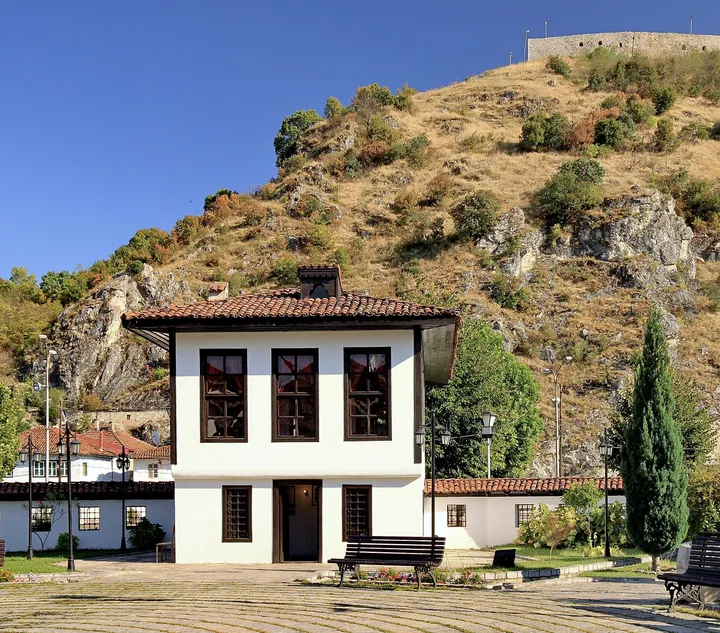
During the First Balkan War of 1912–13, Serbia took Kosovo from the Ottomans, and in 1913 the territory was divided between Serbia and Montenegro.[3] The borders drawn for the new Albanian state in 1913 left Kosovo outside it.[6] After World War I, Kosovo became part of the Kingdom of the Serbs, Croats and Slovenes, later renamed Yugoslavia. In World War II, parts of it were joined to Italian-occupied Albania.[3]
Autonomy in Yugoslavia and the parallel system
The Yugoslav constitution of February 1974 gave Serbia’s two autonomous provinces, Kosovo and Vojvodina, wide powers. Each had its own constitution and constitutional court and a representative in the federal presidency in Belgrade.[8] Kosovo’s rights came close to those of the six Yugoslav republics.[3]
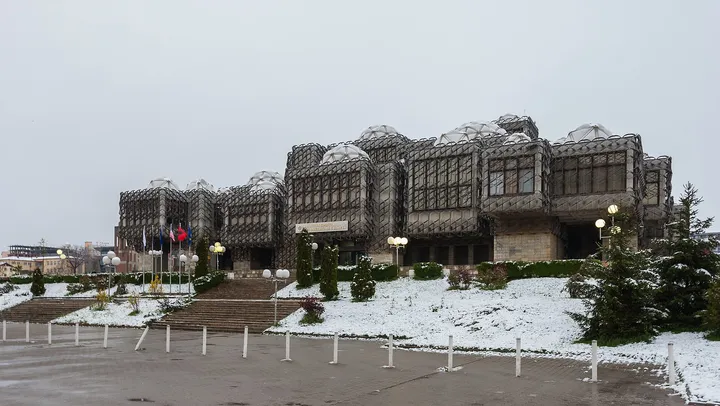
After mass demonstrations by Albanians in 1968, the Yugoslav government set out to build the country’s first Albanian-language university in Pristina. In 1970 the young Croatian architect Andrija Mutnjaković was asked to design its library, which was completed in 1982.[9]
In 1981 Kosovo Albanians demonstrated for full republic status, and the protests were violently suppressed.[3] Calls from Serbs to reduce the province’s autonomy grew. On March 23, 1989, the Kosovo Assembly approved amendments to the Serbian constitution, and the Serbian Assembly adopted them five days later. Education, taxes and the police passed to the government of Serbia. The UN tribunal for the former Yugoslavia later concluded that the amendments had in effect removed Kosovo’s substantial autonomy. On July 5, 1990, the Serbian Assembly suspended the Kosovo Assembly.[8]
From the early 1990s, Albanians working in banks, hospitals, post offices and schools were dismissed in large numbers. Many Albanian teachers refused a new curriculum and lost their posts. Albanian parties then set up an unofficial school system in private homes, and university courses moved there too. Over the following years a parallel system grew up, with an unofficial government and services of its own.[8]
War, flight and UN administration
By 1998 the attacks of the Kosovo Liberation Army (KLA), an armed Albanian group, had grown into an uprising. Serbian special police and then the Yugoslav army tried to regain control.[10] By the end of that year more than 300,000 people in Kosovo had fled their homes.[11] On March 24, 1999, NATO began an air campaign against Yugoslavia that lasted 78 days, until June 10.[11] It acted without the approval of the UN Security Council, a controversial step.[12]
During the bombing, Yugoslav and Serbian forces drove hundreds of thousands of Albanians out of Kosovo.[10] About half a million refugees reached neighboring countries within roughly two weeks. A few weeks later their number had passed 850,000.[12]
On June 10, 1999, the UN Security Council adopted Resolution 1244. It reaffirmed the territorial integrity of Yugoslavia and set up an interim administration “under which the people of Kosovo can enjoy substantial autonomy within the Federal Republic of Yugoslavia”.[13] Kosovo came under the UN Interim Administration Mission in Kosovo (UNMIK), with a NATO-led peacekeeping force.[3]
As Albanians returned, members of the KLA carried out reprisal killings and abductions of Serbs and Roma. Thousands of Serbs, Roma and people from other minorities fled in the second half of 1999.[3] In March 2004, riots against Serbs broke out in towns across Kosovo. Some 30 people died, and more than 4,000 Serbs and members of other minorities were displaced.[10]
Independence and a disputed status
Kosovo declared independence from Serbia on February 17, 2008.[3] The declaration opens with the words “We, the democratically-elected leaders of our people, hereby declare Kosovo to be an independent and sovereign state.”[14] A new constitution came into force on June 15.[5]
Serbia’s constitution of 2006 calls the region the Province of Kosovo and Metohija and states that it “is an integral part of the territory of Serbia”.[15] At Serbia’s request, the UN General Assembly asked the International Court of Justice in October 2008 for an advisory opinion on the declaration.[16] On July 22, 2010, the court found by ten votes to four that the declaration had not violated international law. It held that “general international law contains no applicable prohibition of declarations of independence”. The court left open whether international law gave Kosovo a right to declare independence.[14] Serbia rejected the opinion.[5]
The United States and most members of the European Union recognize Kosovo.[5] Among the states that do not are Serbia, Bosnia and Herzegovina, Russia and China, along with five EU members: Cyprus, Greece, Romania, Slovakia and Spain.[17]
In Yugoslav times, Albanians in Kosovo were eventually allowed to fly the flag of Albania. Kosovo’s own flag was chosen in a competition. It shows a gold map of the country on a blue field below an arc of six white stars, which stand for its communities. Albanians and Serbs in Kosovo kept using the flags of Albania and Serbia.[18]
Records for family history
In 2013 the United Nations estimated that about 12,036 civil registry books from Kosovo were held in Serbia.[19] Under an agreement of July 2, 2011, Belgrade and Pristina set up a joint committee with EULEX to identify missing original civil registry books from before 1999. EULEX was to certify copies of all original books, municipality by municipality.[20] The copying project of the European Union’s rule of law mission ended on March 31, 2014. By then the Kosovo authorities had received 12,391 certified copies.[21]
Yugoslav censuses counted the population of Kosovo in 1948, 1953, 1961, 1971 and 1981. Albanians boycotted the census of 1991, which they saw as a way of legitimizing Serbian rule, and the next census took place in 2011.[2]
Kosovo Albanians in Europe and the United States
At the end of 2025, Germany’s Central Register of Foreign Nationals counted 323,260 citizens of Kosovo, up from 218,150 at the end of 2018.[4]
- 1970s
Kosovo Albanians begin to come to Switzerland as guest workers. Before the war of 1998–99, the Kosovo Albanian community there is estimated at more than 150,000.[22]
- 1992
In May, Kosovo Albanians elect an unofficial parliament. Their parallel institutions are paid for by a large community abroad and by a voluntary solidarity tax.[8]
- 1998–1999
More than 50,000 people from Kosovo seek asylum in Switzerland. Relative to its population, no other country takes in as many refugees from Kosovo. About 80% return after the war.[22]
- April–June 1999
Under the UNHCR’s evacuation program, 4,346 people from Kosovo arrive in the United Kingdom from Macedonia between April 25 and June 25.[23]
- May–July 1999
The first refugees from Kosovo reach Fort Dix, New Jersey, on May 5. Over ten weeks the base receives 4,045 people bound for new homes in the United States.[24]
- 2008
On February 18, one day after the declaration of independence, the United States recognizes Kosovo and agrees to establish diplomatic relations.[3]
- 2024
From January, citizens of Kosovo may travel to the Schengen area without a visa.[17]
Sources
- Constitute Project: Constitution of the Republic of Kosovo (2008, revised 2016), Articles 5 and 13
- Kosovo Agency of Statistics: Population and Housing Census in Kosovo 2024, First Final Results (December 2024)
- Office of the Historian, U.S. Department of State: A Guide to the United States’ History of Recognition, Diplomatic, and Consular Relations, by Country, since 1776, Kosovo
- Statistisches Bundesamt (Destatis): Foreign population by selected citizenships, 2018 to 2025, from the Central Register of Foreign Nationals
- John R. Lampe: Kosovo, Encyclopaedia Britannica (updated October 7, 2026)
- Library of Congress, Federal Research Division: Albania, A Country Study, The Balkan Wars and Creation of Independent Albania (1994)
- Library of Congress, Federal Research Division: Albania, A Country Study, The Rise of Albanian Nationalism (1994)
- International Criminal Tribunal for the former Yugoslavia: Prosecutor v. Milutinović et al., Judgement, volume 1 (February 26, 2009)
- Bekim Ramku: Literary Circles, on the National Library of Kosovo, The World of Interiors (January 2024), via the Kosovo Architecture Foundation
- Encyclopaedia Britannica: Kosovo conflict (updated September 17, 2026)
- NATO: Kosovo Air Campaign (March–June 1999)
- UNHCR: The Kosovo refugee crisis, an independent evaluation of UNHCR’s emergency preparedness and response, summary of conclusions (February 2000), via ReliefWeb
- United Nations Security Council: Resolution 1244 (June 10, 1999)
- International Court of Justice: Accordance with International Law of the Unilateral Declaration of Independence in respect of Kosovo, Advisory Opinion of July 22, 2010, UN document A/64/881
- Constitute Project: Constitution of the Republic of Serbia (2006), Preamble
- Antonia Young: Kosovo, Self-declared independence, Encyclopaedia Britannica (updated October 7, 2026)
- Igor Miskulin, European Parliament: The Western Balkans, Fact Sheets on the European Union (April 2026)
- Whitney Smith: Flag of Kosovo, Encyclopaedia Britannica
- United Nations Security Council: Report of the Secretary-General on the United Nations Interim Administration Mission in Kosovo, S/2013/254 (April 30, 2013)
- PA-X Peace Agreements Database, University of Edinburgh: Registry Books, Technical Dialogue Agreement between Kosovo and Serbia (July 2, 2011)
- United Nations Security Council: Report of the Secretary-General on the United Nations Interim Administration Mission in Kosovo, S/2014/305 (April 29, 2014)
- Vera Büchi, SRF: Schweiz und Kosovo-Krieg, Als die Flüchtlinge aus dem Kosovo kamen (February 28, 2023)
- UK Parliament, Hansard: Kosovar Asylum Seekers, written answer, HC Deb 6 June 2000, vol. 351, c175W
- Centers for Disease Control and Prevention: Health Status of and Intervention for U.S.-Bound Kosovar Refugees, Fort Dix, New Jersey, May–July 1999, MMWR 48, no. 33 (August 1999)
More from Europe
British 4Italian 4German 3English 2Irish 2Spanish 2Albanian 1Basque 1Bosnian 1French 1Hungarian 1Portuguese 1