Celebrities with Irish Roots
Mother’s side 2
 Jason MomoaMother’s Iowa family has Irish roots
 Olivia RodrigoMother of German and Irish ancestry
No celebrity matches your search.
Where Irish ancestry comes from
A study published in 2015 presented the first whole genomes of prehistoric people from Ireland. One came from a woman buried between 3343 and 3020 BC in a megalithic tomb at Ballynahatty in County Down. Most of her ancestry went back to early farmers from the Near East. She belonged to a large population, which points to a substantial influx of farmers to the island.[5]
The passage tombs of Newgrange, Knowth and Dowth, in a bend of the River Boyne, date from the same era, around 3200 BC.[6]
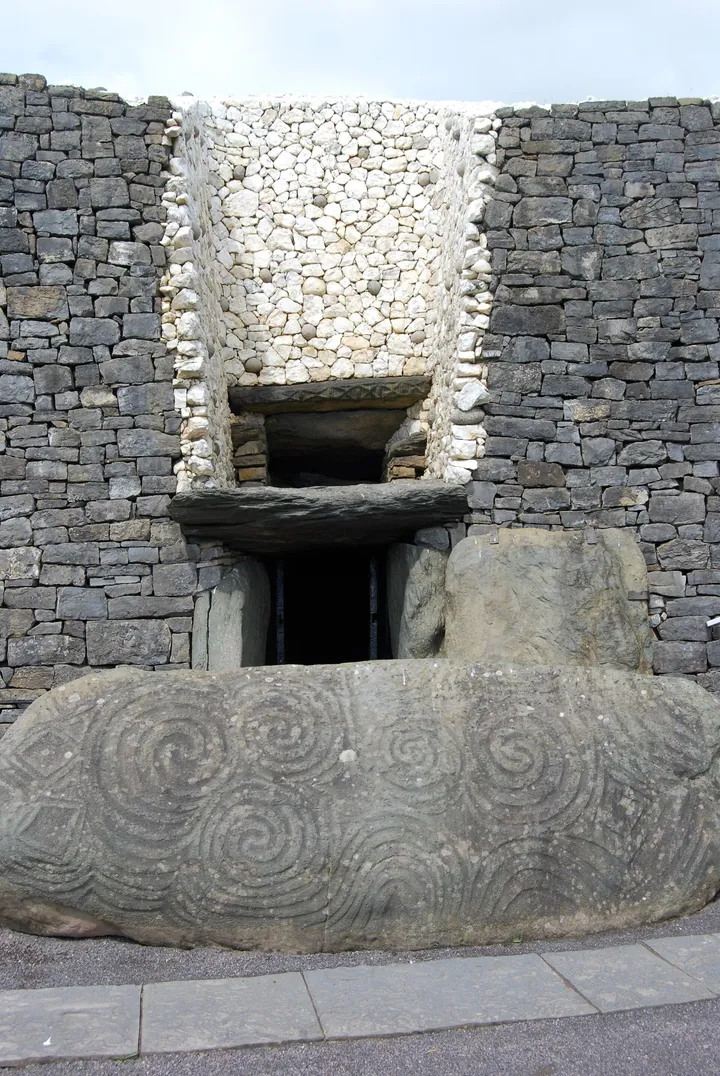
The 2015 study also analyzed three men buried on Rathlin Island between 2026 and 1534 BC. A substantial part of their ancestry came from herders of the Pontic Steppe, whose migrations reshaped the population of Europe in the third millennium BC. The authors suggest that the newcomers may have brought an Indo-European, “perhaps early Celtic,” language. The DNA of these men is most similar to that of people in Ireland, Scotland and Wales today.[5]
The Irish DNA Atlas, a project of the Royal College of Surgeons in Ireland and the Genealogical Society of Ireland, studies people whose eight great-grandparents were all born within 50 km of each other.[7] In 2017 its researchers analyzed DNA from 194 participants and found ten genetic clusters in Ireland, seven of “Gaelic” Irish ancestry and three of shared Irish and British ancestry.[8] The Gaelic clusters follow old borders. Two of them together match the province of Munster, and each lines up with a historical kingdom, the Dál Cais and the Eóganacht. The three shared clusters are found mostly in the north and probably reflect the Ulster Plantations.[7] Across Ireland the study found high levels of ancestry similar to that of north-western France, a region with genetic links to Celtic populations in Britain. Given Ireland’s isolation, the authors describe the island as a “sink” of Celtic ancestry.[8]
Christianity, Vikings and Normans
Tradition credits St. Patrick with bringing Christianity to Ireland in the 5th century.[4] He first came to the island as a captive. In his Confessio he writes that he was “about sixteen” when he was “taken into captivity in Ireland, along with thousands of others”.[9]
The Annals of Ulster, a medieval Irish chronicle, record the burning of Rechru by “heathens” in 795. Under the year 841 they note a naval camp of the raiders at Duiblinn, today’s Dublin.[10] The DNA Atlas found Norwegian-like ancestry all over Ireland, beyond the areas of Norse settlement such as Dublin, Limerick, Waterford and Wexford, and its authors link it to the Vikings.[8]
In 1169 a fleet under Robert FitzStephen arrived to support Diarmait Mac Murchadha, the king of Leinster. Two years later Henry II of England landed with 240 ships and received pledges of submission from Munster and Leinster.[10]
English rule, the plantations and partition
The Nine Years’ War of 1594–1603 ended with the defeat of the Gaelic chieftains and brought the whole island under English control. In 1607 the earls of Tyrone and Tyrconnell left Ireland, and their lands were confiscated. From 1610 thousands of settlers from England and Scotland moved to Ulster under King James I, in what became known as the Plantation of Ulster. It covered six counties.[11]
In the six decades before the American Revolution, more than 100,000 Ulster Presbyterians of Scottish origin emigrated to the American colonies.[12] In the US census, Scotch-Irish is an ancestry of its own, listed apart from Irish.[13] Their story is closely tied to Scottish heritage.
The Anglo-Irish Treaty, signed in London on December 6, 1921, led to the Irish Free State in 1922. It gave Northern Ireland the right to opt out of the new state.[14] Northern Ireland remains part of the United Kingdom. The Good Friday Agreement of 1998 recognizes the right of its people “to identify themselves and be accepted as Irish or British, or both”.[15] In Northern Ireland’s 2021 census, 33.3% of residents identified as Irish, alone or along with another identity. The same census counted 42.8% who identified as British and 31.5% as Northern Irish.[16]
The Great Famine and emigration
By the early 1840s almost half of Ireland’s people, mostly the rural poor, lived almost entirely on potatoes. In 1845 late blight, a plant disease that had arrived from North America, rotted much of the crop, and the harvest failed again every year from 1846 to 1849. About one million people died of starvation, typhus and other diseases, and an estimated two million emigrated. Hundreds of thousands of tenant farmers and laborers who could not pay their rent were evicted.[17]
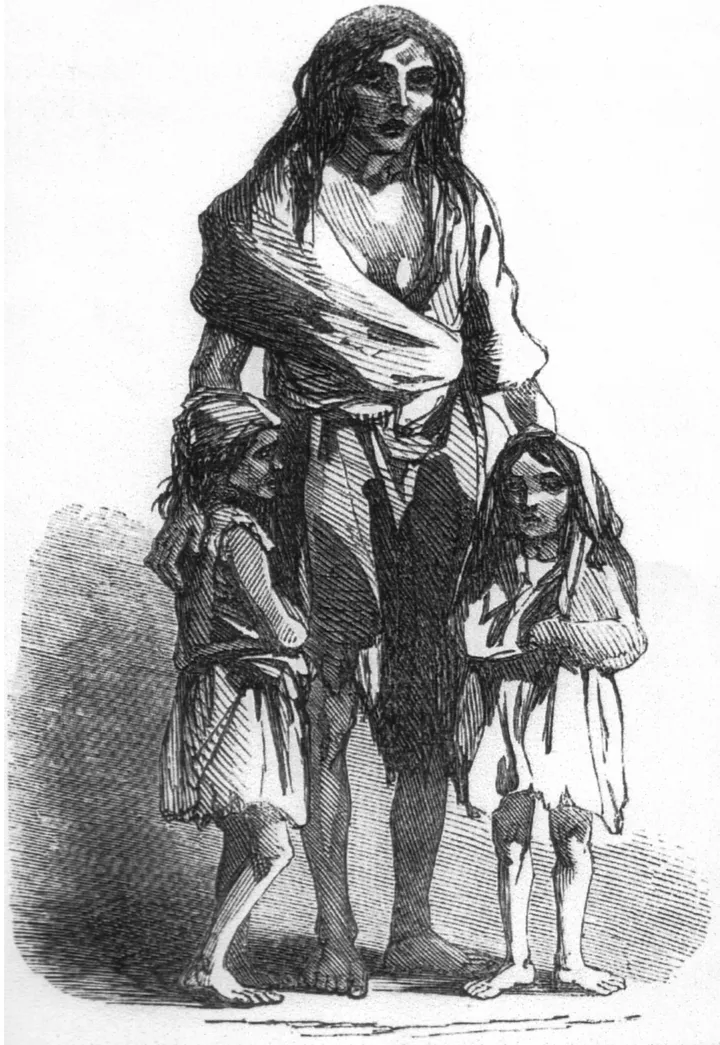
In the area of today’s Republic of Ireland, the census of 1851 counted 1.4 million fewer people than the census of 1841.[18] The decline continued until 1961, and the 2022 census was the first in 171 years to count more than five million people.[2]
Source: Central Statistics Office Ireland[18]
Irish surnames and their English forms
Irish surnames came into use gradually between the middle of the 10th and the end of the 13th century. Families formed them from the name of an ancestor with the prefix Ó or Mac. As the scholar Patrick Woulfe explained in 1922, Ó “literally signifies a grandson, and Mac a son”.[19]
A law of 1465 ordered Irishmen living among the English in Dublin, Meath, Uriel and Kildare to take an English surname. It could come from a town, “as Sutton, Chester, Trym, Skryne, Corke”, from a color, “as white, blacke, browne”, or from a trade, “as smith or carpenter”.[20]
Most Irish surnames first appear in English spelling in government records of 1550–1600, written down roughly as they sounded, such as O’Brien for Ó Briain.[19] In many families the Ó or Mac was later dropped.[20] In the 18th and 19th centuries some families adopted English names meant as translations, so Mac an tSaoir became Carpenter and Ó Bradáin became Salmon.[19]
Around 1900 the Registrar-General received reports that families were taking the O back. The registrar for Armagh wrote, “Those who were formerly known as Neill are now O’Neill; Reilly, now O’Reilly; Hagan, now O’Hagan”.[21]
The Irish language today
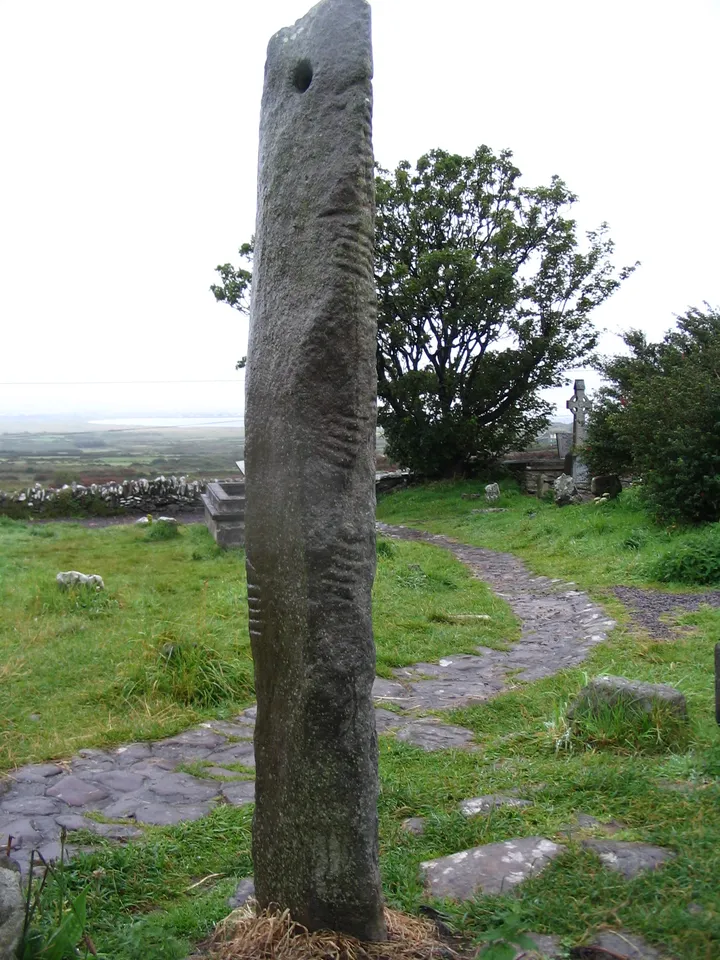
Irish is one of the Gaelic languages. Their earliest written evidence is ogham, a script of short straight lines cut across the edge of a stone or another solid object. Ogham was most widely used in the middle of the first millennium AD.[22]
The constitution states, “The Irish language as the national language is the first official language.” English is recognized as a second official language.[1] In the 2022 census, 40% of people aged three and over said they could speak Irish. Only 71,968 spoke it daily outside the education system. The census counted 106,220 people in the Gaeltacht, the Irish-language areas defined by law in seven counties from Donegal to Waterford.[3]
The Irish in the United States
Ireland’s constitution says that “the Irish nation cherishes its special affinity with people of Irish ancestry living abroad who share its cultural identity and heritage”.[1]
- 1762
Irish soldiers serving in the English military march through New York City on March 17. It is the world’s first St. Patrick’s Day parade.[4]
- 1845
Potato blight reaches Ireland and starts the Great Famine. An estimated two million people leave the country in the following years.[17]
- 1850
The census counts 961,719 residents born in Ireland, 43% of everyone in the US who was born abroad.[23]
- 1890
The number of residents born in Ireland reaches its peak at 1,871,509.[23]
- 1892
On January 1, Annie Moore, a teenager from County Cork, becomes the first immigrant processed at the new station on Ellis Island.[24]
- 1991
Congress designates March as Irish-American Heritage Month.[4]
- 2000
In the census, 30.5 million people report Irish ancestry, 11% of the population. Irish is the largest ancestry in Delaware, Massachusetts and New Hampshire, and German and Irish is the most common combination.[13]
- 2024
The number of Americans with Irish ancestry has grown to 32.4 million, while their share of the population has fallen to 9.5%. Irish-born residents number 116,641.[4]
Sources
- Irish Statute Book: Constitution of Ireland, Articles 2 and 8
- Central Statistics Office: Census of Population 2022, Summary Results, Population Changes (May 30, 2023)
- Central Statistics Office: Census of Population 2022, Profile 8, Irish Language and the Gaeltacht (December 19, 2023)
- U.S. Census Bureau: Irish-American Heritage Month and St. Patrick’s Day, March 2026 (February 17, 2026)
- Lara M. Cassidy et al.: Neolithic and Bronze Age migration to Ireland and establishment of the insular Atlantic genome, PNAS (December 28, 2015)
- Heritage Ireland, Office of Public Works: Brú na Bóinne Visitor Centre, Newgrange and Knowth
- RCSI: Unique study provides the first genetic map of the people of Ireland (December 8, 2017)
- Edmund Gilbert et al.: The Irish DNA Atlas, Revealing Fine-Scale Population Structure and History within Ireland, Scientific Reports (December 8, 2017)
- Royal Irish Academy: St. Patrick’s Confessio, English translation by McCarthy
- CELT, University College Cork: The Annals of Ulster, translations by Mac Airt and Mac Niocaill (to 1131) and by Hennessy and Mac Carthy
- CCEA and Ulster-Scots Agency: The Plantation of Ulster and Ulster-Scots, What’s it all about? (2016)
- Patrick Griffin: The People with No Name, Ireland’s Ulster Scots, America’s Scots Irish, and the Creation of a British Atlantic World, 1689–1764, Princeton University Press (summary on Project MUSE)
- U.S. Census Bureau: Angela Brittingham and G. Patricia de la Cruz, Ancestry: 2000, Census 2000 Brief (June 2004)
- Irish Statute Book: Constitution of the Irish Free State (Saorstát Eireann) Act, 1922, with the Anglo-Irish Treaty of December 6, 1921
- CAIN Archive, Ulster University: The Agreement reached in the multi-party negotiations, Good Friday Agreement (April 10, 1998)
- NISRA: Census 2021 Main Statistics for Northern Ireland, Statistical Bulletin, National Identity (September 22, 2022)
- Encyclopaedia Britannica: Joel Mokyr, Great Famine
- Central Statistics Office: Population at Each Census, 1841 to 2022, table FY001 (May 30, 2023)
- Patrick Woulfe: Irish Names and Surnames, M. H. Gill, Dublin (1922), via Internet Archive
- Robert E. Matheson: Special Report on Surnames in Ireland, appendix to the 29th annual report of the Registrar-General for Ireland (1894), via Internet Archive
- Robert E. Matheson, Registrar-General for Ireland: Varieties and Synonymes of Surnames and Christian Names in Ireland (1901), via Internet Archive
- OG(H)AM project, University of Glasgow and Maynooth University: About Ogham
- U.S. Census Bureau: Campbell J. Gibson and Emily Lennon, Historical Census Statistics on the Foreign-born Population of the United States, 1850–1990, Working Paper No. 29 (February 1999)
- National Park Service: Ellis Island, Frequently Asked Questions
More from Europe
British 4Italian 4German 3English 2Spanish 2Albanian 1Basque 1Bosnian 1French 1Hungarian 1Kosovo Albanian 1Portuguese 1