Celebrities with Italian Roots
 Ariana GrandeRoots in Sicily, Molise and Basilicata
 Bad BunnyGreat-great-great-grandfather from Italy
 Lady GagaGreat-grandparents from Sicily and Lazio
 Selena GomezMother’s family has Italian roots
No celebrity matches your search.
Where Italian ancestry comes from
A genetic study published in 2019 analyzed DNA from 1,616 people from all 20 Italian regions. Its authors found three main groups: Northern Italy, Southern Italy including Sicily, and Sardinia. The northern and Sardinian groups were close to populations of Western Europe, and the southern group was closer to groups from the Middle East. In the authors’ words, migration and admixture have produced in Italy “the largest degree of population structure detected so far in the continent”.[5]
Southern Italians carry more ancestry linked to Bronze Age Anatolia and, ultimately, to the Caucasus. Northern Italians carry more ancestry from the herders of the Bronze Age steppe. The authors suggest that this divide goes back at least partly to the Bronze Age. The study also confirmed that Sardinians are the population most closely related to Europe’s early Neolithic farmers. Later events played a role as well, possibly including movements of groups from continental Europe at the end of the Roman Empire and African ancestry that arrived after Arab kingdoms were founded in southern Europe some 1,200 to 1,300 years ago.[5]
Researchers who sequenced 127 ancient genomes from 29 sites in and around Rome, covering the last 12,000 years, found that the people of the region were already genetically close to today’s Mediterranean populations when the city was founded. In the Imperial period the city received net immigration from the Near East, and later the share of ancestry from Europe grew.[6]
One kingdom since 1861, many regions and languages
Before 1861 the peninsula was split into several states, among them the Kingdom of Sardinia, the Kingdom of the Two Sicilies and the Papal States. In 1861 most of it was united under the House of Savoy of Piedmont-Sardinia as the Kingdom of Italy. By 1871 Italy had added Venetia and the former Papal States, including Rome.[7] The founding law was signed in Turin on March 17, 1861. Its single article reads “Il Re Vittorio Emanuele II assume per sè e pei suoi successori il titolo di Re d’Italia”, which declares that King Victor Emmanuel II takes the title of King of Italy for himself and his successors.[8]
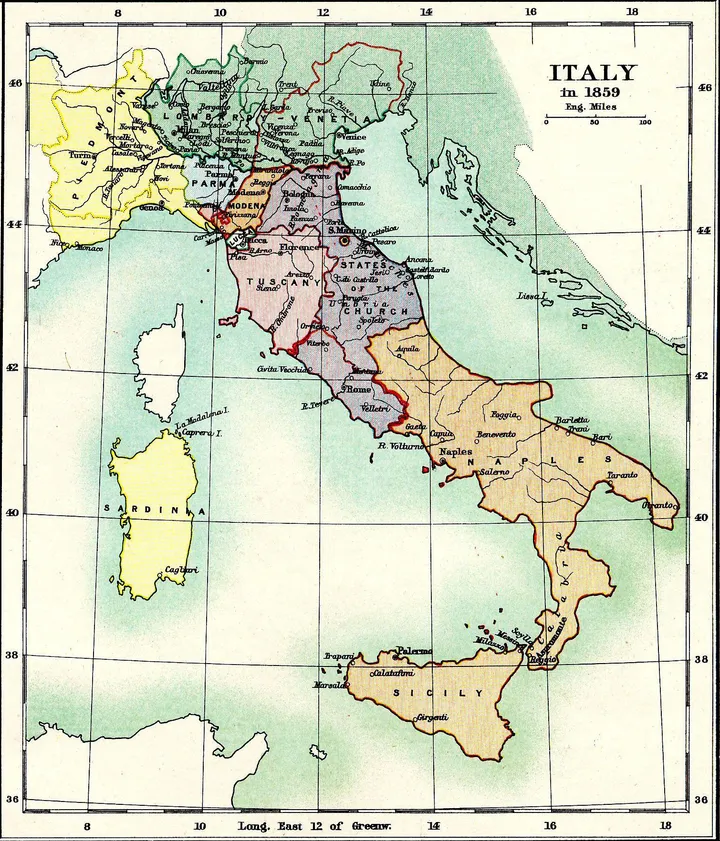
Today the constitution lists 20 regions. Five of them have special autonomy under their own statutes: Sicily, Sardinia, Trentino-Alto Adige/Südtirol, Friuli-Venezia Giulia and Valle d’Aosta/Vallée d’Aoste.[1]
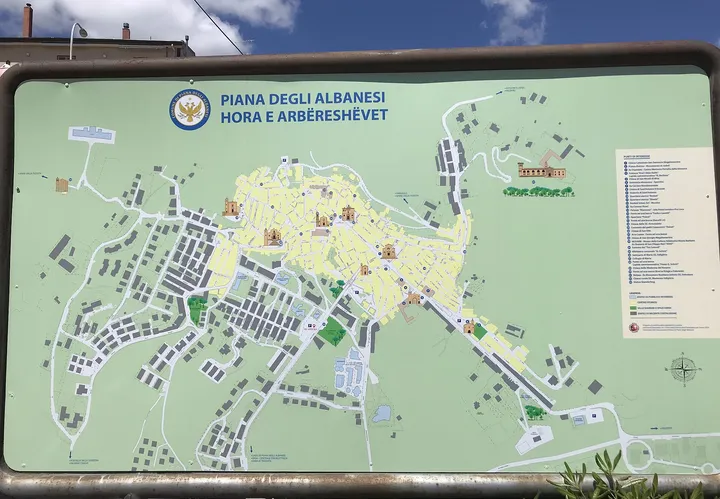
Italian is the official language.[2] The constitution obliges the Republic to protect linguistic minorities,[1] and a law from 1999 names twelve of them: the Albanian, Catalan, Germanic, Greek, Slovene and Croatian communities and the speakers of French, Franco-Provençal, Friulian, Ladin, Occitan and Sardinian.[2]
Local dialects are still widely spoken, though far less than in the 1980s. In 1988, 32% of Italians aged six and over spoke only or mainly dialect at home. By 2024 the share had fallen to 9.6%, and about 42% used dialect in at least one setting, on its own or alongside Italian. At home, dialect is used most in Calabria (64%), Sicily (61.5%) and Campania (61%), counting those who mix it with Italian. Tuscany (75.6%) and Liguria (75.5%) have the highest shares of people who speak mainly Italian at home.[9]
The Albanian- and Greek-speaking minorities of the south were part of a genetic study published in 2017. The Arbëreshë, who speak Albanian, showed a recent origin in the Balkans. The Greek-speaking communities clustered with their Italian-speaking neighbors, which the authors read as a sign of a long history in southern Italy.[10]
The great emigration to America
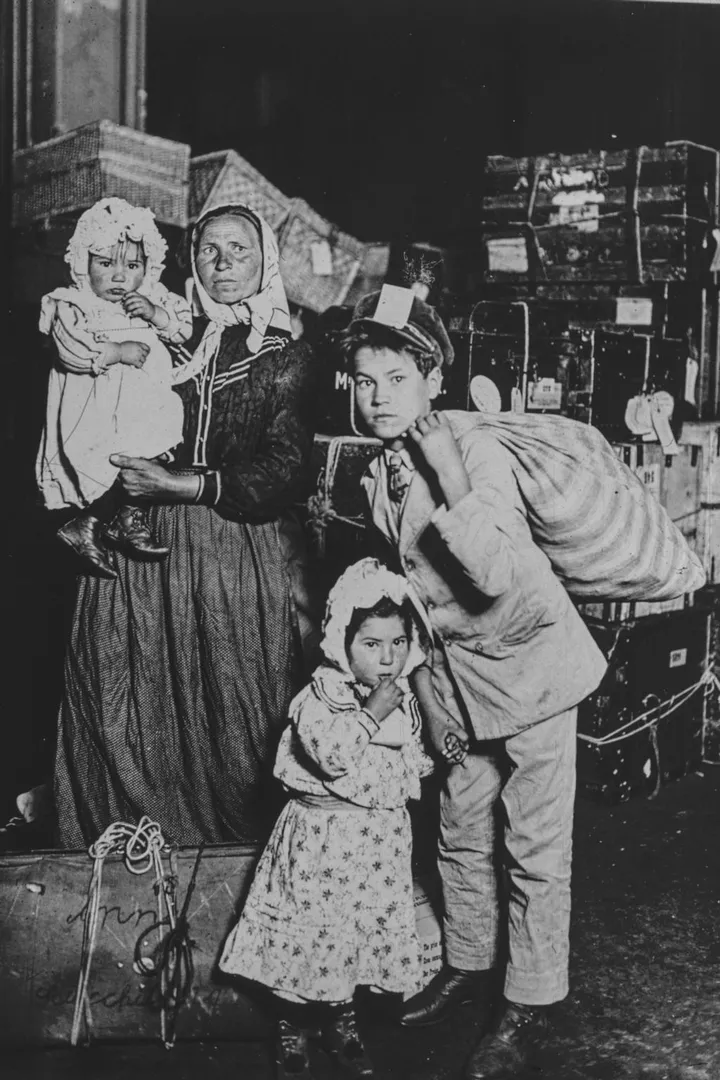
Italians began to arrive in the United States in large numbers in the late 1800s. Most of the early arrivals were young men from the south of Italy, which offered them little opportunity. Nearly half eventually returned to Italy.[11] Immigration from Italy peaked in the first decade of the 20th century.[12]
Source: U.S. Department of Homeland Security[12]
US officials divided the newcomers into two groups. A government dictionary published in 1911 explained that the Bureau of Immigration counted North Italians from the Po basin and South Italians from the rest of the peninsula and the islands, Genoa included. It asserted that the two groups “differ from each other materially in language, physique, and character”. For the years 1899 to 1910 it reported 1,911,933 South Italian arrivals, more than any other group, and 372,668 North Italian arrivals.[13]
From 1892 to 1924, Ellis Island in New York Harbor was the largest and busiest immigration station in the country. More than 12 million immigrants were processed there.[14] Many newcomers thought of themselves as Neapolitans, Sicilians or Calabrians and became Italian Americans only after their arrival in the United States.[15]
Prejudice and belonging in the United States
Like other immigrants of their time, Italians often met hostility. New Orleans had the largest Italian community in the South, most of them from Sicily. After the city’s police chief was shot dead, hundreds of Italian Americans were arrested and 19 were indicted. On March 14, 1891, after six acquittals and three mistrials, a mob stormed the jail and killed 11 men.[16] In 2019 Mayor LaToya Cantrell issued an official apology to the Italian American community. “This attack was an act of anti-immigrant violence,” she said.[16]
During World War II the freedom of more than 600,000 Italian-born immigrants and their families was restricted by government measures that “branded them ‘enemy aliens’”, Congress found in 2000. They had to carry identification cards, faced travel restrictions and had property seized. More than 10,000 Italian Americans on the West Coast were forced to leave their homes, and hundreds were interned in military camps.[17] More than half a million Italian Americans served in the US military during the war.[11]
In the 2024 American Community Survey, 16.3 million people reported Italian ancestry. It is the fifth most common ancestry in the country, after German, Irish, English and American.[4]
Surnames, records and citizenship by descent
Italian surnames came into use in the late Middle Ages and the Renaissance, according to a 2012 study of 77,451 surnames from the 1993 telephone directories. About three in four of them (76.06%) go back to a single place of origin. Depending on the province, between 22.77% and 77.86% of people still lived in the area where their surname had first appeared.[18]
For ancestors who lived on or after January 1, 1866, the Antenati genealogy portal of the Italian state archives points researchers to the civil registers. For earlier dates, back to the early 1600s, it recommends parish registers, and in some areas these go back as far as the 14th century.[19]
Italian citizenship used to pass from parent to child without a limit on generations. Decree-law 36 of 2025, later converted into law, changed that. A person born abroad who also holds another citizenship is now considered never to have acquired Italian citizenship. The exceptions are claims filed by March 27, 2025, people with a parent or grandparent who holds or held only Italian citizenship, and children of a parent who lived in Italy for at least two consecutive years after becoming a citizen and before the child’s birth. In March 2026 the Constitutional Court rejected a challenge to the new rules brought by a court in Turin.[20]
Italians in the United States
New York is home to 2.1 million people of Italian ancestry, more than any other state, and Pennsylvania to 1.4 million. Rhode Island has the highest share, about 15% of its residents.[4]
- 1861
The United States recognizes the new Kingdom of Italy on April 11.[7]
- 1892
Ellis Island in New York Harbor begins to process immigrants.[14]
- 1899
The Bureau of Immigration begins to record new arrivals by “race or people” and counts North Italians and South Italians as two separate groups.[13]
- 1907
More than 240,000 South Italians arrive in a single year, more than any other group of immigrants.[13]
- 1924
The Immigration Act sets quotas of two percent of each nationality counted in the 1890 census. The new system limits immigration from Southern and Eastern Europe.[21]
- 1965
President Lyndon B. Johnson signs the Immigration and Nationality Act at the Statue of Liberty on October 3. It ends the national origins quotas.[22]
- 2000
The Wartime Violation of Italian American Civil Liberties Act becomes law on November 7. It requires the Attorney General to report on how the government treated Italian Americans during World War II.[17]
- 2024
About one in twenty Americans, 16.3 million people in all, report Italian ancestry.[4]
Sources
- Constitutional Court of Italy: Constitution of the Italian Republic, English translation (October 2023)
- Italian Parliament: Law No. 482 of December 15, 1999, on the protection of historical linguistic minorities
- Istat: Indicatori demografici, anno 2025 (March 31, 2026)
- U.S. Census Bureau: American Community Survey 2024, 1-year estimates, Table B04006, People Reporting Ancestry
- A. Raveane et al.: Population structure of modern-day Italians reveals patterns of ancient and archaic ancestries in Southern Europe, Science Advances (September 2019)
- Margaret L. Antonio et al.: Ancient Rome, A genetic crossroads of Europe and the Mediterranean, Science (November 2019)
- Office of the Historian, U.S. Department of State: A Guide to the United States’ History of Recognition, Diplomatic, and Consular Relations, by Country, since 1776, Italy
- Kingdom of Italy: Law of March 17, 1861, on the title of King of Italy, via Wikisource
- Istat: L’uso della lingua italiana, dei dialetti e delle lingue straniere, anno 2024 (January 27, 2026)
- Stefania Sarno et al.: Ancient and recent admixture layers in Sicily and Southern Italy trace multiple migration routes along the Mediterranean, Scientific Reports (May 2017)
- Vincent J. Cannato: What Sets Italian Americans Off From Other Immigrants?, Humanities, National Endowment for the Humanities (January/February 2015)
- U.S. Department of Homeland Security: 2019 Yearbook of Immigration Statistics, Table 2, Persons obtaining lawful permanent resident status by country of last residence, 1820 to 2019
- U.S. Immigration Commission: Dictionary of Races or Peoples (1911), via Internet Archive
- National Park Service: Ellis Island, History and Culture
- U.S. Census Bureau: Italian-American Heritage and Culture Month, October 2023
- Smithsonian Magazine: New Orleans Apologizes for 1891 Lynching of Italian-Americans (April 15, 2019)
- Public Law 106-451, Wartime Violation of Italian American Civil Liberties Act (November 7, 2000)
- Alessio Boattini et al.: General Method to Unravel Ancient Population Structures through Surnames, Final Validation on Italian Data, Human Biology 84, no. 3 (2012)
- Portale Antenati, Italian Ministry of Culture: La ricerca genealogica
- Constitutional Court of Italy: Press release on decree-law 36/2025 on citizenship (March 12, 2026)
- Office of the Historian, U.S. Department of State: The Immigration Act of 1924 (The Johnson-Reed Act)
- History, Art & Archives, U.S. House of Representatives: Immigration and Nationality Act of 1965
More from Europe
British 4German 3English 2Irish 2Spanish 2Albanian 1Basque 1Bosnian 1French 1Hungarian 1Kosovo Albanian 1Portuguese 1