Celebrities with English Roots
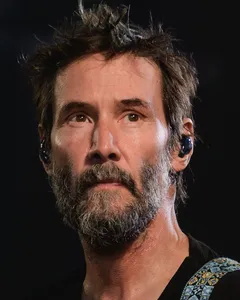 Keanu ReevesMother born in Essex, England
 Lewis HamiltonMother born in Birmingham, England
No celebrity matches your search.
Angles, Saxons and Jutes
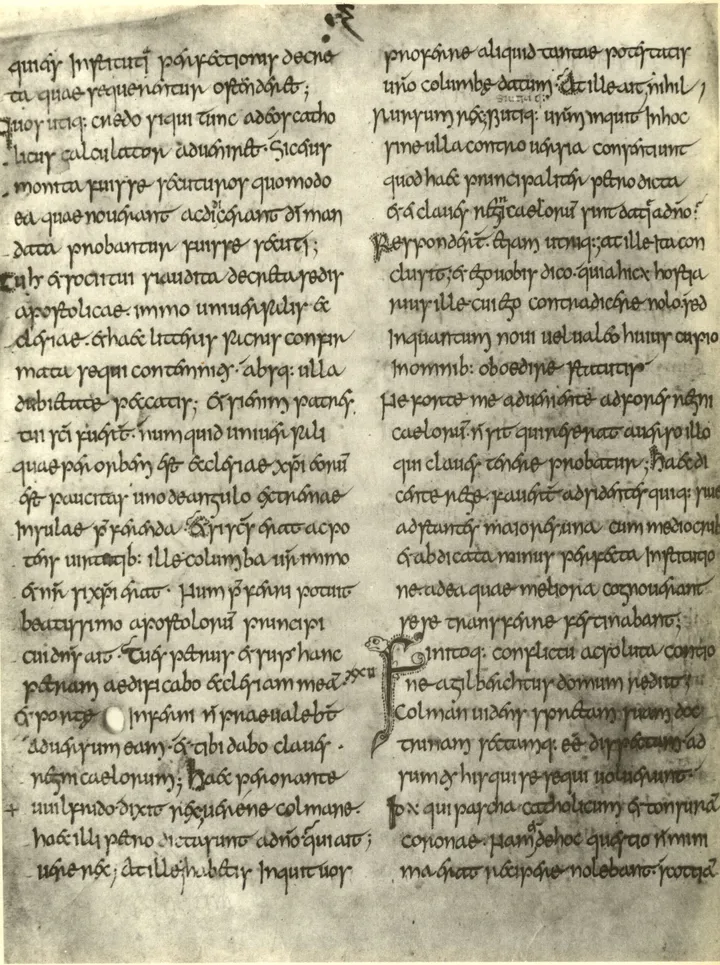
The priest Bede, who lived from 673 to 735, traced the English back to settlers from the continent. In his Ecclesiastical History of the English Nation he writes that the newcomers were “of the three most powerful nations of Germany”, the Saxons, Angles and Jutes. He dates their arrival to the year 449. According to Bede, the people of Kent and the Isle of Wight descend from the Jutes, and the East Angles, Mercians and Northumbrians from the Angles.[4]
A study of ancient DNA published in 2022 examined 460 people from medieval northwestern Europe, 278 of them from England. In early medieval England it found a substantial increase in ancestry from continental northern Europe, closely related to the people of Germany and Denmark, both then and now. Individuals from eastern England derived up to 76% of their ancestry from the continental side of the North Sea. The authors infer “large-scale substantial migration across the North Sea into Britain during the Early Middle Ages”. In their view it was part of a continuous movement of people from the late Roman period into the 11th century.[5]
For people in England today, the study estimates this continental share at 25% to 47%, with peaks in Sussex, the East Midlands and East Anglia. A second component, closest to people of Iron Age France, accounts for 14% to 43% and is also highest in East Anglia. Both are lower in the southwest, the northwest and along the Welsh border. The second component already appears at several early medieval burial sites in the southeast. According to the authors, this ancestry kept arriving through the Middle Ages and possibly beyond.[5] The British page follows the earlier migrations into Britain, from the first farmers to the Bronze Age.
Vikings and the Danelaw
The Anglo-Saxon Chronicle first records ships of Danish men in England in 787. In 865 a large Viking force, the Great Heathen Army, arrived and camped for successive winters in the East Midlands, at places such as Repton and Torksey. In 878 Alfred the Great won a victory over the Danes, who then converted to Christianity. Nottingham, where the Chronicle places a Viking camp in 868, later became one of the Five Boroughs of the East Midlands. The area followed Scandinavian customs to such an extent that it became known as the Danelaw.[6]
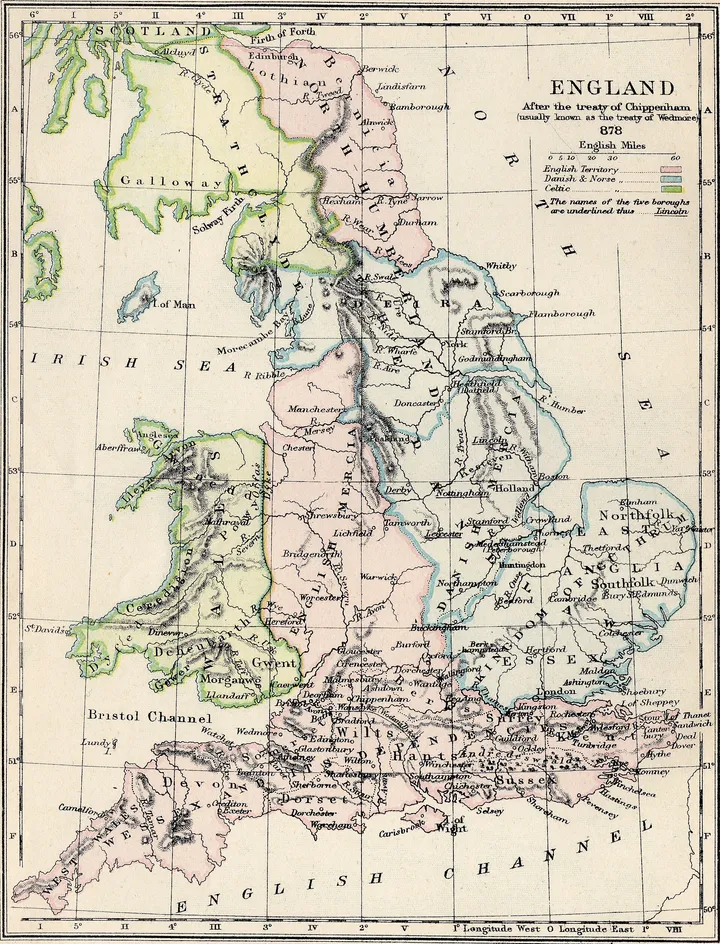
Old Norse also left its mark on the map. The most common Scandinavian element in the place names of the region is -by, meaning farm or homestead, often joined to a personal name, as in Scrooby, Skropi’s farm. In Nottingham, the many street names ending in -gate go back to Old Norse gata, a street or road.[6]
The Norman Conquest and Domesday Book
On October 14, 1066, the English and Norman armies met near Hastings. King Harold died in the battle, and William, Duke of Normandy, was crowned King of England on Christmas Day.[7]
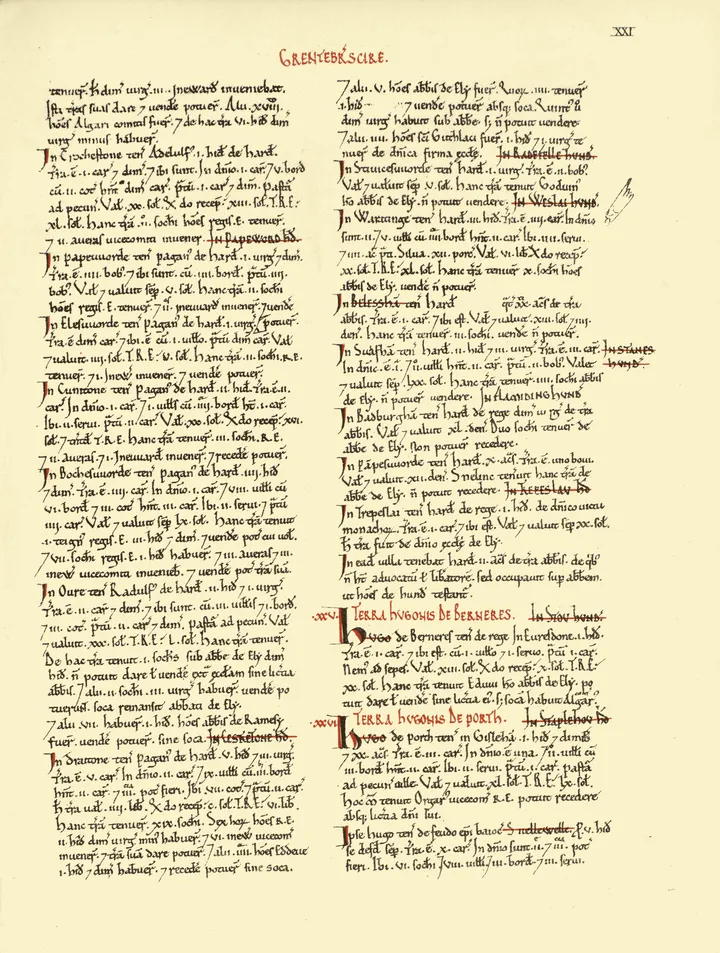
At Christmas 1085 William ordered a survey of land and property across England, which was carried out the following year. Royal commissioners put fixed questions to local men at sworn inquests in the local courts. For each property they asked how it had been held on the last day of Edward the Confessor’s reign, when King William granted it and in 1086.[8] The Norman inspectors spoke French and Latin, and the people in England spoke English. Juries of leading local men, among them the village priest and the reeve, understood the different languages and had to decide whether their neighbors were telling the truth.[7]
The result, Domesday Book, holds details of 270,000 inhabitants, free and unfree, in 13,000 settlements. The writer of the Anglo-Saxon Chronicle noted in English that “there was no single hide nor virgate of land” left out of the record.[9] The people it names are almost all landholders, and The National Archives advises anyone tracing a Norman ancestor to turn to other reference works.[8]
How English surnames came about
Most English surnames go back to a name that became hereditary between the 13th and the 16th century. In south Lancashire, some surnames were still being formed from a father’s name in the early 17th century. Many only settled into their present spelling in the 20th century.[10]
The Oxford Dictionary of Family Names in Britain and Ireland, published in 2016, explains 45,600 of the most frequent surnames, nearly 40,000 of them native to Britain and Ireland. Richard Coates, one of its editors, names the main types. Smith and Baker come from occupations, as do the less obvious Beadle, Rutter and Baxter. Hill refers to a place, and so does Green, after a village green. Jackson and Jenkinson preserve a father’s name. Brown, Short and Thin once described the first bearer, though Short may have been an ironic nickname for a tall person.[11]
One spelling can stand for unrelated names. The English surname Lee comes from a Middle English word for a clearing in a wood. According to the dictionary’s editors, nearly half of the 84,000 people named Lee in Britain have Chinese ancestry and carry a Chinese surname spelled the same way.[10]
Parish registers, certificates and census returns
On September 5, 1538, Thomas Cromwell, Henry VIII’s deputy in church affairs, ordered every parish to keep a register of baptisms, marriages and burials.[12] Only a very few parishes still have registers from that first year. Before 1813, London’s baptism registers typically give the date, the child’s name, the parents’ names and possibly the father’s occupation. The mother’s maiden name is never entered.[13]
Civil registration in England and Wales began in July 1837. The General Register Office holds every birth, marriage and death registered since then, and its index references can be looked up for free on the FreeBMD website.[14]
England and Wales have taken a census every ten years since 1801, except in 1941, and Scotland has held its own. The 1841 returns are the earliest to name every person. From 1851 they give the county and parish of birth for people born in England or Wales. Census records stay closed for 100 years, and 1921 is the latest open census. The 1931 census was destroyed by fire in 1942.[15] The 1939 Register fills part of the gap. Taken on September 29, 1939, and used to produce identity cards, it records about 40 million civilians with their exact dates of birth.[16]
English ancestry in American statistics
In 2020, people who marked White as their race could write in a more specific origin, a new option on the census form. In all, 46.6 million people identified as English, alone or in any combination with other groups, more than any other White group. German followed with 45 million and Irish with 38.6 million. Maricopa County in Arizona, which includes Phoenix, had the largest English population of any county, 620,199 people.[3]
The American Community Survey has an ancestry question of its own, and only the first two groups a person names are counted. Some people answer American. The Census Bureau explains that this could be because their ancestors “have been in United States for so long or they have such mixed backgrounds that they do not identify with any particular group”.[17] In 2024, 18.1 million people gave American as their ancestry. As a share of the population, English ancestry is most common in Utah and Maine.[2]
Source: U.S. Census Bureau, American Community Survey[2]
The English in America
Counting only people who named no other group, English was the largest White group in 35 states and the District of Columbia in the 2020 census. Texas had the most, more than 2.1 million.[3]
- 1587
A group of 118 men, women and children led by John White settles on Roanoke Island. On August 18, Virginia Dare is born, the first English child born in the Americas.[18] When White returns in August 1590, he finds “CROATOAN” carved into a palisade, and the colonists are gone.[19]
- 1607
On May 13, 104 English men and boys choose the site of Jamestown, named after King James I. It becomes the first permanent English settlement in North America, on land the Powhatan used for hunting.[20]
- 1620
The Mayflower reaches Cape Cod on November 11 with 102 passengers. There 41 of the men sign an agreement to “covenant and combine ourselves together into a civil Body Politick”.[21][22] At Plymouth they build their town where a Wampanoag community had lived until a sickness killed most of its people. About half of the passengers die in the first winter.[21]
- 1630s
Between 1620 and 1640 about 20,000 English men, women and children settle in New England, most of them from 1634 on. The Great Migration slows sharply after the calling of the Short Parliament in 1640.[23]
- 1890
The census finds 908,141 people in the US who were born in England, the peak in the counts from 1850 to 1930. Forty years earlier there had been 278,675.[24]
- 1980
For the first time, the census includes a question on ancestry.[17] With 49.6 million people, English edges out German, at 49.2 million.[25]
- 2000
English ancestry falls to 24.5 million people, 8.7% of all residents. Ten years earlier its share had been 13%. Over the same decade, the number who give American as their only ancestry rises from 12.4 million to 20.2 million.[26]
- 2024
The American Community Survey estimates 31.0 million people with English ancestry, 9.1% of all Americans.[2]
Sources
- Office for National Statistics: Population and household estimates, England and Wales, Census 2021 (June 28, 2022)
- U.S. Census Bureau: American Community Survey 2024, 1-year estimates, Table DP02, Selected Social Characteristics, national and state data
- U.S. Census Bureau: Paul Jacobs, Alli Coritz and Rachel Marks, Over Half of White Population Reported Being English, German or Irish (October 10, 2023)
- Fordham University, Internet Medieval Sourcebook: Bede, Ecclesiastical History of the English Nation, Book I (Everyman edition, 1910)
- Joscha Gretzinger et al.: The Anglo-Saxon migration and the formation of the early English gene pool, Nature 610 (September 21, 2022)
- University of Nottingham, Manuscripts and Special Collections: Arrival and Settlement, exhibition Danelaw Saga, curated by Roderick Dale and Judith Jesch
- The National Archives: What does Domesday Book tell us?, education resource
- The National Archives: Domesday Book, research guide
- The National Archives: Domesday, Explore the collection
- Patrick Hanks, Richard Coates and Peter McClure: Methods for studying the Origins and History of Family Names in Britain, in Facts and Findings on Personal Names, symposium in Uppsala (October 2011), via UWE Bristol
- UWE Bristol: UK’s largest ever study reveals origins of 45,600 surnames (November 17, 2016)
- Surrey History Centre, Surrey County Council: Early parish registers
- London Metropolitan Archives: Research Guide 2, Parish Registers at London Metropolitan Archives
- GOV.UK: Research your family history using the General Register Office
- The National Archives: Census records, research guide
- The National Archives: 1939 Register, research guide
- U.S. Census Bureau: About Ancestry
- National Park Service, Fort Raleigh National Historic Site: 1587, The Lost Colony
- National Park Service, Fort Raleigh National Historic Site: 1590 Rescue Voyage
- National Park Service, Historic Jamestowne: A Short History of Jamestown
- Plimoth Patuxet Museums: Mayflower and Mayflower Compact
- Avalon Project, Yale Law School: Mayflower Compact, Agreement Between the Settlers at New Plymouth (1620)
- American Ancestors, New England Historic Genealogical Society: The Great Migration Study Project
- U.S. Census Bureau: Campbell J. Gibson and Emily Lennon, Historical Census Statistics on the Foreign-born Population of the United States, 1850–1990, Working Paper No. 29, Table 4 (February 1999)
- U.S. Census Bureau: Ancestry of the Population by State, 1980, Supplementary Report PC80-S1-10, Table 2 (April 1983)
- U.S. Census Bureau: Angela Brittingham and G. Patricia de la Cruz, Ancestry: 2000, Census 2000 Brief (June 2004)
More from Europe
British 4Italian 4German 3Irish 2Spanish 2Albanian 1Basque 1Bosnian 1French 1Hungarian 1Kosovo Albanian 1Portuguese 1