Celebrities with Hungarian Roots
 SneakoPaternal grandfather was half Hungarian
From the Urals to the Carpathian Basin
Hungarians call themselves Magyar. The name comes from Megyeri, said to be one of the original tribes. The English word Hungary has been traced to a Slavic form of the Turkic on ogur, “ten arrows”, which may refer to the number of tribes.[4]
Historians disagree on where the early Magyars first lived. The most likely area lies between the Volga River and the Ural Mountains. Before the 5th century their ancestors moved south onto the steppes, where they lived near Bulgar-Turkic peoples and later on lands ruled by the Khazars. In 895 or 896 an attack by the Pechenegs drove them across the Carpathian Mountains into the basin of the Danube and Tisza rivers, roughly today’s Hungary. Estimates put the migrants at about 400,000 people in seven Magyar tribes, one Kabar tribe and smaller groups.[4]
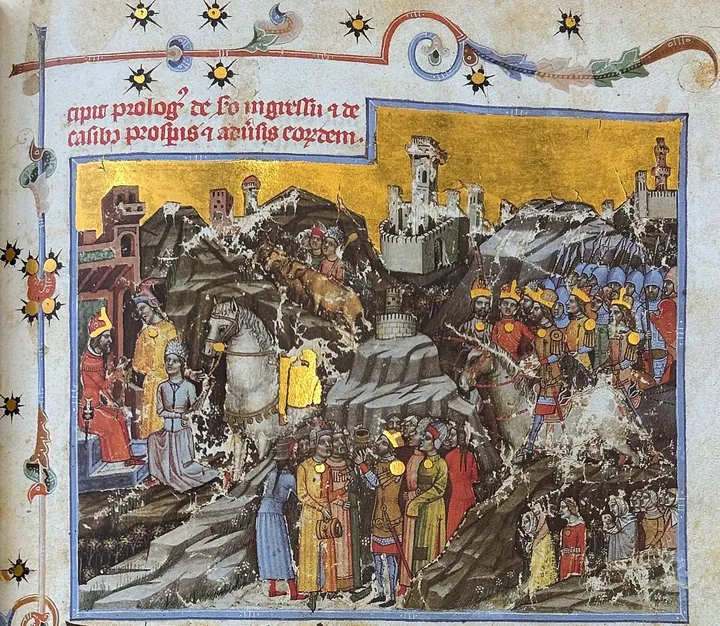
A 2022 study sequenced the genomes of 113 people buried in the Carpathian Basin during the conquest period. As in the Hun and Avar periods, most were local residents with European ancestry. The authors traced a smaller immigrant core to an earlier mixture of groups related to today’s Mansi, early Sarmatians and descendants of the late Xiongnu, the Asian Huns. Hun-related ancestry in a number of Avar and conquest-period graves pointed them to “a genetic link between these successive nomadic groups”.[5]
In 2025 a team working with 131 ancient genomes from the Ural region and the Carpathian Basin traced the Magyars mainly to the Karayakupovo horizon, burial sites from 750–1000 on both sides of the southern Urals. In its view, the sources proposed in 2022 “do not align with prevailing linguistic and archaeological interpretations”.[6] Long matching stretches of DNA connect individuals buried as much as about 3,000 kilometers apart.[7] Some of the newcomers may have made the journey within a single generation.[6]
Hungarians today carry almost none of the Siberian ancestry that many Uralic-speaking peoples share, a third study found in 2025. Tian Chen Zeng, who led its DNA analysis, adds, “But we know, based on ancient DNA work from the medieval conquerors of Hungary, that the people who brought the language there did carry this ancestry.”[8]
A Uralic language in Central Europe
Hungarian belongs to the Ugric branch of the Uralic language family. Linguists place its development east of the Ural Mountains between 1000 and 500 BC.[9] The language of the Mansi belongs to the same branch.[6] More than 25 million people speak Uralic languages today, Finnish and Estonian among them. In Hungary the family forms a language island surrounded by German, Slovak and other Indo-European languages.[8]
Most Hungarian words for farming and animal husbandry have Turkic roots, a legacy of the centuries near Bulgar-Turkic peoples. Many other words came from Slavic, German, Latin and French.[4] The first written documents in Hungarian date from the 11th century.[6]
In the 1230s, European travelers reported Hungarian speakers in the middle Volga and lower Kama regions, an area known as Magna Hungaria. Place names suggest that Hungarian-speaking groups lived there until the 16th century.[6]
Stephen’s crown, Ottoman rule and 1848
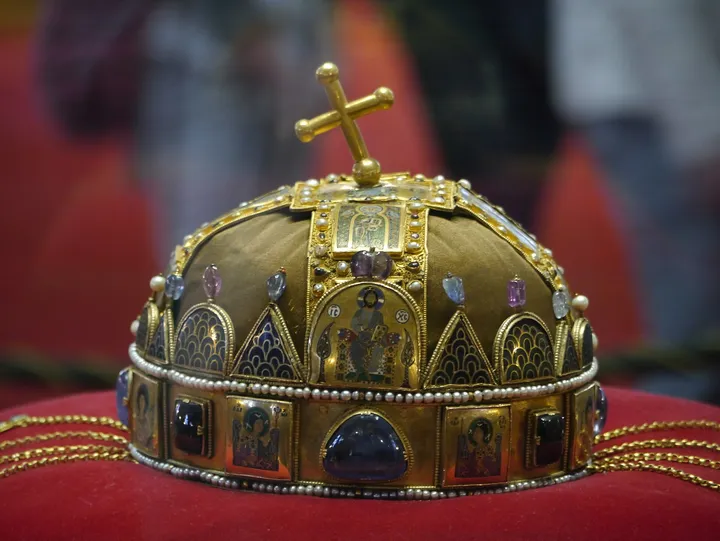
Géza, a great-grandson of Árpád, who by tradition led the migration, was baptized in 975. His son Stephen asked Pope Sylvester II to recognize him as king, and legend says he was crowned on Christmas Day in the year 1000.[4] August 20, a national holiday, commemorates the founding of the state and King Saint Stephen.[1]
The Holy Crown, also called the Crown of Saint Stephen, was used in the coronations of some fifty kings from the 12th century on.[10] The constitution honors “the Holy Crown, which embodies the constitutional continuity of Hungary’s statehood and the unity of the nation”, and the crown sits on top of the coat of arms.[1] It is on display in the Parliament in Budapest.[10]
In 1526 the army of Sultan Suleyman defeated the Hungarians at Mohács, and King Louis II died. After the Ottomans took Buda in 1541, the country stayed divided for more than 150 years. The Habsburgs held Royal Hungary along the Austrian border, the Ottomans ruled the center and south, and Transylvania became a vassal state under its own princes. In 1699 the sultan gave up almost all of his Hungarian lands.[4]
The revolution of 1848 began on March 15, another national holiday.[4][1] In April 1849 the Diet deposed the Habsburgs and named Lajos Kossuth governor. Russian troops then joined the fight against Hungary, and on August 13 the Hungarian army surrendered. Kossuth escaped to the Ottoman Empire.[4]
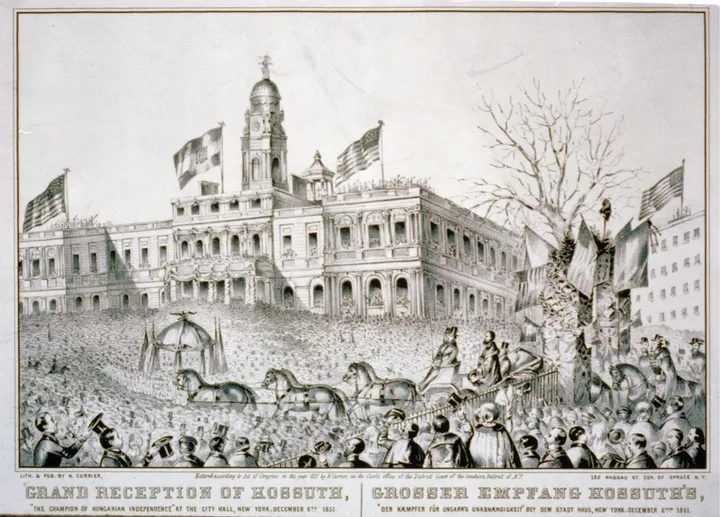
In 1851 President Millard Fillmore sent the warship USS Mississippi to bring him out of Turkey. Kossuth reached New York on December 4, 1851, and an estimated 200,000 people crowded the streets to welcome him.[11] On January 7, 1852, the House of Representatives received him, the second foreign leader after Lafayette to be honored this way.[12]
The Compromise of 1867 created the Dual Monarchy of Austria-Hungary and gave Hungary control of its domestic affairs.[4] In the multiethnic kingdom, Hungarians made up only about half of the population.[13]
Trianon, war and 1956
Hungary signed the Treaty of Trianon on June 4, 1920. It lost more than two-thirds of its prewar territory and about 60% of its prewar population.[4][14] Romania gained Transylvania, the Kingdom of Serbs, Croats and Slovenes gained Croatia, Slavonia and Vojvodina, Slovakia became part of Czechoslovakia and Austria received a small area. About a third of the 10 million ethnic Hungarians now lived outside the country.[4] In 2010 Hungary made June 4 a Day of National Cohesion.[15]
Source: Census results from Romania, Slovakia, Serbia and Ukraine[16][17][18][19]
In two counties of central Romania, Harghita and Covasna, Hungarians made up 80% and 67% of the population in the 2021 census.[16]
In 1910 about 900,000 Jews lived in Hungary, 5% of the population and 23% of the people of Budapest.[4] German troops occupied the country on March 19, 1944. Between May 15 and July 9, about 437,000 Jews were deported from Hungary, most of them to Auschwitz-Birkenau. Of some 825,000 Jews under Hungarian control during the war, about 550,000 were killed in the Holocaust.[14]
On October 23, 1956, a student rally in Budapest grew into an uprising against Soviet domination. Soviet troops put it down in November, and by then about 200,000 Hungarians had escaped to the West.[4] The anniversary is one of the three national holidays.[1]
Hungarian surnames and family records
In Hungarian the family name comes before the given name. Families of foreign origin often took up this order, as the gravestones of a German-speaking family in one Hungarian village show, from Petrus Leitold to Leitold Franz and Leitold Ambrus.[13]
The most common surnames are Nagy (“big”), Kovács (“smith”), Tóth (“Slavic, Slovak”), Szabó (“tailor”) and Horváth (“Croat”). In the 2007 population register, 241,928 people were called Nagy.[20] The ending -i marks origin from a place, as in Pécsi, “from Pécs”.[13]
A decree of Emperor Francis I in 1814 allowed official changes of surname. From the middle of the 19th to the middle of the 20th century about 300,000 surnames were changed, most of them to Hungarian ones. People often kept the first letter of the old name, and some translated it, so that a Müller (“miller”) could become a Molnár.[13] Jewish families, who had to adopt German surnames under a decree of 1787, took Hungarian names more and more often from 1848 and especially after 1867.[21] An estimated 30–40% of the surnames in Hungary today are of foreign origin.[13]
For the 1910 US census, enumerators had to distinguish Austria from Hungary, ask every person born abroad for their mother tongue and “Write Magyar instead of ‘Hungarian.’”[22] That year the census counted 495,609 residents born in Hungary and 229,094 foreign-born white residents with Magyar as their mother tongue.[23]
In Hungary, the state began registering births, marriages and deaths in 1895.[21] FamilySearch has indexed more than 18 million records from Roman Catholic registers of 1636 to 1895, written in Hungarian, Latin or German, some of them from places that belonged to the old Kingdom of Hungary.[24] Its civil registration collection holds images of births to 1920, marriages to 1950 and deaths to 1980.[25]
Before 1895, parish registers served as the official record. A law of 1827 made parishes keep each register in duplicate, and the National Archives of Hungary holds microfilms of the duplicates from today’s Hungary, kept by the Roman Catholic, Greek Catholic, Greek Orthodox, Calvinist, Lutheran and Jewish communities.[26] Between 1903 and 1907 a fortnightly paper in the port of Fiume, today Rijeka in Croatia, printed lists of the emigrants who sailed from there, with name, age and place of birth.[27] Hungaricana, a shared portal of Hungarian archives, museums and libraries run by the Library of Parliament, lays survey and cadastral maps of the Habsburg era over present-day maps.[28]
Hungarians in the United States
In Ohio, about 145,000 people or 1.2% of residents report Hungarian ancestry, the highest share of any state. New York has the most, about 167,000, and Pennsylvania ranks third with 102,000 (2024 estimates).[3]
- 1870s
Hungarian immigration to Cleveland becomes significant. Most of the newcomers are single men or men who have left their families behind, planning to return with enough savings to buy land.[29]
- 1891–1892
Cleveland gets the first Hungarian Reformed, Roman Catholic and Greek Catholic churches in North America.[29]
- 1907
About 200,000 peasants a year now leave Hungary, up from about 50,000 a year in the 1870s.[4] By one estimate, 1,078,974 Hungarians immigrated to the US from 1870 to 1920, not counting the kingdom’s other nationalities. Many take unskilled jobs in the steel mills, foundries and coal mines of the industrial Northeast.[30]
- 1914–1920s
More than half of the roughly one million Hungarian immigrants return to Hungary during and after World War I. In Cleveland, more and more of those who stay buy homes and become US citizens after 1920.[29]
- 1924
The Immigration Act of May 26 sets each yearly quota at 2% of the foreign-born of that nationality counted in the 1890 census. From July 1, the quota for people born in Hungary is 473.[31]
- 1956–1957
After the revolution more than 200,000 Hungarians flee, most of them to Austria. An emergency program brings 38,000 of them to the United States, and over 32,000 pass through the reception center at Camp Kilmer, New Jersey.[32]
- 1978
On January 6, a US delegation led by Secretary of State Cyrus Vance returns the Holy Crown to Hungary. At the end of World War II the Hungarian Crown Guard had handed it to the US Army to keep it out of Soviet hands, and it had been stored at Fort Knox, Kentucky.[10]
- 2024
The American Community Survey estimates that 59,578 people born in Hungary live in the United States.[33]
Sources
- Comparative Constitutions Project, constituteproject.org: Hungary’s Constitution of 2011 with Amendments through 2016 (The Fundamental Law of Hungary), Preamble and Articles F, H, I and J
- Eurostat: Population on 1 January, table tps00001 (updated October 27, 2026)
- U.S. Census Bureau: American Community Survey 2024, 1-year estimates, Table B04006, People Reporting Ancestry, national and state data
- Stephen R. Burant (ed.): Hungary, A Country Study, Federal Research Division, Library of Congress (1989)
- Zoltán Maróti et al.: The genetic origin of Huns, Avars, and conquering Hungarians, Current Biology 32 (July 2022)
- Balázs Gyuris et al.: Long shared haplotypes identify the southern Urals as a primary source for the 10th-century Hungarians, Cell 188 (October 16, 2025)
- Institute of Archaeogenomics, ELTE Research Centre for the Humanities: Genetic evidence identifies the southern Urals as a primary source of the 10th-century Hungarians (Magyars) (2025)
- Christy DeSmith, Harvard Gazette: Ancient DNA solves mystery of Hungarian, Finnish language family’s origins (July 16, 2025)
- Veronika Csáky et al.: Early medieval genetic data from Ural region evaluated in the light of archaeological evidence of ancient Hungarians, Scientific Reports 10 (November 2020)
- Association for Diplomatic Studies and Training: Returning the Crown of Saint Stephen to post-Cold War Hungary (December 2014)
- Susan M. Papp: Hungarian Americans and Their Communities of Cleveland, Cleveland State University (1981), chapter The Civil War Era (1851–1870)
- Office of the Historian, U.S. House of Representatives: House Receptions for Foreign Leaders
- Tamás Farkas: Surnames of Foreign Origin in a Language Contact Situation, Proceedings of the 23rd International Congress of Onomastic Sciences, York University (2009)
- United States Holocaust Memorial Museum: The Holocaust in Hungary, Holocaust Encyclopedia (January 24, 2025)
- Peter Murphy, Agence France-Presse, via The Jakarta Post: Hungary haunted by post-WWI dismemberment 100 years on (June 3, 2020)
- National Institute of Statistics of Romania: 2021 Population and Housing Census, final results, Table 2.02.1, Resident population by ethnicity (June 2023)
- Radio Slovakia International: Census, Hungarians largest ethnic minority (January 21, 2022)
- Statistical Office of the Republic of Serbia: Final results of the 2022 Census of Population, Households and Dwellings (April 28, 2023)
- State Statistics Committee of Ukraine: All-Ukrainian Population Census 2001, National composition of population
- Tamás Farkas: Surnames of ethnonymic origin in the Hungarian language, in Oliviu Felecan (ed.): Proceedings of ICONN 2 (2013)
- Center for Jewish History: Genealogy Guide, Hungary, Primary Records
- IPUMS USA, University of Minnesota: 1910 Census, Instructions to Enumerators
- U.S. Census Bureau: Campbell J. Gibson and Emily Lennon, Historical Census Statistics on the Foreign-born Population of the United States, 1850–1990, Working Paper No. 29, Tables 4 and 6 (February 1999)
- FamilySearch: Hungary, Catholic Church Records, 1636–1895
- FamilySearch: Hungary, Civil Registration, 1895–1980
- National Archives of Hungary (Magyar Nemzeti Levéltár): Parish registers, Guide to family history research
- National Archives of Hungary (Magyar Nemzeti Levéltár): Families immigrated to America, Guide to family history research
- Hungaricana, Library of Parliament, Hungary: About
- Susan M. Papp: Hungarians, Encyclopedia of Cleveland History, Case Western Reserve University
- Susan M. Papp: Hungarian Americans and Their Communities of Cleveland, Cleveland State University (1981), chapter The Great Immigration (1870–1920)
- The American Presidency Project, UC Santa Barbara: Calvin Coolidge, Proclamation 1703, Establishing Nationality Quota of Aliens Allowed Entry During Fiscal Year 1924–1925 (June 30, 1924)
- The American Presidency Project, UC Santa Barbara: Dwight D. Eisenhower, White House Statement on the Termination of the Emergency Program for Hungarian Refugees (December 28, 1957)
- U.S. Census Bureau: American Community Survey 2024, 1-year estimates, Table B05006, Place of Birth for the Foreign-Born Population
More from Europe
British 4Italian 4German 3English 2Irish 2Spanish 2Albanian 1Basque 1Bosnian 1French 1Kosovo Albanian 1Portuguese 1