Celebrities with Jewish Roots
Countries of origin documented in these profiles
 Bruno MarsJewish roots in Hungary and Ukraine
 Hailee SteinfeldJewish father
 SneakoGrandfather half Ashkenazi Jewish
 Timothée ChalametMother is Russian and Austrian Jewish
No celebrity matches your search.
Who counts as Jewish
Being Jewish can mean belonging to a religion, to a people or to both. In a 2010 paper in Nature, a team of geneticists led by Doron Behar describes Jews as “an aggregate of ethno-religious communities whose worldwide members identify with each other through various shared religious, historical and cultural traditions”.[5]
By traditional Jewish law, Jewish status passes through the mother. The child of a Jewish father and a non-Jewish mother has to convert to become Jewish.[6] In 1983 the Reform rabbis of the Central Conference of American Rabbis declared that “the child of one Jewish parent is under the presumption of Jewish descent”. Public acts of Jewish identity, such as a Hebrew name or a bar or bat mitzvah, establish that status.[6]
In Pew Research Center’s 2020 survey, 27% of Jewish adults in the United States did not identify with the Jewish religion. They considered themselves Jewish “ethnically, culturally or by family background”.[2]
Population counts depend on these definitions. The demographer Sergio DellaPergola counts as the core Jewish population everyone whose only identity is Jewish, religious or not. By this measure the United States had 6.3 million Jews in 2024. Pew also counts people who see themselves as partly Jewish and arrives at 7.5 million for 2020.[1][2] Israel’s Law of Return reaches further and covers the children and grandchildren of Jews and their spouses.[1] In 2024, Israel and the United States together were home to over 85% of the world’s Jews.[1]
From ancient Judea to the diaspora
The geneticist Gil Atzmon and his co-authors, also writing in 2010, date the origin of the Jews as a national and religious group in the Middle East to the second millennium BCE.[7]
In 586 BCE the Babylonian king Nebuchadnezzar II destroyed Jerusalem and its First Temple and took many people of Judah into exile in Babylon.[8] The Jews of Iraq and Iran descend from communities that formed in the Babylonian and Persian empires between the sixth and fourth centuries BCE.[7]
By the first century CE, Jews lived throughout the Roman Empire and in the Parthian Empire to its east. In a 2013 review, Harry Ostrer and Karl Skorecki write that more of them probably lived outside Judea than inside it, with the largest communities in Alexandria in Egypt and Antioch in what is now Turkey.[9] The Jewish War against Rome lasted from 66 to 74 CE.[10] It brought the end of the Judean kingdom and the fall of the Second Temple in 70 CE.[9] The Arch of Titus in Rome, built soon after 81 CE, celebrates the Roman victory. Its reliefs show the sacred vessels taken from the Temple, among them the seven-branched menorah.[10]
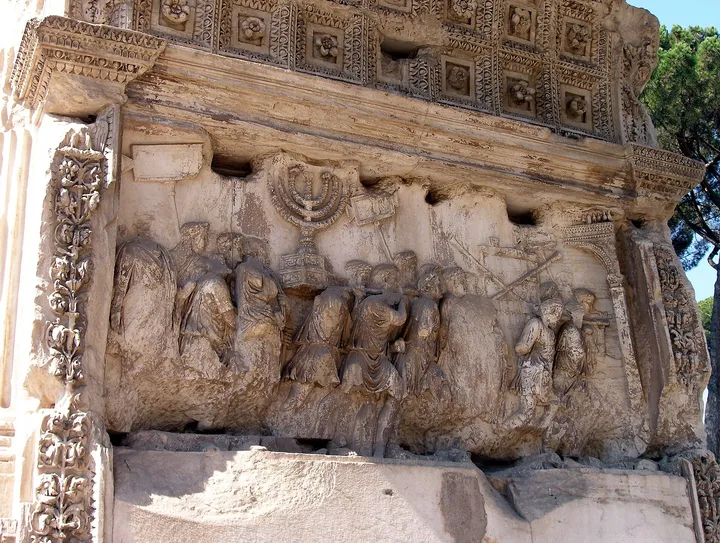
Ostrer and Skorecki see the Jews of the Roman era as the likely ancestors of the later communities in the Middle East, Europe and North Africa. Religious law and hostility toward Jews in the Christian and Islamic worlds then favored marriage among Jews. Judaism also reached Yemen, Ethiopia, India and China.[9]
What DNA studies show about Jewish ancestry
Behar’s team compared samples from 14 Jewish communities with 69 non-Jewish populations. Most Jewish samples formed a tight cluster close to Druze and Cypriot samples, and the authors “trace the origins of most Jewish Diaspora communities to the Levant”.[5] Ethiopian Jews, as well as the Bene Israel and Cochin Jews of India, grouped with their neighbors, although the Bene Israel carry a clear paternal link to the Levant.[5]
Atzmon’s team examined Iranian, Iraqi, Syrian, Italian, Turkish, Greek and Ashkenazi Jews. Each group formed its own cluster, all with shared Middle Eastern ancestry and varying amounts of European and North African admixture. The groups fell into two branches, Middle Eastern Jews and European and Syrian Jews, which by the study’s estimate separated 100–150 generations ago.[7]
Ostrer and Skorecki sum up the genetic findings as showing “a major, but variable component of shared Near East ancestry”, combined with different degrees of mixing with the host populations of the diaspora. They add that these results agree with the conclusions of many historians, though not all.[9]
Ashkenazi, Sephardic and Mizrahi Jews
Pew Research Center describes Ashkenazi Jews as following the customs of Central and Eastern Europe, Sephardic Jews those of Spain, and Mizrahi Jews those of the Middle East and North Africa. The labels refer to customs and liturgy as well as ancestry.[3]
Ashkenaz is a place name from the Hebrew Bible. In the Middle Ages it referred only to the German lands. As Jews migrated into the Polish–Lithuanian Commonwealth, the term came to include the Jews of Eastern Europe.[11]
Sephardic Jews descend from the Jews of Spain and Portugal. Spain expelled its Jews in 1492, and Portugal followed five years later.[12] The exiles settled in Italy, the Balkans, Syria, Morocco and Algeria, often within existing Jewish communities.[9]
Mizrahi Jews have their roots in the Middle East and North Africa.[3] Large numbers of Jews left the Arab countries in the late 1940s and 1950s, and most of them moved to Israel.[13] In the United States, two-thirds of Jews say they are Ashkenazi, 3% call themselves Sephardic and 1% Mizrahi.[3]
Hebrew, Yiddish, Ladino and Judeo-Arabic
“Throughout the world, wherever Jews have lived, they have spoken and written differently from their non-Jewish neighbors,” writes the Jewish Language Project.[4]
Hebrew ceased to be widely spoken in daily life around 200 CE and lived on as the language of prayer and Bible study. Modern Hebrew is often traced to the work of Eliezer Ben Yehuda in the late 19th and early 20th centuries. In 2024 it had about 9 million speakers.[14]
Yiddish is “the historic language of Ashkenazic (Central and East European) Jewry”. It fuses a Germanic core, taken from medieval German city dialects, with Hebrew and Aramaic. A Slavic layer came later. About 13 million people spoke Yiddish on the eve of World War II, and the Holocaust drastically reduced that number.[15]
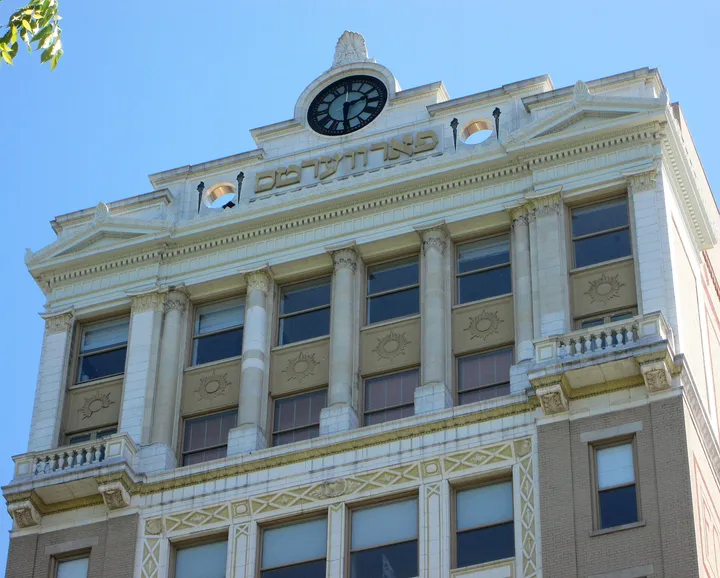
In New York the Yiddish daily Forverts first appeared in 1897. By the mid-1920s its paid circulation had passed 250,000, and it was the most widely read foreign-language newspaper in the United States. On its ten-story building on East Broadway, completed in 1912, large gold Hebrew letters spell out the paper’s name.[16]
Judeo-Spanish, also called Ladino or Judezmo, is the language of Jews whose families came from Spain. It flourished in the Ottoman Empire after the expulsion. The Jewish Language Project estimates 350,000 speakers in 1900 and 51,000 in 2024.[17]
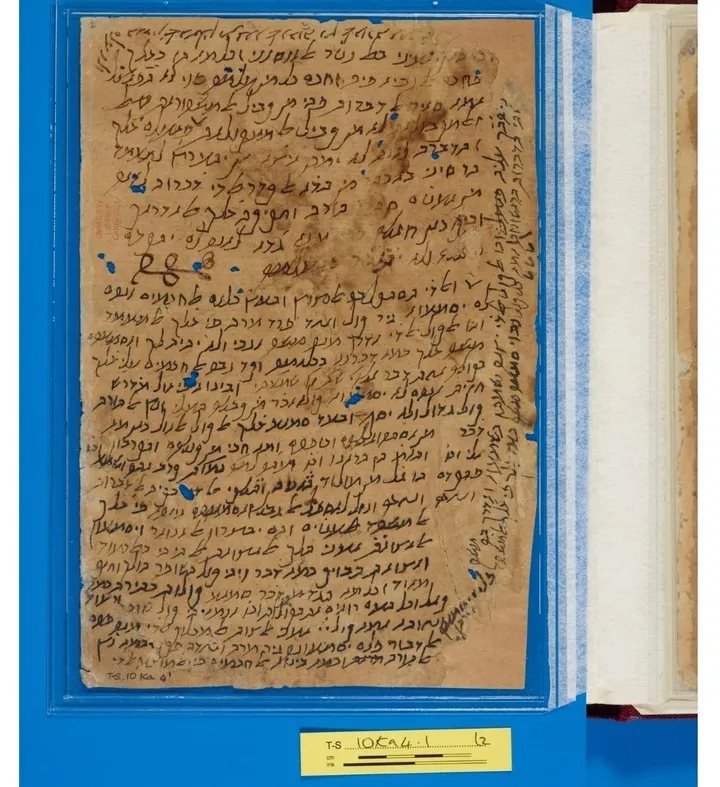
Jews across the Arabic-speaking world, from Iraq and Yemen to Spain and Morocco, spoke and wrote their own varieties of Arabic, usually in Hebrew letters. Maimonides wrote his Guide for the Perplexed in Judeo-Arabic in the 12th century.[13] A draft in his own hand survived in the Cairo Genizah and is now held by Cambridge University Library.[18] Most varieties of Judeo-Arabic are approaching extinction today.[13]
Expulsions, pogroms and the Holocaust
In the autumn of 1290, King Edward I expelled England’s entire Jewish population of around 3,000 people. France followed 16 years later. Jews were allowed back into England only in 1656.[19]
In April 1881, weeks after the assassination of Emperor Alexander II, riots against Jews broke out in Elisavetgrad in the Russian Empire. The violence of 1881 and 1882 brought the word pogrom into wide use. Almost 50 Jews were killed in the Kishinev pogrom of 1903. During the Russian Civil War, at least 50,000 Jews died in pogroms, according to the lowest credible estimate.[20]
“The Holocaust was the systematic, state-sponsored persecution and murder of six million European Jews by the Nazi German regime and its allies and collaborators,” writes the United States Holocaust Memorial Museum. Europe’s Jews numbered 9 million in 1933, and nearly two out of every three were killed.[21]
DellaPergola writes that the world’s Jewish population “has not yet recovered its estimated size” of 1939, “and it may still take a few more decades before that milestone is attained.”[1]
Source: Sergio DellaPergola, American Jewish Year Book 2024[1]
Jews in the United States
Nine in ten Jewish American adults were born in the United States, and 68% belong to families that have lived in the country for three generations or longer.[3]
- 1654
Portugal retakes Recife in Brazil and expels its Jewish settlers. Twenty-three Jewish refugees, women and children among them, arrive in New Amsterdam hoping to make a new home there.[12]
- 1763
The Jeshuat Israel synagogue opens in Newport, Rhode Island. Renamed Touro Synagogue in the 19th century, it is the oldest standing synagogue in the United States.[12]
- 1790
President George Washington writes to the Hebrew Congregation in Newport that the government of the United States “gives to bigotry no sanction, to persecution no assistance”.[12]
- 1840–1860
Jews from the German lands immigrate in the tens of thousands. The Jewish population of the United States grows from 15,000 to 150,000.[22]
- 1881–1924
More than two and a half million Jews from Eastern Europe arrive, driven by persecution and a lack of economic opportunity. Most settle in cities, join the working class and speak Yiddish.[22]
- 1907–1914
The Galveston Movement brings 10,000 Jewish immigrants through the port of Galveston, Texas, to steer them away from the crowded cities of the Atlantic coast.[23]
- 1924
The Immigration Act limits visas to 2% of each nationality counted in the 1890 census, which restricts immigration from Southern and Eastern Europe.[24] Jewish immigration from Eastern Europe never again reaches the levels of the years before 1920.[22]
- 1939
The liner St. Louis sails from Hamburg to Havana with 937 passengers, almost all of them Jewish refugees. Cuba refuses to let them land, and the United States and Canada are unwilling to admit them. In the end, 254 of the passengers are killed in the Holocaust.[25]
- 2020
Pew Research Center estimates the Jewish population of the United States at 7.5 million, including 1.8 million children. Jews make up 2.4% of American adults.[2]
Sources
- Sergio DellaPergola: World Jewish Population, 2024, American Jewish Year Book 2024 (Springer, 2025), via Israel Central Bureau of Statistics
- Pew Research Center: Jewish Americans in 2020 (May 11, 2021)
- Pew Research Center: Race, ethnicity, heritage and immigration among U.S. Jews, in Jewish Americans in 2020 (May 11, 2021)
- HUC Jewish Language Project: Jewish Languages, edited by Sarah Bunin Benor
- Doron M. Behar et al.: The genome-wide structure of the Jewish people, Nature 466 (July 2010)
- Central Conference of American Rabbis: Status of Children of Mixed Marriages, resolution (March 15, 1983)
- Gil Atzmon et al.: Abraham’s Children in the Genome Era, Major Jewish Diaspora Populations Comprise Distinct Genetic Clusters with Shared Middle Eastern Ancestry, American Journal of Human Genetics 86 (June 2010)
- Shayna Sheinfeld: Nebuchadnezzar, Bible Odyssey, Society of Biblical Literature
- Harry Ostrer and Karl Skorecki: The population genetics of the Jewish people, Human Genetics 132 (2013)
- Yeshiva University Center for Israel Studies: The Arch of Titus Project
- Ivan G. Marcus: Ashkenaz, YIVO Encyclopedia of Jews in Eastern Europe (2010)
- Library of Congress: From Haven to Home, 350 Years of Jewish Life in America, Haven
- Benjamin Hary and Josh Mendel: Judeo-Arabic, HUC Jewish Language Project
- Eden Moyal: Hebrew, HUC Jewish Language Project (2025)
- Dovid Katz: Yiddish, YIVO Encyclopedia of Jews in Eastern Europe (2010)
- New York City Landmarks Preservation Commission: Forward Building, 173–175 East Broadway, designation report LP-1419, by Shirley Zavin (March 18, 1986)
- Ora Schwarzwald: Judeo-Spanish/Judezmo/Ladino, HUC Jewish Language Project
- Cambridge University Library: Autograph draft of Moses Maimonides, Guide for the Perplexed, T-S 10Ka4.1, Cairo Genizah collection
- The National Archives (UK): Jews in England in 1290
- John Klier: Pogroms, YIVO Encyclopedia of Jews in Eastern Europe (2010)
- United States Holocaust Memorial Museum: Introduction to the Holocaust, Holocaust Encyclopedia (September 20, 2024)
- Library of Congress: From Haven to Home, 350 Years of Jewish Life in America, A Century of Immigration, 1820–1924
- Jane Manaster: Galveston Movement, Handbook of Texas Online, Texas State Historical Association (revised May 18, 2016)
- Office of the Historian, U.S. Department of State: The Immigration Act of 1924 (The Johnson-Reed Act)
- United States Holocaust Memorial Museum: Voyage of the St. Louis, Holocaust Encyclopedia