Celebrities with Bosnian Roots
 Dua LipaMaternal grandmother is Bosnian
Bosnian, Bosniak, Serb and Croat
Bosnian is the name for anyone from Bosnia and Herzegovina. The constitution of 1995 names its authors as the “Bosniacs, Croats, and Serbs, as constituent peoples (along with Others), and citizens of Bosnia and Herzegovina”.[1]
The three peoples share the same South Slav heritage, and their main cultural difference is religious origin. In the 19th century nationalist movements encouraged Orthodox Bosnians to be labeled Serbs and Catholic Bosnians to be labeled Croats.[6] In communist Yugoslavia the Central Committee of the Bosnian communists declared in 1968 that the Muslims were a distinct nation. Since the mid-1990s Bosnian Muslims have called themselves Bosniaks.[7]
The census of 2013 counted 3,531,159 people. No one had to state an ethnicity or a religion. Asked about religion, 50.7% answered Islamic, 30.7% Orthodox and 15.2% Catholic.[2]
Source: Agency for Statistics of Bosnia and Herzegovina[2]
When the results appeared in June 2016, the statistics agency of Republika Srpska refused to publish them in its entity. Its objection was that the count included people who had fled during the war and now live abroad. The state agency said it had included 196,000 people who lived abroad and still owned property in Bosnia.[8]
The three seats of the presidency are reserved for one Bosniak, one Croat and one Serb.[1] Citizens who do not declare themselves members of a constituent people cannot stand for the presidency or the upper house of parliament. In 2009 the European Court of Human Rights ruled on the case of two such citizens, of Roma and Jewish origin, and found that this violated their rights.[9]
Slavic settlers and the medieval kingdom
A 2023 study of ancient DNA, most of it from today’s Croatia and Serbia, traced the Balkan population through the 1st millennium CE. After Roman rule ended, newcomers genetically similar to today’s Slavic speakers of Eastern Europe contributed between 30% and 60% to the ancestry of the region’s people. The authors call this “one of the largest permanent demographic changes anywhere in Europe during the Migration Period”. Present-day Serbs and Croats carry about 50–60% of this ancestry, and the earlier population was never completely replaced.[10]
In 2005 researchers compared the Y chromosomes of 256 Bosniak, Serb and Croat men from Bosnia. Despite some differences, the three groups “share a large fraction of the same ancient gene pool distinctive for the Balkan area”.[11] A genome-wide study of 2014, which included all three, described the western Balkan populations as genetically uniform, especially the speakers of western South Slavic languages.[12]
Slavs began to settle in the region in the 6th century. A Bosnian state of some kind existed for most of the period from 1180 to 1463. Under King Tvrtko I, who ruled from 1353 to 1391, it was briefly the most powerful state in the western Balkans.[13]
Medieval Bosnia had its own church, which grew apart from Rome during a long isolation. Many 19th-century historians linked it to the dualist Bogomils of Bulgaria. Later scholars pointed out that its members accepted the cross and the Old Testament, which the Bogomils rejected. They see it as a branch of the Catholic Church with some Orthodox practices.[13]
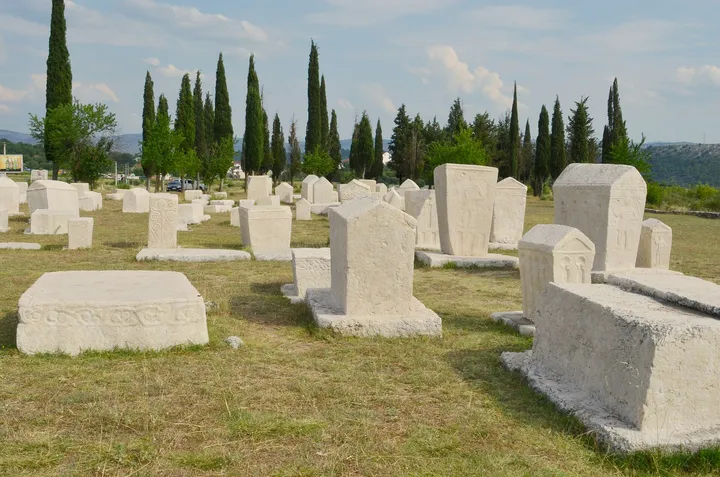
The stećci, tombstones mostly of limestone, were made from the second half of the 12th century to the 16th. More than 70,000 survive at over 3,300 sites. Orthodox and Catholic Christians and members of the Church of Bosnia all used them. Since 2016, 28 of their graveyards in Bosnia and Herzegovina, Croatia, Montenegro and Serbia have formed a UNESCO World Heritage Site.[14]
Ottoman centuries and Habsburg rule
Ottoman forces took Vrhbosna in central Bosnia in 1448 and built it up into the city of Sarajevo. They conquered most of the kingdom in 1463, and the last fortress in Herzegovina fell in 1482. Herzegovina owes its name to herceg, “duke”, the title taken by the nobleman Stefan Vukčić.[13]
Of all the Balkan lands under Ottoman rule, only Bosnia and later Albania saw a large part of the native population convert to Islam. Reasons included the privileged legal status of Muslims and city life in Sarajevo and Mostar, where a full civic life required conversion. Modern historians have largely disproved the old belief that nobles converted en masse to keep their estates. The Ottomans also brought settlers from Serbia and Herzegovina, most of them Orthodox, into depopulated parts of northern and western Bosnia.[15]
Sephardic Jews settled in Ottoman Sarajevo and founded a quarter of their own.[16] At Mostar the Ottomans replaced a wooden bridge over the Neretva in 1566 with a single stone arch 27 meters (90 feet) wide. The town’s name comes from most, “bridge”.[17]
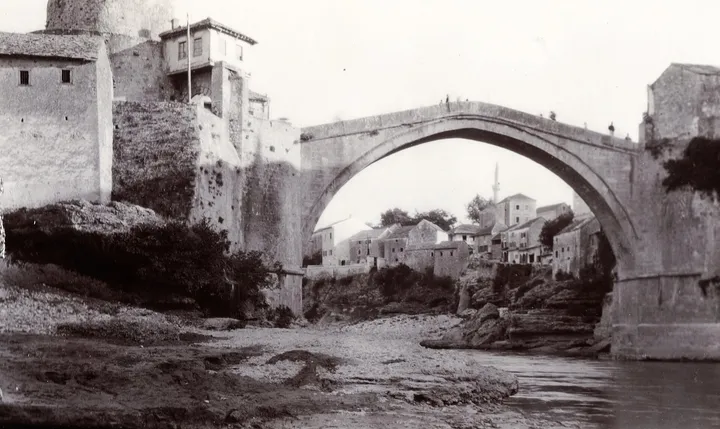
The bridge was destroyed in November 1993 and reopened in 2004. A year later UNESCO added it and the surrounding old town to the World Heritage List.[17]
Article 25 of the Treaty of Berlin, signed on July 13, 1878, reads, “The provinces of Bosnia and Herzegovina shall be occupied and administered by Austria-Hungary.”[18] In October 1908 Austria-Hungary annexed them outright. On June 28, 1914, Gavrilo Princip of the Young Bosnia movement killed the heir to the throne, Archduke Franz Ferdinand, in Sarajevo. A month later Austria-Hungary declared war on Serbia, and World War I began.[19]
Yugoslavia, war and the Dayton state
In 1918 Bosnia became part of the new Kingdom of Serbs, Croats and Slovenes, renamed Yugoslavia in 1929. During World War II an estimated 164,000 Serbs, 75,000 Muslims and 64,000 Croats died in Bosnia. Most of its 14,000 Jews were killed.[19] From 1946 Bosnia and Herzegovina was one of the constituent republics of communist Yugoslavia.[7] In the census of 1991, the last before the war, 43.5% of its people were Muslims, 31.2% Serbs and 17.4% Croats.[8]
Bosnia voted on independence on February 29 and March 1, 1992, and almost no Bosnian Serbs took part. Of the nearly two-thirds of the electorate who voted, almost all voted yes. The United States and the European Community recognized the new state on April 7.[7] The war that followed lasted until 1995, killed about 100,000 people and displaced 2 million.[8]
In July 1995 Bosnian Serb forces captured Srebrenica, a UN safe area in eastern Bosnia. Between 7,000 and 8,000 Bosnian Muslim men from the enclave were killed. In 2004 the Appeals Chamber of the International Criminal Tribunal for the former Yugoslavia ruled, “By seeking to eliminate a part of the Bosnian Muslims, the Bosnian Serb forces committed genocide.”[20] The International Court of Justice also found in 2007 that genocide was committed at Srebrenica. The evidence did not show that the acts could be attributed to Serbia. The court ruled that Serbia had violated its obligation to prevent the genocide.[21]
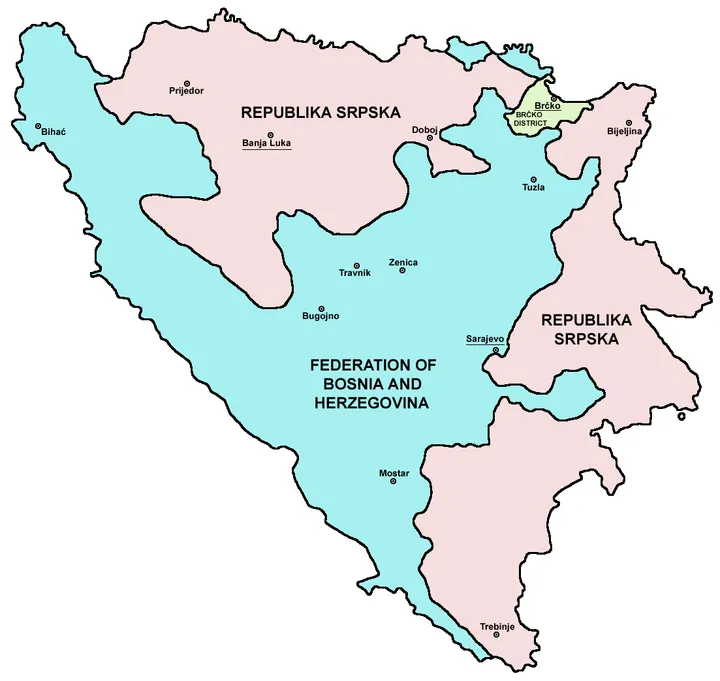
The Dayton Agreement of 1995 kept one state with two entities, the Federation of Bosnia and Herzegovina on 51% of the land and Republika Srpska on 49%.[7] Annex 4 of the agreement remains the constitution.[22] Brčko, on which the parties could not agree at Dayton, became a district of its own through an arbitration award in 1999. Its territory belongs to both entities as a condominium.[3]
One language, three names, two alphabets
Most people speak mutually intelligible languages known as Bosnian, Croatian or Serbian, depending on the speaker’s ethnic and political affiliation. The varieties spoken within Bosnia and Herzegovina are closer to one another than to the speech of Belgrade or Zagreb.[6] Whether they form one language or several depends on how a language is defined, as the linguist Wayles Browne notes. Under the Dayton Agreement, official documents appear in Bosnian, Croatian and Serbian versions. In practice they differ in a few words and in the alphabet, Cyrillic for Bosnian Serbs and Latin for the others.[23]
In 2013, 52.9% of the population named Bosnian as their mother tongue, 30.8% Serbian and 14.6% Croatian.[2] Both alphabets have been taught in schools. Since the 1990s Serbs have aligned with Cyrillic, and Croats and Bosniaks with the Latin alphabet.[6]
From Sarajevo to St. Louis
Between 2020 and 2024, about 10,500 people born in Bosnia and Herzegovina lived in the Chicago area and about 8,400 in the St. Louis area. By state, Illinois, Missouri and New York had the largest numbers.[5]
- Late 1800s
The first migrants from Bosnia and Herzegovina reach Chicago, most of them young men looking for work. Many find jobs in construction and mining.[24]
- 1906
Bosnian Muslims in Chicago found Dzemijetul Hajrije, a benevolent society that keeps up religious traditions and helps with funerals and illness. It is the oldest Muslim organization in the United States still in existence.[24]
- 1957
A mosque of the Bosnian Muslim community opens on Halsted Street in Chicago.[24]
- 1992
The United States recognizes Bosnia and Herzegovina as an independent state on April 7. Diplomatic relations follow on August 6.[25]
- 1993
Refugees from the war begin to settle in St. Louis. Bosnians who came before the 1990s already live there, and thousands of refugees make a home in the city over the following years.[26]
- 1994
The American embassy in Sarajevo opens on July 4. Since November 1993 the embassy for Bosnia and Herzegovina had worked from the premises of the American embassy in Vienna.[25]
- 1995
From November 1 to 21 the presidents of Bosnia, Croatia and Serbia negotiate at Wright-Patterson Air Force Base near Dayton, Ohio. The peace agreement initialed there is signed in Paris on December 14.[22]
- 2010
The American Community Survey counts 125,793 residents born in Bosnia and Herzegovina.[27]
- 2022
Saint Louis University puts the Bosnian population of the St. Louis region at more than 60,000.[26]
- 2024
The survey counts 108,665 residents born in Bosnia and Herzegovina.[28] In the race question, 130,912 people list Bosnian and Herzegovinian, on its own or with other groups. Since 2020 that question has collected detailed groups like this one from all respondents.[4][29]
Sources
- Office of the High Representative: Constitution of Bosnia and Herzegovina, Annex 4 to the General Framework Agreement for Peace (1995)
- Agency for Statistics of Bosnia and Herzegovina: Census of Population, Households and Dwellings in Bosnia and Herzegovina, 2013, Final Results (June 2016), via UN Statistics Division
- Office of the High Representative: Brčko Supervision
- U.S. Census Bureau: American Community Survey 2024, 1-year estimates, Table S0201, Selected Population Profile, Bosnian and Herzegovinian alone or in any combination
- U.S. Census Bureau: American Community Survey 2020–2024, 5-year estimates, Table B05006, Place of Birth for the Foreign-Born Population, by state and metropolitan area
- Encyclopaedia Britannica: Bosnia and Herzegovina, People
- Encyclopaedia Britannica: Bosnia and Herzegovina, Bosnia and Herzegovina in communist Yugoslavia
- Radio Free Europe/Radio Liberty: Charles Recknagel, Bosnia Erupts In Feuding Over New Census Data (June 30, 2016)
- European Court of Human Rights, Grand Chamber: Case of Sejdić and Finci v. Bosnia and Herzegovina, judgment (December 22, 2009)
- Iñigo Olalde et al.: A genetic history of the Balkans from Roman frontier to Slavic migrations, Cell 186 (December 2023)
- Damir Marjanović et al.: The peopling of modern Bosnia-Herzegovina, Y-chromosome haplogroups in the three main ethnic groups, Annals of Human Genetics 69 (November 2005), abstract via PubMed
- Lejla Kovačević et al.: Standing at the Gateway to Europe, The Genetic Structure of Western Balkan Populations Based on Autosomal and Haploid Markers, PLOS ONE 9 (August 2014)
- Encyclopaedia Britannica: Bosnia and Herzegovina, History
- UNESCO World Heritage Centre: Stećci Medieval Tombstone Graveyards
- Encyclopaedia Britannica: Bosnia and Herzegovina, Ottoman Bosnia
- Encyclopaedia Britannica: Sarajevo
- Encyclopaedia Britannica: Mostar
- Treaty of Berlin (July 13, 1878), in Thomas Erskine Holland: The European Concert in the Eastern Question (1885), via Wikisource
- Encyclopaedia Britannica: Bosnia and Herzegovina, Bosnia and Herzegovina under Austro-Hungarian rule
- International Criminal Tribunal for the former Yugoslavia: Appeals Chamber Judgement in the Case the Prosecutor v. Radislav Krstić (April 19, 2004)
- International Court of Justice: Application of the Convention on the Prevention and Punishment of the Crime of Genocide (Bosnia and Herzegovina v. Serbia and Montenegro), overview of the case
- Bill Clinton: Dayton Accords, Encyclopaedia Britannica
- Wayles Browne: Bosnian-Croatian-Montenegrin-Serbian language, Encyclopaedia Britannica
- Asad Husain: Bosnians, Encyclopedia of Chicago (Newberry Library, 2004), via the Internet Archive
- Office of the Historian, U.S. Department of State: A Guide to the United States’ History of Recognition, Diplomatic, and Consular Relations, by Country, since 1776, Bosnia and Herzegovina
- Saint Louis University: SLU Staffers Pen “Bosnian St. Louis: Between Two Worlds” (November 2022)
- U.S. Census Bureau: American Community Survey 2010, 1-year estimates, Table B05006, Place of Birth for the Foreign-Born Population in the United States
- U.S. Census Bureau: American Community Survey 2024, 1-year estimates, Table B05006, Place of Birth for the Foreign-Born Population in the United States
- U.S. Census Bureau: Demonstration Data, Profiles of Selected Populations Based on Ancestry Data and Newly Collected Detailed Race Data from the 2022 American Community Survey (September 26, 2024)
More from Europe
British 4Italian 4German 3English 2Irish 2Spanish 2Albanian 1Basque 1French 1Hungarian 1Kosovo Albanian 1Portuguese 1