Celebrities with Native Hawaiian Roots
Father’s side 2
 Jason MomoaNative Hawaiian father from Nānākuli
 Keanu ReevesFather’s family from Kuliʻouʻou Valley
No celebrity matches your search.
Who counts as Native Hawaiian
In a joint resolution of 1993 that apologizes for the overthrow of the Kingdom of Hawaii, Congress defines a Native Hawaiian as “any individual who is a descendent of the aboriginal people who, prior to 1778, occupied and exercised sovereignty in the area that now constitutes the State of Hawaii.”[6] In Hawaiian, a Native Hawaiian is a Kanaka Maoli. The Pukui-Elbert dictionary translates maoli as native, indigenous or genuine and notes that reports of the 1852 legislative session used kanaka maoli for a Hawaiian native.[7]
In federal statistics, Native Hawaiians belong to the category Native Hawaiian or Pacific Islander, which is separate from the category American Indian or Alaska Native.[8]
In the 2020 census, 680,442 people identified as Native Hawaiian, 29.1% more than in 2010. The count includes everyone who also named another race or group. Native Hawaiian alone was reported by 199,880 people.[1] In Hawaii itself, 21.8% of residents identified as Native Hawaiian alone or in combination, and 6.5% as Native Hawaiian alone.[2]
The Hawaiian Homes Commission Act of 1921 uses a narrower definition for its homestead leases. Applicants need a blood quantum of at least 50% Hawaiian, a requirement unchanged since the law was passed.[9]
Polynesian settlement and the voyaging canoes
A 2012 study analyzed the DNA of 148 Native Hawaiians from the Multiethnic Cohort, a health study in Hawaii and California. Participants who reported full Native Hawaiian heritage carried on average 78% Native Hawaiian, 11.5% European and 7.8% Asian ancestry. When the study modeled their genomes as a mix of Melanesian and East Asian sources, on average 32% came from the Melanesian side. The authors see this as support for the “Slow Boat” model, in which the ancestors of the Polynesians, widely believed to have come from East Asia, mixed with Melanesians before they settled the remote islands.[10]
Studies disagree on when the first settlers arrived. A 2011 meta-analysis of 1,434 radiocarbon dates from East Polynesia counted only samples of short-lived material as reliable. It dates the settlement of the Society Islands to about 1025–1120 and the spread to all other islands of the region, Hawaii among them, to about 1190–1290.[11] A 2014 study combined pollen and charcoal from sediment cores with archaeological dates. It places the first settlement of Hawaii between 940 and 1130, most probably between 1000 and 1100.[12]
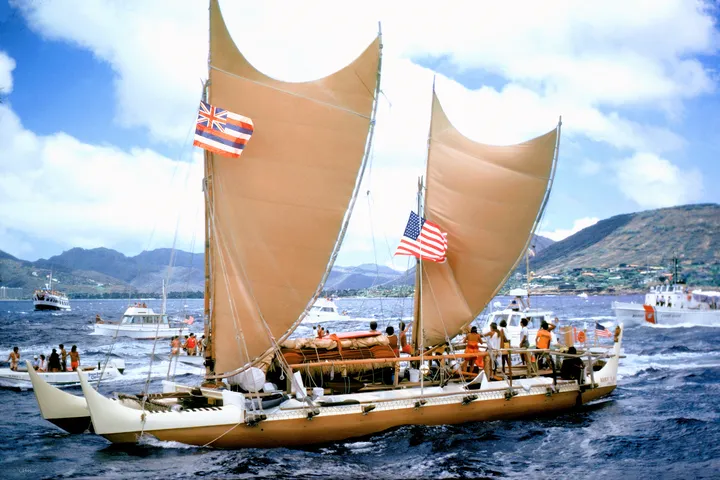
The Polynesian Voyaging Society, founded in 1973, set out to show that ancient Polynesians could have settled the Polynesian Triangle on purpose in double-hulled canoes. Its canoe Hōkūleʻa, the first voyaging canoe built in Hawaii in more than 600 years, left for Tahiti on May 1, 1976. The Micronesian navigator Mau Piailug guided it without instruments, and after 33 days it reached Papeete, where a crowd of more than 17,000 greeted it.[13]
The kingdom and its overthrow
Kamehameha I united the islands in 1810, when Kauaʻi came under his rule.[14] No census exists from the time of first contact in 1778. Estimates for that year range from 200,000 to 1,000,000. A 2019 study that projects the census of 1910 back in time arrives at 683,200. Diseases against which the islanders had no immunity soon took a heavy toll.[15] The censuses that followed record a steady decline.[16]
Source: Office of Hawaiian Affairs, after Robert C. Schmitt[16]
From the 1850s, sugar plantations recruited contract workers, first from China, later from Portugal and Japan. As Hawaiians married into the new communities, the number of part-Hawaiians grew.[16]
According to the 1993 resolution, a Committee of Safety representing American and European sugar planters, descendants of missionaries and financiers deposed Queen Liliʻuokalani on January 17, 1893, and proclaimed a Provisional Government. The day before, the American minister John L. Stevens and US naval officers had sent armed forces ashore to positions near the government buildings and ʻIolani Palace. The queen yielded “to the superior force of the United States of America” under protest, until the US government would “undo the action of its representatives”. President Grover Cleveland called for the monarchy to be restored. The Provisional Government stayed in power and declared itself the Republic of Hawaii on July 4, 1894.[6]
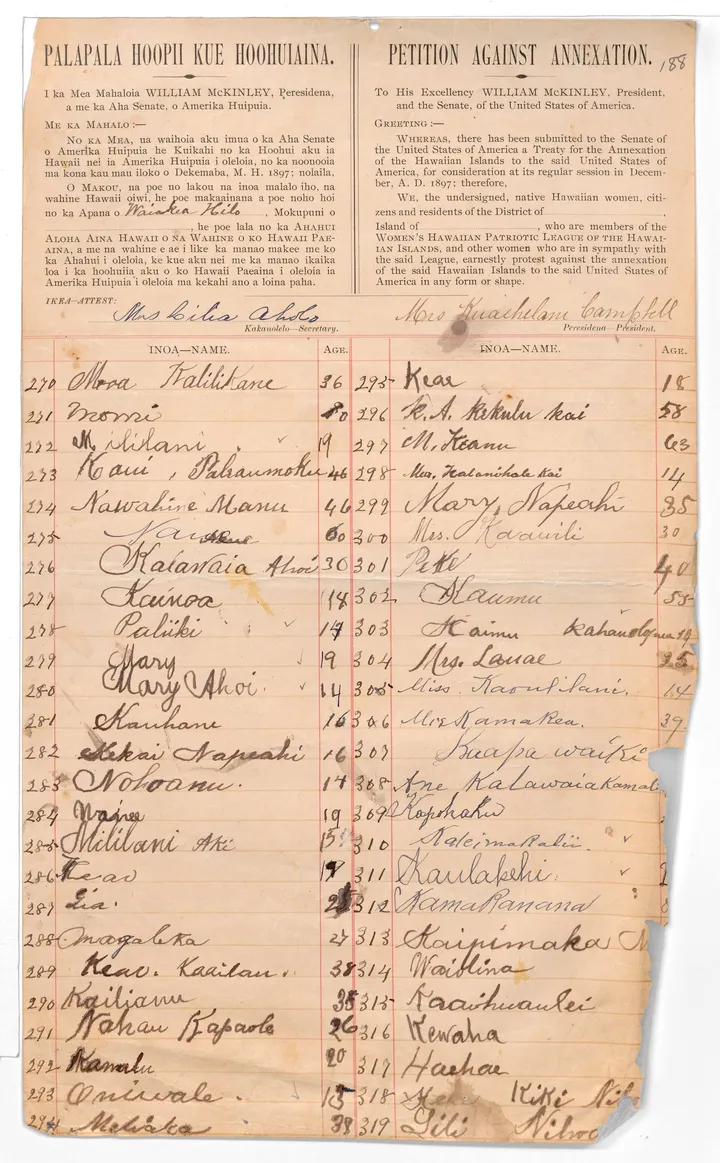
In 1897 a treaty of annexation went to the US Senate. That fall, 21,269 Native Hawaiians signed a petition against it, more than half of the 39,000 Native Hawaiians and part-Hawaiians in the census of the time. A delegation carried the petition to Washington, and the treaty failed for lack of votes.[17]
The Spanish-American War of 1898 strengthened the case for Hawaii as a naval and fueling station in the mid-Pacific. Congress then annexed the islands by a joint resolution, which needed only a simple majority in both houses, and President William McKinley signed it on July 7, 1898.[17]
In the resolution of 1993, Congress “apologizes to Native Hawaiians on behalf of the people of the United States for the overthrow of the Kingdom of Hawaii on January 17, 1893 with the participation of agents and citizens of the United States”. Its last section states that it is not intended as a settlement of any claims against the United States.[6]
ʻŌlelo Hawaiʻi, the Hawaiian language
After American missionaries arrived in 1820, an alphabet was created for Hawaiian, and printing in the language began in 1822.[18] Over time the alphabet settled on 12 letters, plus the ʻokina for the glottal stop and the kahakō, a mark for long vowels.[19] In 1825 King Kauikeaouli, Kamehameha III, declared, “ʻO koʻu aupuni, he aupuni palapala koʻu”, my kingdom shall be a kingdom of literacy.[18]
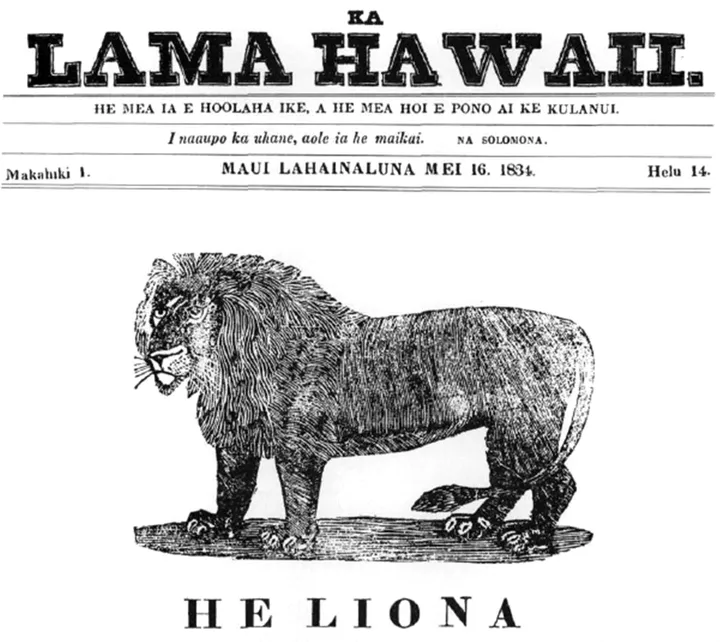
Hawaiian-language newspapers appeared from 1834 to 1948, more than 100 titles with around 125,000 pages.[18] The first, Ka Lama Hawaii, came out in 1834 at the Lahainaluna school on Maui, where the principal Lorrin Andrews taught his students the printing trade.[20]
Three years after the overthrow, the Republic of Hawaii passed Act 57 of 1896. It stated, “The English Language shall be the medium and basis of instruction in all public and private schools.”[21] A resolution adopted by the state legislature in 2022 apologizes for this effective prohibition of Hawaiian in schools, which lasted until 1986. It puts the number of speakers at nearly 40,000 in 1896 and 2,000 in 1978.[21][22] On the privately owned island of Niʻihau, a small Native Hawaiian community kept speaking the language in its own dialect.[19]
The constitutional convention of 1978 made Hawaiian an official language of the state alongside English.[4] A group of educators founded ʻAha Pūnana Leo in 1983. Its first Hawaiian-language preschool opened in Kekaha on Kauaʻi in August 1984. A law of 1986 ended the 90-year ban on teaching in Hawaiian. In 1987 the first immersion classes began in public schools. Education in Hawaiian now runs from preschool to the doctoral level.[23] In 2019–2023, Hawaiian ranked fifth among the languages other than English spoken at home in the state.[5]
Moʻokūʻauhau and Hawaiian family records
Moʻokūʻauhau is the Hawaiian word for genealogy.[24] The Hawaii State Archives in Honolulu keep records of births, marriages and deaths from 1826 to 1929. Many reports were never filed. Marriage records before 1896 do not name the parents of the bride and groom. The name indexes can be searched online through the Ulukau website.[25] Census returns of the kingdom survive only for 1866, 1878, 1890 and 1896, and only parts of the last three list people by name.[26]
About 75,000 pages of the Hawaiian-language newspapers can be read online,[18] among other places in the Papakilo Database of the Office of Hawaiian Affairs, launched in 2011.[27] For homestead leases, the Department of Hawaiian Home Lands establishes Hawaiian ancestry mainly through birth certificates, including Certificates of Hawaiian Birth.[9]
The authors of a 2021 study of Polynesian ancestry in about 4,000 Native Hawaiians write that they do not endorse using genetic data to replace self-identity or genealogical records as the standards of community membership.[28]
Native Hawaiians and the United States
In 2020, more Native Hawaiians lived in other states than in Hawaii, 362,893 against 317,497. Their number outside the islands grew by 53.1% in ten years, in Hawaii by 9.5%.[3]
- 1778
The British captain James Cook reaches the islands and names them the Sandwich Islands, after the Earl of Sandwich.[14]
- 1820
The first American missionaries arrive. By 1850 the American Board of Commissioners for Foreign Missions has sent more than 100 to the kingdom.[6][18]
- 1826
On December 23 the United States signs a treaty with the kingdom and thereby indirectly recognizes Hawaiian independence.[14]
- 1898
The transfer of sovereignty takes place on August 12. The Republic of Hawaii cedes 1,800,000 acres of crown, government and public lands of the former kingdom to the United States.[6][14]
- 1900
The Organic Act of April 30 creates the Territory of Hawaii and declares the citizens of the Republic of Hawaii to be citizens of the United States. From this year on, the islands are part of the US census.[26][29]
- 1921
President Warren G. Harding signs the Hawaiian Homes Commission Act on July 9, after a campaign led by Prince Kūhiō. It sets aside about 200,000 acres as a homeland for native Hawaiians.[30]
- 1959
Hawaii becomes the 50th state on August 21.[6]
- 1978
A constitutional convention creates the Office of Hawaiian Affairs, which holds property in trust for Native Hawaiians. Voters approve the amendments on November 7.[4]
- 2020
Native Hawaiians remain the largest Pacific Islander group in the census, at nearly 43% of everyone who identifies as Native Hawaiian or Pacific Islander, alone or in combination.[1]
Sources
- U.S. Census Bureau: Brittany Rico, Joyce Key Hahn and Paul Jacobs, Chuukese and Papua New Guinean Populations Fastest Growing Pacific Islander Groups in 2020 (September 21, 2023)
- Hawaii State Department of Business, Economic Development and Tourism: Naomi Akamine and Giovannie Vila, Native Hawaiian Population in Hawaii, 2020 (January 2026)
- Hawaii State Department of Business, Economic Development and Tourism: The State of Hawaii Data Book 2023, Table 1.37, Native Hawaiians Living in Hawaii or Other States, 2010 and 2020
- Legislative Reference Bureau, State of Hawaii: The Constitution of the State of Hawaii, Article X, Section 4, Article XII, Section 5, and Article XV, Section 4
- Hawaii State Department of Business, Economic Development and Tourism: The State of Hawaii Data Book 2024, Table 1.44, Top 20 Detailed Languages Other Than English Spoken at Home, 2019–2023
- Public Law 103-150, Joint Resolution to acknowledge the 100th anniversary of the January 17, 1893 overthrow of the Kingdom of Hawaii, and to offer an apology to Native Hawaiians, 107 Stat. 1510 (November 23, 1993), via GovInfo
- Mary Kawena Pukui and Samuel H. Elbert: Hawaiian Dictionary (1986), entry maoli, via Wehewehe Wikiwiki, University of Hawaiʻi
- Office of Management and Budget: Revisions to OMB’s Statistical Policy Directive No. 15, Standards for Maintaining, Collecting, and Presenting Federal Data on Race and Ethnicity, Federal Register (March 29, 2024)
- Department of Hawaiian Home Lands: Applying for Hawaiian Home Lands
- Sung K. Kim et al.: Population Genetic Structure and Origins of Native Hawaiians in the Multiethnic Cohort Study, PLoS ONE 7 (November 2012)
- Janet M. Wilmshurst, Terry L. Hunt, Carl P. Lipo and Atholl J. Anderson: High-precision radiocarbon dating shows recent and rapid initial human colonization of East Polynesia, PNAS 108 (February 2011)
- J. Stephen Athens, Timothy M. Rieth and Thomas S. Dye: A Paleoenvironmental and Archaeological Model-Based Age Estimate for the Colonization of Hawaiʻi, American Antiquity 79, no. 1 (2014)
- Polynesian Voyaging Society: About the Polynesian Voyaging Society, Brief History
- Office of the Historian, U.S. Department of State: Hawaii, A Guide to the United States’ History of Recognition, Diplomatic, and Consular Relations, by Country, since 1776
- David A. Swanson: A New Estimate of the Hawaiian Population for 1778, the Year of First European Contact, Hūlili 11, no. 2 (2019), Kamehameha Schools
- Office of Hawaiian Affairs: Estimated Population of the Hawaiian Islands, 1778–1896, after Robert C. Schmitt (April 2022)
- National Archives: Milestone Documents, Joint Resolution for Annexing the Hawaiian Islands to the United States (1898)
- University of Hawaiʻi at Mānoa, College of Education: Building Upon Kahua Aʻo, Hawaiian Language, A brief history of Hawaiian language newspapers
- Library of Congress, Folklife Today: Stephanie Hall, How Hawaiians Saved Their Language (May 24, 2017)
- Helen Geracimos Chapin: Newspapers of Hawaiʻi 1834 to 1903, From “He Liona” to the Pacific Cable, Hawaiian Journal of History 18 (1984)
- Hawaii News Now: Ben Gutierrez, Lawmakers adopt resolution apologizing for ban on Hawaiian language in schools (April 27, 2022)
- Hawaii State Legislature: House Concurrent Resolution 130, apologizing to the Native Hawaiian people for the effective prohibition in Hawaii schools of the instructional use of the Hawaiian language from 1896 to 1986 (2022, archived April 8, 2025)
- ʻAha Pūnana Leo: Our History
- Wehewehe Wikiwiki, University of Hawaiʻi: moʻokūʻauhau, in Māmaka Kaiao and in Lorrin Andrews, A Dictionary of the Hawaiian Language (1865)
- Hawaii State Archives: Genealogy Research Guide, Vital Statistics
- Hawaii State Archives: Genealogy Research Guide, Census Records
- Office of Hawaiian Affairs: About the Papakilo Database (archived February 26, 2026)
- Hanxiao Sun et al.: The impact of global and local Polynesian genetic ancestry on complex traits in Native Hawaiians, PLoS Genetics 17 (February 2021)
- An Act to provide a government for the Territory of Hawaii (Organic Act), 31 Stat. 141 (April 30, 1900), via GovInfo
- Department of Hawaiian Home Lands: About