Celebrities with Native American Roots
 Jason MomoaNative American on his mother’s side
Tribal nations and citizenship
The Smithsonian’s National Museum of the American Indian treats American Indian, Indian, Native American and Native as acceptable terms that are often used interchangeably in the United States. Its advice is to use the name a community uses for itself.[4] Native American came into broad use in the 1970s as an alternative to American Indian. Alaska Native refers to the Indigenous peoples of Alaska.[3]
Federal statistics place American Indians and Alaska Natives in one category, for people with origins in any of the original peoples of North, Central and South America. Native Hawaiians belong to a separate category together with other Pacific Islanders.[5] The Native Hawaiian page covers them, and the Canadian page the Indigenous peoples of Canada.
Each tribe sets its own membership criteria in its constitution or ordinances, so no uniform requirements exist. Many ask for descent from someone on their base roll, the original list of members. Other common conditions are a minimum degree of tribal blood, residence or continued contact with the tribe.[6]
The Constitution gives Congress the power “To regulate Commerce with foreign Nations, and among the several States, and with the Indian Tribes”.[7] The first treaty between the United States and a tribe was signed with the Delaware Nation at Fort Pitt on September 17, 1778.[3][8] Its sixth article held out the prospect that other friendly tribes might join the Delaware to “form a state whereof the Delaware nation shall be the head, and have a representation in Congress”.[8]
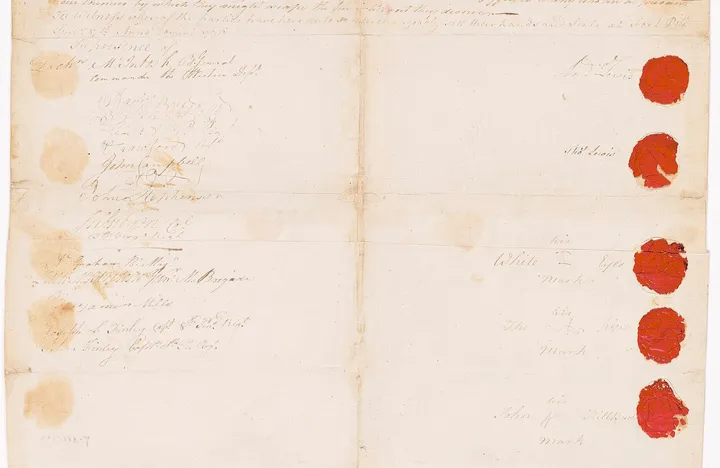
Federally recognized tribes deal with the United States on a government-to-government basis. They can form their own governments, make and enforce laws, levy taxes and decide who their citizens are. Not every tribe has a reservation. The Bureau of Indian Affairs counts about 326 land areas administered as reservations, among them pueblos, rancherias and villages.[3]
What the 2020 census counted
In 2020, 3.7 million people identified as American Indian and Alaska Native and named no other race, 1.1% of the population. Another 5.9 million combined it with another race. The most common combination, with White, was reported by 4 million people.[2]
The Census Bureau sorts the tribes and villages people wrote in into broad groups. American Indian groups came to 2.2 million people alone and 6.4 million alone or in any combination, Alaska Native groups to 133,311 and 241,797. The category also takes in the Indigenous peoples of Latin America. Aztec and Maya, listed as examples on the form for the first time, made up most of the 1.3 million people with a Latin American Indian group.[9]
Source: U.S. Census Bureau, 2020 Census Detailed DHC-A[9]
Oklahoma had the largest American Indian population, 14.2% of everyone who reported an American Indian group alone, followed by Arizona, California, New Mexico and Texas.[9]
Ancient genomes and the first Americans
Researchers broadly agree that people first reached the Americas by way of Beringia, the land bridge that joined northeast Asia and northwestern North America during the Pleistocene. In 2018 a team sequenced the genome of an infant from Upward Sun River in Alaska, dated to about 11,500 years ago. The child’s population, which the authors call Ancient Beringians, and the ancestors of all other Native Americans go back to a single founding population. It split from East Asians around 36,000 years ago, with gene flow continuing until about 25,000 years ago. The ancestors of the other Native Americans then divided into a northern and a southern branch between about 17,500 and 14,600 years ago, probably south of the North American ice sheets.[10]
A review of ancient genomes from 2021 finds that the first migrations from northeast Asia included distinct populations, some of them without any known descendants today. Apart from Arctic peoples who arrived later, every ancient individual studied in the Americas is more closely related to today’s Indigenous Americans than to any population elsewhere.[11]
Many Indigenous communities are wary of genetic research, and some have set their own rules for it. A 2018 paper names past research misconduct as one cause of this mistrust. One example is the Havasupai Tribe, which sued the Arizona Board of Regents over genetic research done with its members’ DNA samples without proper consent. The same paper notes that the Navajo Nation had kept a moratorium on genetic research for 16 years and was working on a policy of its own.[12]
Finding Native American ancestors
The Bureau of Indian Affairs keeps no database of tribal members and does no genealogical research for individuals. Each tribe holds its own enrollment records. To enroll, a person must know which tribe an ancestor belonged to and document a direct line of descent, usually with birth and death certificates. Aunts, uncles and cousins do not count. On genetic tests the bureau writes, “Blood tests and DNA tests will not help an individual document his or her descent from a specific Federally recognized tribe or tribal community.” A tribe may still accept a test as proof of a biological relationship to a member.[13]
From 1885 to 1940, reservation agents usually sent a yearly census of their people to the Commissioner of Indian Affairs. The Indian Census Rolls give English and often Indian names, age or date of birth, sex and relationship to the head of the family, and from 1930 also the degree of Indian blood. Only people formally affiliated with a tribe under federal supervision appear on them.[14]
For the Cherokee, Choctaw, Chickasaw, Creek and Seminole Nations in Indian Territory, the Final Dawes Rolls are among the most used records at the National Archives. The Dawes Commission accepted applications from 1898 to 1907 and a few in 1914. Its approved rolls list the people accepted as members, among them Freedmen, who had been enslaved by these nations, and their descendants.[15] The Cherokee Nation still bases citizenship on these rolls.[13]
More Americans claim a Cherokee ancestor than an ancestor from any other Native group.[16] In the 2020 census, more than 1.5 million people wrote in Cherokee, alone or in combination with other answers.[9] The Cherokee Nation, the largest of three federally recognized Cherokee tribes, had 466,181 citizens in 2024.[17][18] Part of the explanation for the many Cherokee claims, according to the historian Gregory D. Smithers, lies in 18th-century marriages between Cherokee women and British traders and in Cherokee migration across North America. He dates a wave of such claims to the South of the 1840s and 1850s, when many white families began to speak of a Cherokee great-grandmother, often called a princess. The tribe “never had a social system with anything resembling an inherited title like princess,” Smithers writes.[16]
Languages, writing and names
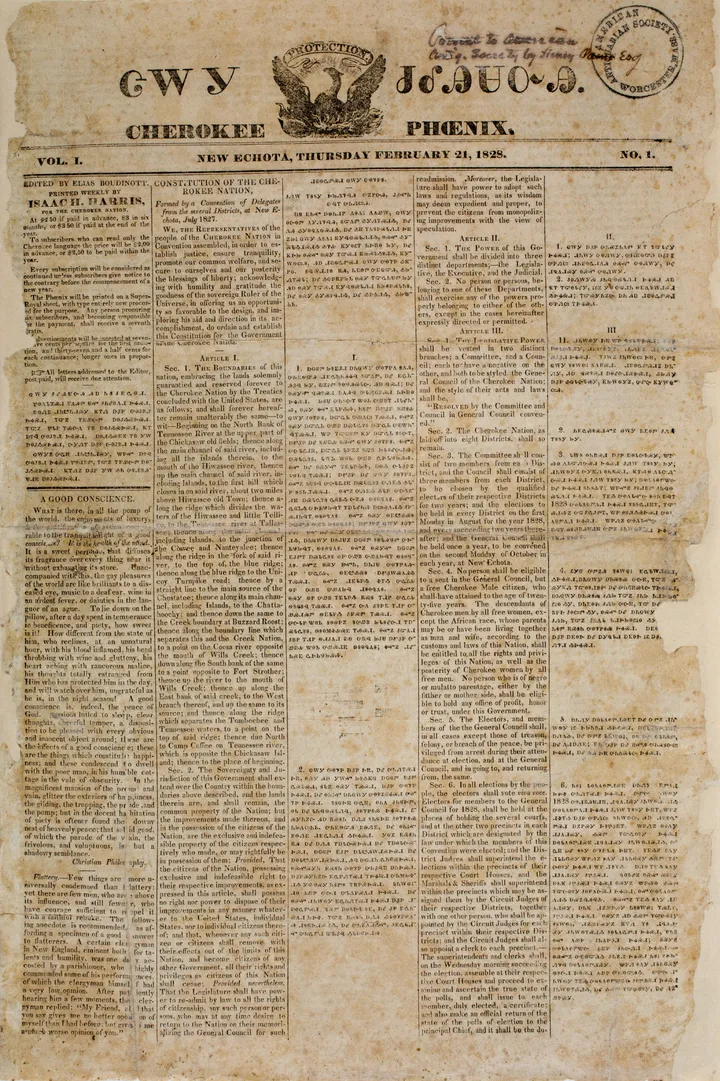
Sequoyah, a Cherokee, began working on a writing system for his language around 1809. By 1821 he had created 86 symbols, one for each syllable of spoken Cherokee.[19] On February 21, 1828, the first issue of the Cherokee Phoenix appeared in New Echota, then the capital of the Cherokee Nation in present-day Georgia. It was the first Native American newspaper in the United States, with columns in English and Cherokee.[20]
From 1819 to 1969, the federal government ran 408 Indian boarding schools in 37 states or then territories. According to an Interior Department report from 2022, the schools renamed children with English names and discouraged or prevented the use of their languages.[21] A directive of 1902 advised agents compiling the Indian census on translating Indian names into English and on giving the whole family one surname, which mattered for property and inheritance. After about 1904, Indian names rarely appear on the rolls.[14] In 1990 Congress made it federal policy to protect and promote the right of Native Americans to use and develop their languages.[22]
In 2020–2024, an estimated 145,600 people aged five and older spoke Navajo at home, and another 168,100 spoke a different Native language of North America.[23] Many nations are known by more than one name, because Europeans mispronounced tribal names or gave tribes European names.[4]
Tribal nations and federal law
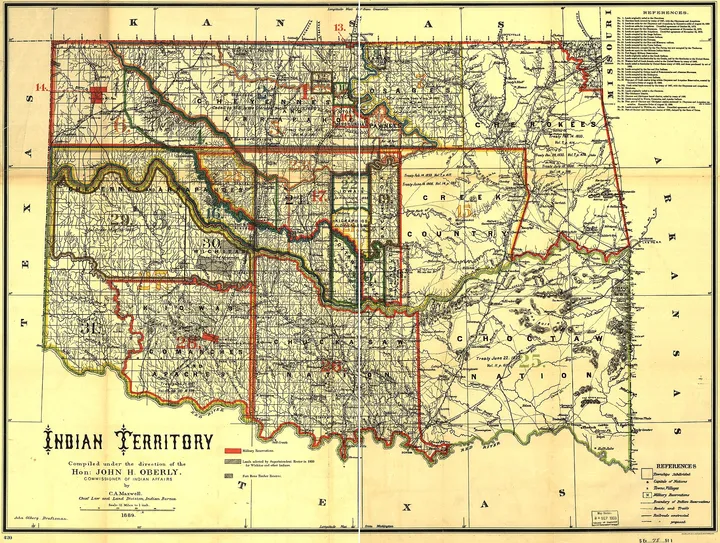
Between 1778 and 1871 the Senate ratified 370 treaties with tribes. At least 45 more were negotiated and never ratified.[3]
- 1830
President Andrew Jackson signs the Indian Removal Act of May 28. By the end of his presidency, almost 70 removal treaties have moved nearly 50,000 people from the East to Indian Territory, in what later became eastern Oklahoma.[24]
- 1838
U.S. troops and state militias force more than 16,000 Cherokee from their homelands in Tennessee, Alabama, North Carolina and Georgia. More than a thousand die on the way west. The removal, known as the Trail of Tears, ends in March 1839.[25]
- 1871
Congress ends treaty-making with tribes. From then on, acts of Congress, executive orders and agreements govern relations.[3]
- 1887
The Dawes Act of February 8 allows the President to break up reservation land into allotments for individual tribal members.[15] By 1934, Indian landholdings shrink from more than 136 million acres to less than 50 million.[26]
- 1924
On June 2, Congress declares all Indians born in the United States who are not yet citizens to be citizens. The law leaves their rights to tribal property untouched.[27]
- 1934
The Indian Reorganization Act of June 18 stops all further allotment and gives tribes the right to adopt their own constitutions.[28]
- 1975
The Indian Self-Determination and Education Assistance Act opens the way for tribal governments to run programs of the Bureau of Indian Affairs for their own members.[3]
- 2020
In McGirt v. Oklahoma, decided on July 9, the Supreme Court rules that the land promised to the Creek Nation in treaties of 1832 and 1833 is still a reservation under federal criminal law. “Because Congress has not said otherwise, we hold the government to its word.”[29]
- 2025
The National Defense Authorization Act for fiscal year 2026, enacted on December 18, recognizes the Lumbee Tribe of North Carolina. The federal list of tribes published in January 2026 counts 575.[1]
Sources
- Bureau of Indian Affairs: Indian Entities Recognized by and Eligible To Receive Services From the United States Bureau of Indian Affairs, Federal Register 91, 4102 (January 30, 2026)
- U.S. Census Bureau: Nicholas Jones et al., 2020 Census Illuminates Racial and Ethnic Composition of the Country (August 12, 2021)
- Bureau of Indian Affairs: Frequently Asked Questions
- National Museum of the American Indian, Smithsonian: The Impact of Words and Tips for Using Appropriate Terminology, Native Knowledge 360°
- Office of Management and Budget: Revisions to OMB’s Statistical Policy Directive No. 15, Standards for Maintaining, Collecting, and Presenting Federal Data on Race and Ethnicity, Federal Register (March 29, 2024)
- U.S. Department of the Interior: Tribal Enrollment
- National Archives: The Constitution of the United States, A Transcription
- Avalon Project, Yale Law School: Treaty With the Delawares (1778), from Charles J. Kappler, Indian Affairs, Laws and Treaties, vol. II (1904)
- U.S. Census Bureau: Ana I. Sánchez-Rivera, Paul Jacobs and Cody Spence, A Look at the Largest American Indian and Alaska Native Tribes and Villages in the Nation, Tribal Areas and States (October 3, 2023)
- J. Víctor Moreno-Mayar et al.: Terminal Pleistocene Alaskan genome reveals first founding population of Native Americans, Nature 553 (January 2018)
- Eske Willerslev and David J. Meltzer: Peopling of the Americas as inferred from ancient genomics, Nature 594 (June 2021)
- Katrina G. Claw et al.: A framework for enhancing ethical genomic research with Indigenous communities, Nature Communications 9 (July 2018)
- Bureau of Indian Affairs: Tracing American Indian and Alaska Native Ancestry
- National Archives: Indian Census Rolls, 1885–1940
- National Archives: Dawes Records of the Five Civilized Tribes
- Gregory D. Smithers: Why Do So Many Americans Think They Have Cherokee Blood?, Slate (October 1, 2015)
- Cherokee Nation: About the Nation
- Cherokee Nation GeoData Center: Cherokee Nation Citizens by State, 2024 (map, August 21, 2024)
- Encyclopaedia Britannica: Sequoyah
- Angela Pulley: Cherokee Phoenix, New Georgia Encyclopedia (last modified July 17, 2020)
- U.S. Department of the Interior: Department of the Interior Releases Investigative Report, Outlines Next Steps in Federal Indian Boarding School Initiative (May 11, 2022)
- Public Law 101-477, Title I, Native American Languages Act (October 30, 1990), 104 Stat. 1153, via GovInfo
- U.S. Census Bureau: American Community Survey 2020–2024, 5-year estimates, Table B16001, Language Spoken at Home by Ability to Speak English for the Population 5 Years and Over
- National Archives: President Andrew Jackson’s Message to Congress ‘On Indian Removal’ (1830)
- National Park Service, Trail of Tears National Historic Trail: History and Culture
- Bureau of Indian Affairs: Fiftieth Anniversary of Act That Changed Tribal History Is Marked (June 18, 1984)
- An Act To authorize the Secretary of the Interior to issue certificates of citizenship to Indians (June 2, 1924), 43 Stat. 253, via GovInfo
- An Act To conserve and develop Indian lands and resources (Indian Reorganization Act, June 18, 1934), 48 Stat. 984, via GovInfo
- Supreme Court of the United States: McGirt v. Oklahoma, No. 18–9526 (July 9, 2020)
More from The Americas
Puerto Rican 3African-American 2Canadian 2Mexican 2Chilean 1Grenadian 1Haitian 1Kittitian 1