Celebrities with African-American Roots
 Hailee SteinfeldGrandfather half African-American
 ZendayaFather’s family from Arkansas
No celebrity matches your search.
Who counts as African American
The federal standard for data on race, revised in 2024, places everyone with “origins in any of the Black racial groups of Africa, including, for example, African American, Jamaican, Haitian, Nigerian, Ethiopian, and Somali” in the category Black or African American.[6] In the 2020 census, more than half of all Black respondents wrote in African American as their specific origin. Jamaican and Haitian were the largest Caribbean groups, and Nigerian and Ethiopian the largest African ones.[2]
The number of Black immigrants more than doubled between 2000 and 2024, to 5.6 million. They make up 11.4% of all Black Americans, and their most common countries of birth are Jamaica, Haiti and Nigeria.[7]
On this site, African-American stands for Black families whose roots in the United States go back many generations, in most cases to people enslaved in the country. In 1860, 89% of the 4.4 million Black people counted by the census were enslaved.[8] Families with more recent roots in the Caribbean or in Africa are listed under their own heritage, such as Haitian.
From West and Central Africa to North America
Between 1525 and 1866, about 12.5 million Africans were shipped across the Atlantic, and 10.7 million survived the crossing. About 388,000 of them were taken directly to North America.[9] Within the Americas, slave traders moved nearly 500,000 people from one colony to another. Most of the documented voyages started in the Caribbean.[3]
Before 1650, most slave ships sailed from Senegambia and from West Central Africa, in today’s Democratic Republic of the Congo and Angola. West Central Africa remained the largest source, while more and more voyages started in the Bights of Benin and Biafra, on the coasts of present-day Benin, Nigeria, Cameroon and Gabon. The people brought to the United States came from every region of Atlantic Africa.[3]
Death rates among enslaved people in North America were generally lower than on the plantations of the Caribbean and South America, and their numbers grew through births.[10] As the College of Charleston’s Lowcountry Digital History Initiative puts it, “Ultimately, a large number of African Americans descended from the relatively small number of Africans sent to North America.”[10] The domestic slave trade moved about one million enslaved people across the southeastern states between 1790 and 1860.[3]
Source: U.S. Census Bureau, Working Paper No. 56[8]
What DNA studies show about African American ancestry
Among 5,269 customers of the testing company 23andMe who described themselves as African American, a 2015 study found on average 73.2% African, 24.0% European and 0.8% Native American ancestry. African ancestry was highest in the South, especially in South Carolina and Georgia. About 22% of the participants carried at least 1% Native American ancestry.[11]
A 2016 study of 3,726 African Americans, drawn from cohorts that represent all states and income levels, estimates that 82.1% of their ancestors lived in Africa before the transatlantic voyages began, 16.7% in Europe and 1.2% in the Americas. The authors note that the 23andMe sample was not designed to be representative.[12] Both studies date the mixing of African and European ancestry mainly to the time before the Civil War.[11][12]
A 2020 study compared the DNA of 50,281 people in the Americas, Africa and Europe with the records of slave voyages. Most participants from the United States carried ancestry from all four African populations the study could tell apart, and Nigerian ancestry was the most common. Its share exceeds what the ships from present-day Nigeria would predict, and the authors trace the difference to the trade in captives from the British Caribbean to other colonies. Senegambian ancestry is rarer than the voyage records would suggest. Many enslaved Senegambians worked on rice plantations, where malaria was widespread, and the authors suspect higher death rates among them.[3]
More than 60% of the people on the slave ships were men. For the United States, the same study estimates that about 1.5 African women passed on their DNA for every African man, and about three European men for every European woman. The authors link this pattern to the sexual exploitation of enslaved women by slave owners.[3]
Tracing African American family history
Until 1860, the federal census counted enslaved people without their names. The slave schedules of 1850 and 1860 list them under the name of the enslaver by age, sex and color, and census takers were told to write numbers in place of names. The mortality schedules of the same years, which record everyone who died in the year before the census, often include the names of enslaved people.[13] The 1870 census was the first to list all African Americans by name. According to the National Archives, it is “often the first official record of a surname for former slaves.”[13]
Congress created the Bureau of Refugees, Freedmen, and Abandoned Lands, known as the Freedmen’s Bureau, on March 3, 1865. It helped legalize marriages entered into during slavery and provided transport for freed people trying to reunite with their families. Its records are full of names, from marriage certificates and labor contracts to school and hospital records, and they can be viewed online at FamilySearch.[14]
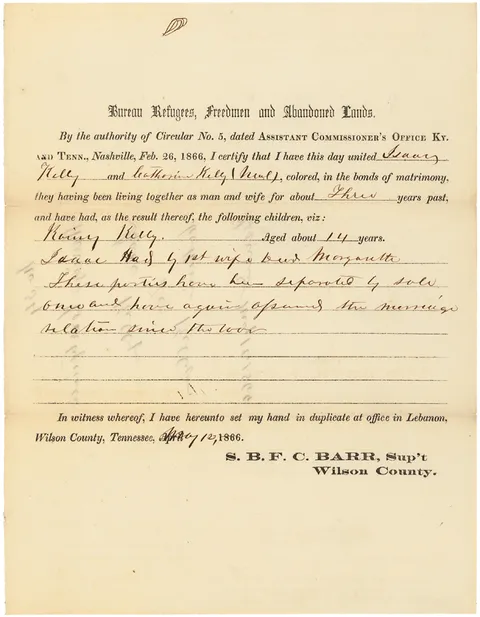
After emancipation, some freed people took the surname of a former enslaver, and some names were assigned by the first officials who wrote them down. Other families had used a surname for generations during slavery. For people without one, “choosing a surname after emancipation was a powerful way to exercise their new freedom”, writes Meaghan E. H. Siekman of the genealogical society American Ancestors. After the war, many freed people placed newspaper advertisements to find relatives who had been sold away.[15]
The Great Migration and the return to the South
In 1910, the largest Black populations lived in Georgia, Mississippi and Alabama.[16] The Census Bureau estimates that 6 million Black Americans left the South between 1910 and 1970. The first migrants went to industrial cities of the Northeast and Midwest such as Chicago, Detroit, New York and Philadelphia, where limits on immigration had left factories short of workers. During and after World War II, an even larger wave followed.[17] William Frey of the Brookings Institution puts the total at an estimated 5 million. By 1970, New York, Illinois and California had the largest Black populations.[16]
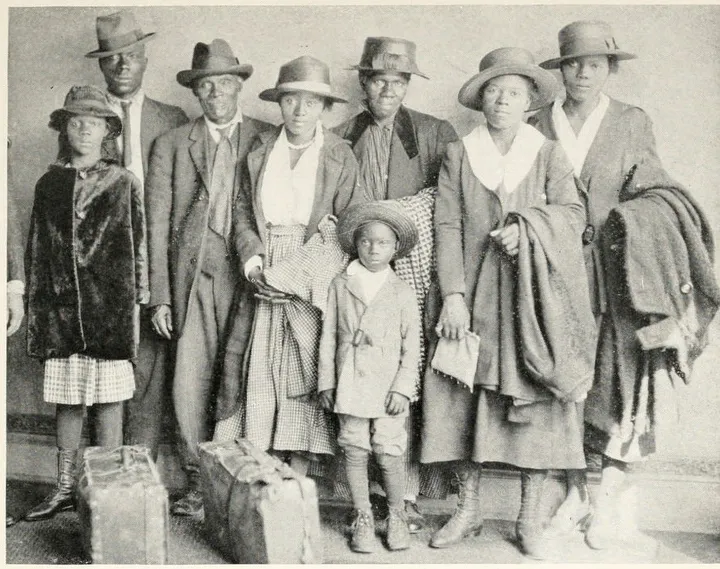
Genetic kinship between African Americans who live far apart follows the routes of the Great Migration from the South to the North and West.[12]
From the 1970s the movement reversed, slowly at first and faster from the 1990s. Frey sees younger, college-educated Black Americans as its main drivers.[16] The Black population grew the most in Texas, Florida and Georgia between 2010 and 2024 and declined in Illinois.[18]
Churches, colleges and the Gullah Geechee
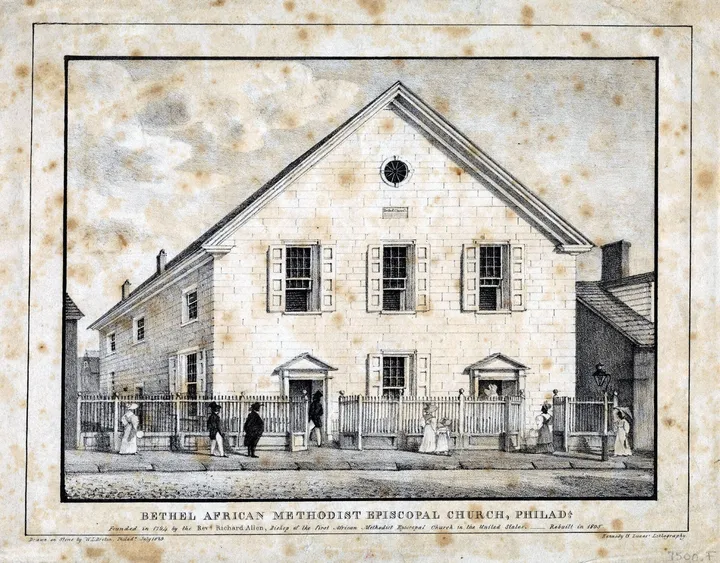
In Philadelphia, the preacher Richard Allen, who was born into slavery, dedicated Bethel Church in 1794. Black congregations in Baltimore, Washington, Wilmington, Philadelphia and Salem, New Jersey, joined together in 1816 as the African Methodist Episcopal (AME) Church and elected Allen its first bishop. Mother Bethel, as the church is known today, stands on the oldest parcel of land in the country continuously owned by Black Americans.[19]
Historically Black colleges and universities, or HBCUs, are institutions founded before 1964, in the era of legal segregation, with the principal mission of educating Black Americans. The country had 99 of them in 2022, spread over 19 states, the District of Columbia and the U.S. Virgin Islands.[20]
On the coast of the Carolinas, Georgia and Florida live the Gullah Geechee, descendants of West and Central Africans who were enslaved on rice, Sea Island cotton and indigo plantations. Life on isolated plantations and islands allowed them to keep many African traditions, and they created Gullah, a creole language “spoken nowhere else in the world”. The Gullah Geechee Cultural Heritage Corridor, designated by Congress in 2006, runs from Pender County, North Carolina, to St. Johns County, Florida.[21]
Key dates in African American history
The National Park Service counts 246 years of slavery in the United States, from the arrival of the first enslaved Africans in English Virginia in 1619 to abolition in 1865.[5]
- 1619
On August 25, the English privateer White Lion reaches Old Point Comfort in Virginia with Africans seized from a Spanish slave ship. They come from the kingdom of Ndongo in present-day Angola. The colonists trade food for 15 women and 17 men.[5]
- 1808
A law passed in 1807 takes effect on January 1 and bans bringing enslaved people into the United States from abroad.[22] Slavery and the slave trade within the country continue.[10]
- 1863
On January 1, President Abraham Lincoln’s Emancipation Proclamation declares that people held as slaves in the rebelling states “are, and henceforward shall be free”. It also opens the Union Army and Navy to Black men, and almost 200,000 fight for the Union by the end of the war.[23]
- 1865
On June 19, a day after Union troops reach Galveston, General Order No. 3 informs the people of Texas that “all slaves are free”. The day becomes known as Juneteenth.[24] The 13th Amendment, ratified on December 6, abolishes slavery throughout the United States.[4]
- 1870
The 15th Amendment, ratified on February 3, forbids denying the vote “on account of race, color, or previous condition of servitude”.[25]
- 1954
In Brown v. Board of Education, the Supreme Court rules that separating children in public schools by race is unconstitutional.[26]
- 1964–1965
The Civil Rights Act of 1964 outlaws segregation in public places and discrimination in employment.[27] The Voting Rights Act of 1965 bans literacy tests as a condition for voting.[28]
- 2021
June 19 becomes a federal holiday, Juneteenth National Independence Day, under a law approved on June 17.[29]
Sources
- U.S. Census Bureau: 2020 Census Illuminates Racial and Ethnic Composition of the Country (August 12, 2021)
- U.S. Census Bureau: Alli Coritz, Ricardo Henrique Lowe Jr. and Jessica E. Peña, Over Half of Those Who Reported Their Race as Black or African American Identified as African American, Jamaican or Haitian (October 17, 2023)
- Steven J. Micheletti et al.: Genetic Consequences of the Transatlantic Slave Trade in the Americas, American Journal of Human Genetics 107 (August 2020)
- National Archives: 13th Amendment to the U.S. Constitution, Abolition of Slavery (1865)
- National Park Service, Fort Monroe National Monument: Arrival of the First Africans in 1619
- Office of Management and Budget: Revisions to OMB’s Statistical Policy Directive No. 15, Standards for Maintaining, Collecting, and Presenting Federal Data on Race and Ethnicity, Federal Register (March 29, 2024)
- Pew Research Center: Gabriel Piña, Alexandra Cahn and Carolyne Im, Key findings about Black immigrants in the U.S. (March 20, 2026)
- U.S. Census Bureau: Campbell Gibson and Kay Jung, Historical Census Statistics on Population Totals by Race, 1790 to 1990, Working Paper No. 56 (September 2002)
- Henry Louis Gates Jr.: How Many Slaves Landed in the U.S.?, The African Americans: Many Rivers to Cross, PBS (2013)
- Lowcountry Digital History Initiative, College of Charleston: North American Context, in the exhibit African Passages, Lowcountry Adaptations
- Katarzyna Bryc et al.: The Genetic Ancestry of African Americans, Latinos, and European Americans across the United States, American Journal of Human Genetics 96 (January 2015)
- Soheil Baharian et al.: The Great Migration and African-American Genomic Diversity, PLOS Genetics 12 (May 2016)
- National Archives: African Americans and the Federal Census, 1790–1930, reference report (revised July 2012)
- National Archives: The Freedmen’s Bureau, records of the Bureau of Refugees, Freedmen, and Abandoned Lands (Record Group 105)
- Meaghan E. H. Siekman: Common Myths, 10 Million Names, American Ancestors
- William H. Frey: A ‘New Great Migration’ is bringing Black Americans back to the South, Brookings Institution (September 12, 2022)
- U.S. Census Bureau: The Great Migration, 1910 to 1970 (September 13, 2012)
- Pew Research Center: Mark Hugo Lopez and Joseph Copeland, Key facts about Black Americans (February 5, 2026)
- Ricardo Howell: Mother Bethel AME Church, Congregation and Community, Encyclopedia of Greater Philadelphia
- National Center for Education Statistics: Fast Facts, Historically Black Colleges and Universities
- National Park Service: Gullah Geechee Cultural Heritage Corridor
- An Act to prohibit the importation of Slaves (March 2, 1807), 2 Stat. 426, via GovInfo
- National Archives: Emancipation Proclamation (1863)
- Michael Davis, National Archives News: National Archives Safeguards Original ‘Juneteenth’ General Order (June 19, 2020)
- National Archives: 15th Amendment to the U.S. Constitution, Voting Rights (1870)
- National Archives: Brown v. Board of Education (1954)
- National Archives: Civil Rights Act (1964)
- National Archives: Voting Rights Act (1965)
- Public Law 117-17, Juneteenth National Independence Day Act (June 17, 2021), via GovInfo
More from The Americas
Puerto Rican 3Canadian 2Mexican 2Chilean 1Grenadian 1Haitian 1Kittitian 1Native American 1