Celebrities with Mexican Roots
 Jenna OrtegaGreat-grandmother came from Sinaloa
 Selena GomezGrandparents came to Texas in the 1970s
No celebrity matches your search.
Where Mexican ancestry comes from
The genomes of present-day Mexicans combine ancestry from the Indigenous peoples of the Americas with lines that trace mainly to Western Europe, West Africa and East Asia over the last 500 years.[6]
A study published in Science in 2014 analyzed DNA from more than 1,000 people in 20 Indigenous and 11 mestizo populations. It found deep differences between the Indigenous groups. “Some groups were as differentiated as Europeans are from East Asians,” the authors write. The Seri in the far north and the Lacandon in the far south differ the most.[7]
Most mestizo individuals in the study had a large share of Native and European ancestry and a small share of African ancestry, typically under 5%. The Indigenous part of their ancestry matches the region they come from. A northern Native component is strongest in Sonora and the neighboring states, and a Mayan component dominates on the Yucatán Peninsula. The authors conclude that present-day Mexicans still carry the genetic structure of the ancient Indigenous populations, despite the mixing that followed colonization.[7]
The Mexican Biobank, published in Nature in 2023, genotyped 6,057 people from 898 localities in all 32 states. Ancestry from the Americas is higher in the central and southern states than in the north. West African ancestry appears in every state, in line with the records of the transatlantic slave trade. Small shares of East Asian ancestry, up to 2.3% in Guerrero, probably go back to the Manila galleon trade of the 16th and 17th centuries and to later migration from China and Japan.[6]
Indigenous and Afro-Mexican peoples today
Based on the 2020 census, an estimated 23.2 million people aged three and older identify as Indigenous, 19.4% of that age group. About 7.4 million speak an Indigenous language, and 87.2% of them also speak Spanish. The share of speakers is highest in Oaxaca, Chiapas, Yucatán and Guerrero.[2]
A law from 2003 makes the Indigenous languages and Spanish national languages with the same validity.[1] Nahuatl was the language of the Aztecs. A large body of Nahuatl literature survives from the 16th century, written in an alphabet that Spanish priests introduced.[8] Today it is the predominant Indigenous language in 15 states.[2]
Source: INEGI[2]
Since a constitutional amendment in 2019, Mexico recognizes Afro-Mexican peoples and communities as part of the nation’s pluricultural makeup.[9] In the 2020 census, 2,576,213 people, 2.0% of the population, identified as Afro-Mexican or Afro-descendant. Of them, 7.4% speak an Indigenous language.[3]
Conquest and the colonial caste system
Tenochtitlan, the Aztec capital, was founded around 1325 on islands in Lake Texcoco, where Mexico City stands today. Its population in 1519 is estimated at about 400,000. Spanish conquistadors under Hernán Cortés destroyed the city in 1521.[10]
Epidemics followed the conquest. Researchers writing in the CDC journal Emerging Infectious Diseases estimate that smallpox killed 5 million to 8 million people in 1519 and 1520. An epidemic called cocoliztli, Nahuatl for “pest”, killed an estimated 5 million to 15 million people from 1545 to 1548, up to 80% of the native population.[11]
Spain ruled the colony, called New Spain, until 1821.[12] Indigenous people, Spaniards born in Spain or in the Americas, and Africans lived there. A large part of the population came to be of mixed descent. These mixtures were known collectively as castas. Ilona Katzew, curator of Latin American art at the Los Angeles County Museum of Art, describes casta painting as “a uniquely Mexican pictorial genre documenting the process of racial mixing among the colony’s inhabitants: Amerindians, Spaniards, and Africans.” The paintings were made largely for a European audience. Miguel Cabrera painted his set of 16 scenes in 1763.[13]
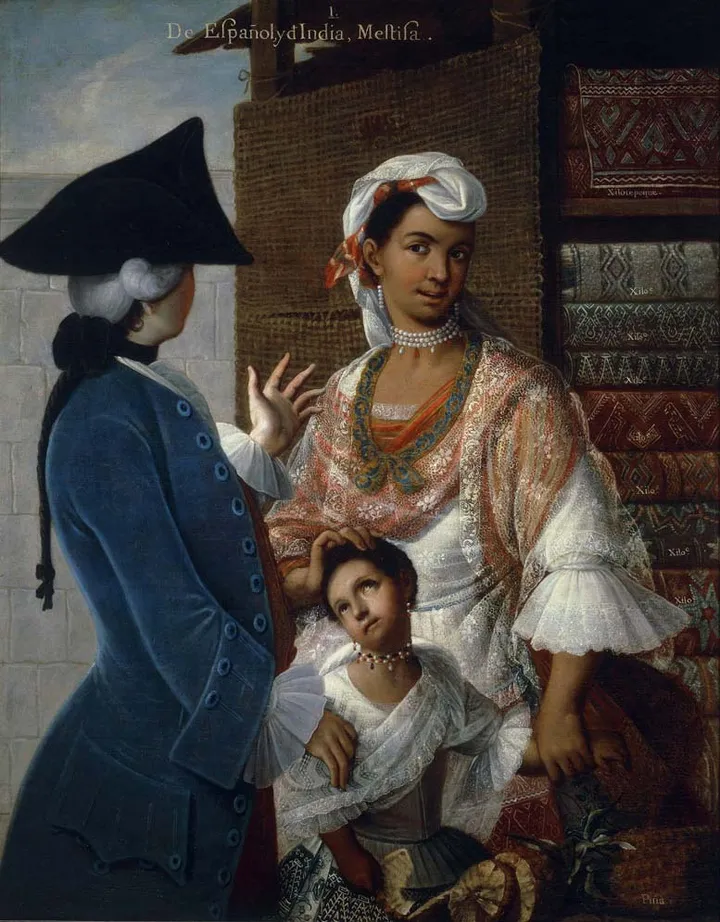
Mexico’s National Human Rights Commission describes the caste system as rigid. In its account, the system kept Indigenous people, enslaved people and Afro-Mexicans from rising in society, and criollos, Spaniards born in New Spain, could not reach high offices in the administration or the church.[12][13]
The eagle on the cactus and independence
The founding story of Tenochtitlan inspired Mexico’s coat of arms. According to the story, the god Huitzilopochtli told the Mexica that an eagle standing on a nopal cactus and devouring a snake would show them the place to found their empire.[14]
The Codex Mendoza was painted in 1542 by order of the viceroy Antonio de Mendoza and has been in the Bodleian Library at Oxford since 1659.[15] Its history of Tenochtitlan opens with the city’s founding by ten leaders guided by Tenoch. At the center stands an eagle perched on a prickly pear cactus, the sign of the promised land that Huitzilopochtli had foretold.[16]
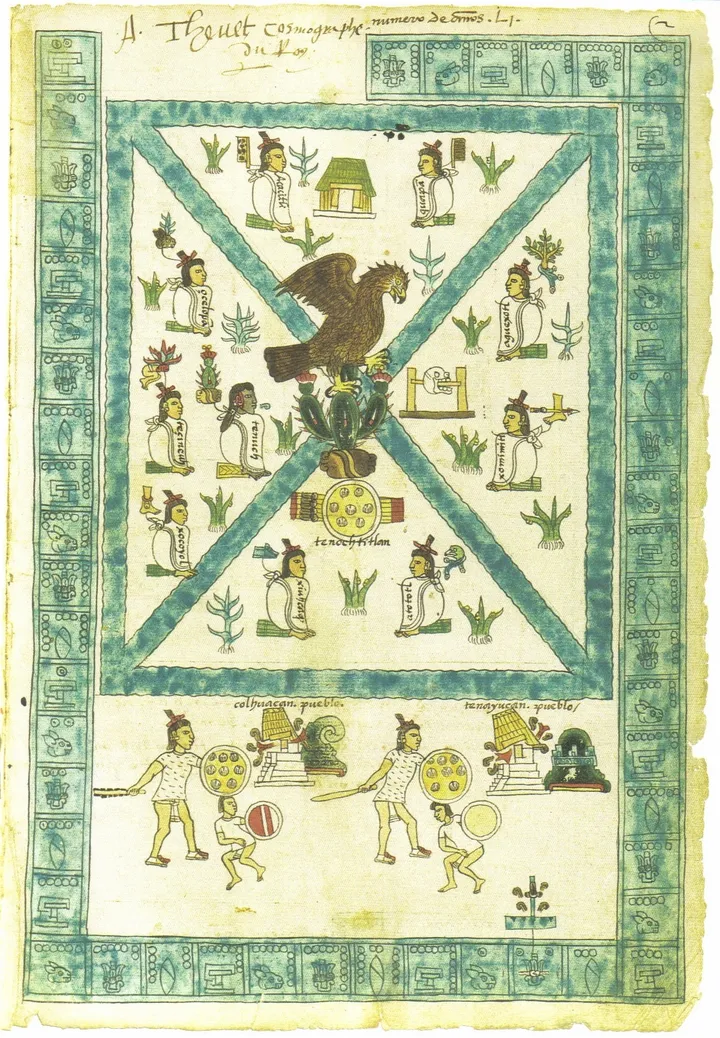
The eagle in the codex holds no snake.[16] The historian Guillermo Correa Lonche found that no pre-Hispanic or colonial document refers to the scene exactly as the story tells it. In his account, the German printer Henrico Martínez played a key part in establishing the image of the eagle devouring a snake. The title page of his book Reportorio de los tiempos from 1606 shows the elements that later formed the coat of arms.[14]
By law, the flag has three vertical stripes of green, white and red, with the coat of arms in the center. The eagle stands with its left talon on a flowering nopal that grows from a rock in a lake and holds a snake with its right talon and its beak.[17] The illustrator Francisco Eppens Helguera redesigned the coat of arms in 1968.[14]
The war of independence began early on September 16, 1810, when the priest Miguel Hidalgo rang the church bell in Dolores, Guanajuato, and gave the cry known as the Grito de Dolores.[12] Mexico celebrates its independence on that day.[18] The Army of the Three Guarantees entered Mexico City on September 27, 1821, and the Act of Independence was signed the next day.[12]
The treaty that moved the border
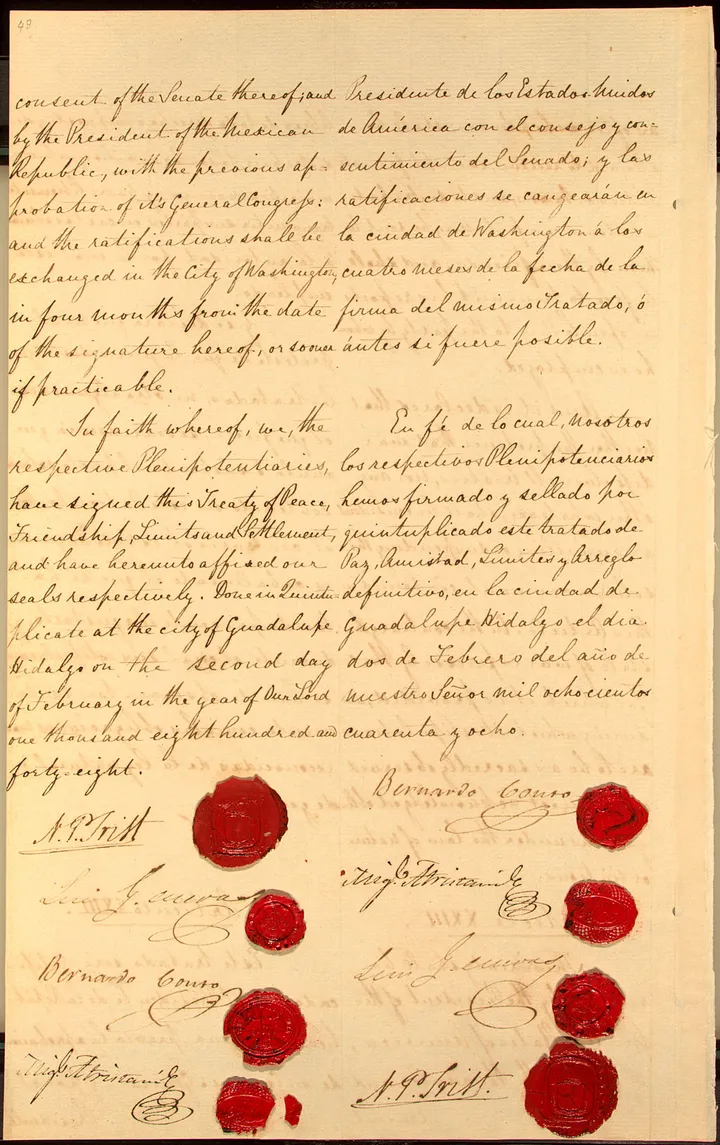
The Mexican-American War of 1846–1848 ended with the Treaty of Guadalupe Hidalgo, signed on February 2, 1848. Mexico ceded 55% of its territory, including present-day California, Nevada, Utah and New Mexico, most of Arizona and Colorado, and parts of Oklahoma, Kansas and Wyoming. It also gave up its claims to Texas.[19]
Article VIII of the treaty dealt with the Mexicans who lived there. They were free to stay or to move to Mexico, and they could keep or sell their property. Those who stayed could “either retain the title and rights of Mexican citizens or acquire those of citizens of the United States.” Anyone who stayed for a year without declaring to remain Mexican was considered to have chosen US citizenship.[19]
In US statistics, Mexican is a Hispanic origin. The Office of Management and Budget defines Hispanic or Latino as “a person of Cuban, Mexican, Puerto Rican, South or Central American, or other Spanish culture or origin regardless of race.” The Census Bureau adds that Hispanic people can be of any race.[20] In the 2020 census, 35.9 million people identified as Mexican, 58% of the Hispanic population.[4] Pew Research Center counts immigrants from Mexico and people who trace their family ancestry to Mexico as Hispanics of Mexican origin.[5]
Mexicans in the United States
Of all people of Mexican origin in the US, 34% live in California and 26% in Texas (2021).[5]
- 1848
The Treaty of Guadalupe Hidalgo ends the Mexican-American War and moves the border south.[19] An estimated 75,000 to 100,000 former Mexican citizens stay north of the new line and are offered US citizenship.[21]
- 1854
In the Gadsden Purchase, the United States pays Mexico $10 million for 29,670 square miles that later become part of Arizona and New Mexico.[22]
- 1910
The Mexican Revolution begins and intensifies migration within Mexico and across the border. The number of Mexican nationals living in the US rises from at least 220,000 in 1910 to 478,000 in 1920.[21]
- 1929
Authorities in California and across the country begin to push people of Mexican ancestry to leave for Mexico.[23] A study for the National Park Service estimates that during the Great Depression 350,000 to 500,000 Mexican immigrants and their children were pressured or forced to leave.[21] A California law of 2005 apologizes for the campaign and gives a total of two million people, about 1.2 million of them born in the United States.[23]
- 1942
On August 4, the US and Mexico agree on a program for Mexican farmworkers, known as the Bracero Program. By its end in 1964, 4.6 million contracts have been signed, many of them by workers who returned several times.[24]
- 1968
Hispanic Heritage Week is first observed. In 1988 it becomes a month, from September 15 to October 15, which includes Mexican Independence Day on September 16.[18]
- 2020
The census counts 35.9 million people of Mexican origin. They are the largest Hispanic group in 40 states, and 12.2 million of them live in California.[4]
Sources
- Ley General de Derechos Lingüísticos de los Pueblos Indígenas, Article 4 (March 13, 2003, text as amended October 18, 2023), via Instituto Federal de Telecomunicaciones
- INEGI: Estadísticas a propósito del Día Internacional de los Pueblos Indígenas, press release 430/22 (August 8, 2022)
- INEGI: En México somos 126 014 024 habitantes, Censo de Población y Vivienda 2020, press release 24/21 (January 25, 2021)
- U.S. Census Bureau: Colombian and Honduran Populations Surpassed a Million for First Time; Venezuelan Population Grew the Fastest of all Hispanic Groups Since 2010 (September 2023)
- Pew Research Center: Mexicans in the U.S., Data on Latinos (August 16, 2023, updated May 2026)
- Mashaal Sohail et al.: Mexican Biobank advances population and medical genomics of diverse ancestries, Nature (October 2023)
- Andrés Moreno-Estrada et al.: The genetics of Mexico recapitulates Native American substructure and affects biomedical traits, Science (June 2014)
- Encyclopaedia Britannica: Nahuatl language
- Diario Oficial de la Federación: Decree adding section C to Article 2 of the Constitution, recognizing Afro-Mexican peoples and communities (August 9, 2019)
- Encyclopaedia Britannica: Tenochtitlan
- Rodolfo Acuna-Soto, David W. Stahle et al.: Megadrought and Megadeath in 16th Century Mexico, Emerging Infectious Diseases 8, no. 4 (April 2002)
- Comisión Nacional de los Derechos Humanos: Inicio de la Independencia de México, 16 de septiembre de 1810 (September 2024)
- Ilona Katzew, LACMA Unframed: Why an Albino? Some Notes On Our New Casta Painting by Miguel Cabrera (April 22, 2015)
- INAH: Rastrean en fuentes históricas el origen del símbolo fundacional de Tenochtitlan, bulletin 339 (June 14, 2024)
- INAH: Codex Mendoza digital edition, About
- Baltazar Brito and Gerardo Gutiérrez, INAH: Codex Mendoza, Part 1, Foundation of Mexico-Tenochtitlan and the History of the Conquests of the Mexica Huey Tlatotoque
- Ley sobre el Escudo, la Bandera y el Himno Nacionales, Articles 2 and 3 (February 8, 1984), Orden Jurídico Nacional
- Library of Congress and partners: About National Hispanic Heritage Month
- National Archives: Treaty of Guadalupe Hidalgo (1848)
- U.S. Census Bureau: About the Hispanic Population and its Origin
- David G. Gutiérrez, National Park Service: American Latino Theme Study, Immigration
- Office of the Historian, U.S. Department of State: Gadsden Purchase, 1853–1854
- California Legislature: SB 670, Apology Act for the 1930s Mexican Repatriation Program (Chapter 663, October 7, 2005)
- Bracero History Archive (Smithsonian National Museum of American History and partners): About
More from The Americas
Puerto Rican 3African-American 2Canadian 2Chilean 1Grenadian 1Haitian 1Kittitian 1Native American 1