Celebrities with Grenadian Roots
 Lewis HamiltonGrandfather emigrated from Grenada
Three islands and their first settlers
Grenada lies at the southern end of the Lesser Antilles, about 100 miles (160 km) north of the coast of Venezuela.[1] The state also includes Carriacou and Petite Martinique, two smaller islands in the Grenadines.[2] Of the 106,669 people counted in the 2011 census, 5,661 lived on these two islands.[5]
The oldest traces of people are cut lambie shells, a kind of conch, found near today’s international airport and dated to between 1700 and 1400 BC. Storms have shifted them from where they lay, so this early evidence remains uncertain. Permanent villages appeared around AD 300, and most of the 87 Amerindian sites known on the island were settled after AD 750, according to the archaeologist Jonathan Hanna. Records from the early French period name two Amerindian groups, the Caraibe and the Galibis. The Caraibe lived at some of the earliest village sites, and Hanna concludes that they descended from the island’s first settlers. He sees “Carib” as a European label for “a highly heterogeneous mix of peoples”.[6]
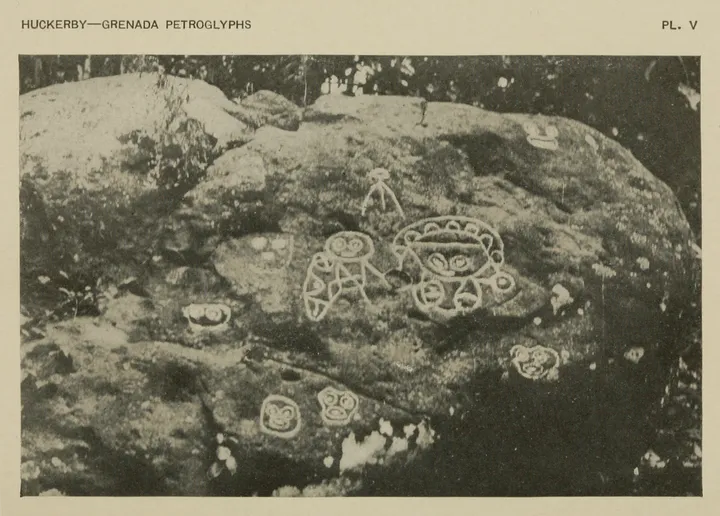
Rock carvings survive at several sites. They are also known as Carib stones, although the people who carved them were not necessarily the Island Caribs of colonial times.[7]
Christopher Columbus sailed past the island on August 15, 1498, without landing, and named it Concepción.[1] By 1523 Spanish maps called it Granada, a name that became La Grenade under the French and Grenada under the British.[8] British merchants tried to found a settlement in 1609, and the Island Caribs forced them to leave.[1]
Between France and Britain
French settlers arrived in March 1649, and within months they were at war with the Island Caribs over the island.[7] Jacques-Dyel du Parquet, the governor of Martinique, bought Grenada from a French company in 1650.[1] An anonymous French history of those years describes an attack on Island Caribs gathered in the far north on the night of May 30, 1650. About 40 of them leapt from a cliff into the sea.[7] The cliff became known as le Morne des Sauteurs, today Leapers’ Hill,[8] and a town in the north still bears the name Sauteurs.[9] The Island Caribs survived on the edges of plantation society into the mid-1700s.[7]
Britain captured Grenada in 1762.[1] The French king ceded “the islands of Grenada, and the Grenadines” to Britain in the peace signed at Paris in 1763. The treaty gave their inhabitants the terms granted to Canada, where Catholics could worship “as far as the laws of Great Britain permit”.[10]
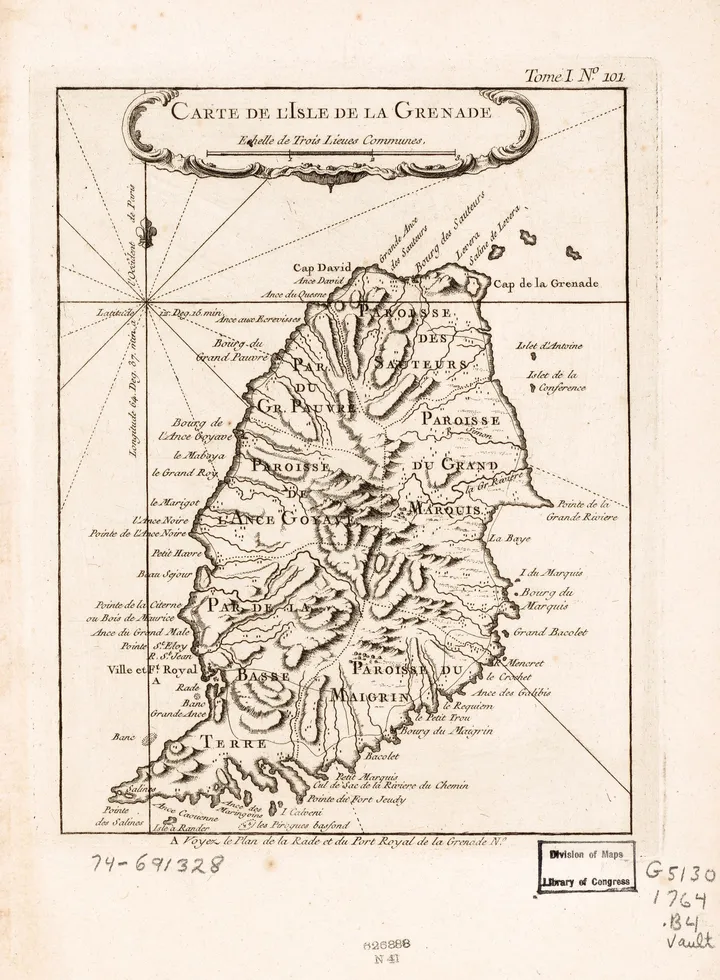
French forces took the island back in 1779, and the Treaty of Versailles returned it to Britain in 1783.[8] In 1795 Grenada still had a large French-speaking population with restricted political, religious and civil rights, above all for people of mixed race. About 30,000 people lived in slavery.[11] On the night of March 2, 1795, the planter Julien Fédon, a man of mixed race, led an uprising backed by the French Republic.[8][11] He promised to free the enslaved, and some 7,000 joined his forces. British reinforcements arrived in March 1796 and took the rebels’ stronghold by early July. Fédon was never caught and either escaped or died in the attempt. A special court sentenced at least 77 men to death, and almost all of those executed were of mixed race. Around 400 more were transported or banished.[11]
Patois and the Catholic Church
In the 2011 census, the Roman Catholic Church was the largest denomination, with 37,941 members. Pentecostals followed with 18,139 and Seventh-day Adventists with 13,898.[5] A Library of Congress country study of 1987 called the strength of the Catholic Church “a lingering effect of periodic French domination”.[12]
Grenada has two Creole languages, one based on French and one on English. The French Creole, which Grenadians call Patois, goes back to the early French colony. In a survey in 1999, the eight speakers interviewed in depth in northern Grenada were between 67 and 77 years old. None of them knew of anyone under 60 who still spoke the language, and all eight had learned it from their grandparents. Some named River Sallee, a small town east of Sauteurs, as the place with the most speakers. On Carriacou, too, no children were learning it.[9]
Africa, India and the Big Drum of Carriacou
The British imported large numbers of enslaved Africans for the sugar plantations in the late 18th century.[1] Slavery in the British colonies was abolished in 1834, although apprenticeship schemes prolonged it for many until 1838.[13] Indentured laborers from India were then brought in to replace the freed workers.[1] The first ship, the Maidstone, reached Grenada with 287 of them on May 1, 1857.[2]
Source: Central Statistical Office of Grenada[5]
Between the censuses of 2001 and 2011, the mixed group grew by 68% and the number of people of African descent fell by 5.7%.[5]
On Carriacou, families kept track of the African nation of their forebears, traced through the father’s line. “Even today, Carriacouans will tell you of what African nations they are,” Andrew Pearse wrote in the notes to a recording published in 1956. Families held a Big Drum Dance for their ancestors on the eve of a wedding, at a Stone Feast when a tombstone was raised, or when a schooner was launched. The night followed a set order of nation dances, among them Cromanti, Ibo, Manding and Congo. In the Beg Pardon dance the family kneels and sings in Patois, “Si mwe merite, pini mwe, si mwe ba merite, padone mwe”, which Pearse translates as “if I deserve it punish me, if I don’t deserve it, pardon me”.[14]
A nutmeg on the flag
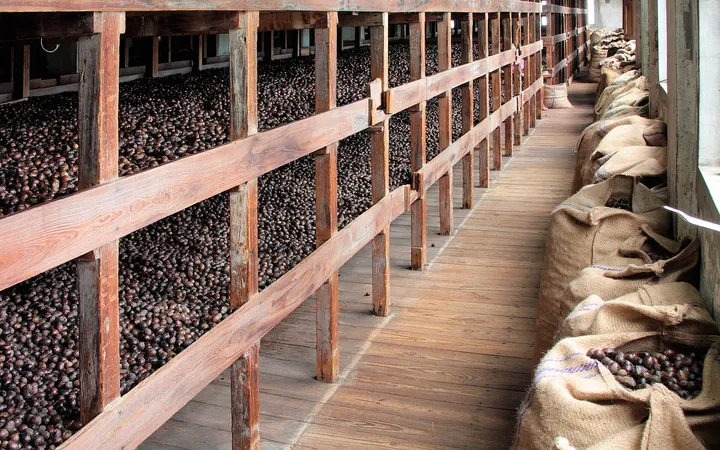
Grenada’s byname is the Isle of Spice.[1] Nutmeg is native to the Moluccas, and the first trees on Grenada are said to have grown from seeds brought from the Banda Islands in 1843. By 1865 Grenadian nutmeg had become a factor on the world market. Hurricane Janet destroyed about 80% of the trees in 1955. A study published by the FAO in 1995 describes Grenada as by far the largest producer of nutmeg and mace in the West Indies, surpassed worldwide only by Indonesia.[15]
In 1967 Grenada became an associated state of Britain, self-governing in its internal affairs. Its flag at that time showed a nutmeg in the center. The nutmeg stayed on the new flag hoisted at midnight between February 6 and 7, 1974, when Grenada became independent. The flag’s seven yellow stars stand for Grenada’s original administrative divisions.[16] Grenada was the first of the six West Indies Associated States to gain independence.[1]
Grenadian roots in the archives
From 1817 to 1834 the British kept registers of enslaved people for every parish of Grenada and for Carriacou.[17] Duplicates survive in series T 71 of the UK National Archives. The first registration of a colony lists every enslaved person, and later returns usually record only changes such as births, deaths and sales. Many entries note where a person was born.[13] The registers give name, age, gender, parish and owner, and they can be searched free of charge on Ancestry. The Legacies of British Slave-ownership website can serve as an index to the compensation returns of slave owners in the same series.[18]
Older records survive in Grenada itself. A project of the British Library’s Endangered Archives Programme, funded in 2009, digitized parts of the 18th-century French deeds at the Supreme Court Registry, which help trace migrants from Africa, Europe and elsewhere in the Caribbean. It also copied the registers of births, deaths and marriages for St. George’s. Hurricane Ivan in 2004 had caused significant losses among the papers kept at Government House.[19]
For the years 1866 to 1940, FamilySearch has indexed 239,229 birth, marriage and death records kept by Grenada’s civil registration offices.[20]
Grenada’s emigrants and returnees
Brooklyn is home to 14,696 of the 31,817 Grenada-born residents of the United States (2020–2024 estimates).[4]
- 1890
Around 1890 the labor market contracts. Grenada had drawn in workers for much of the 19th century, and soon more people leave than arrive. Most emigrants go to other Caribbean islands, Britain, the United States and Canada.[12]
- 1904–1910
Walter Clement Noel, aged 20, leaves Grenada to study dentistry in Chicago.[7] Tests of his blood lead the physician James B. Herrick to publish the first description of sickle cell anemia in Western medical literature in 1910. Noel later returns to practice dentistry in Grenada.[21]
- 1970–1991
From 1970 to 1991 the census population drops from 92,775 to 85,123. The statistics office attributes the decline to emigration during the political disturbances of those years.[5]
- 1979
On March 13 the New Jewel Movement takes power in a bloodless coup and forms the People’s Revolutionary Government under Maurice Bishop.[1]
- 1983
Bishop is killed in a military coup in October. On October 25 a US-led force lands, and power passes back to the governor-general.[1] President Ronald Reagan cites the safety of about 1,000 American citizens on the island, 800 of them medical students, and a request from eastern Caribbean states.[22] On November 2 the UN General Assembly deplores the intervention as “a flagrant violation of international law”.[23]
- 2001–2011
The census of 2001 finds 21% more people than in 1991, which the statistics office puts down to Grenadians coming home from abroad. Another 13,119 return over the following ten years.[5]
- 2020
In the US census, 25,910 people identify as Grenadian alone or in combination with another origin, 14,922 of them in New York State.[24]
- 2021
England and Wales have 8,490 residents born in Grenada, according to the census, and 5,785 of them live in London.[25]
Sources
- Encyclopaedia Britannica: Eric V. B. Britter, Grenada (updated November 4, 2026)
- Ministry of External Affairs, Government of India: India–Grenada Relations, bilateral brief (January 2020)
- World Bank Open Data: Population, total, Grenada (updated October 8, 2026)
- U.S. Census Bureau: American Community Survey 2020–2024, 5-year estimates, Table B05006, Place of Birth for the Foreign-Born Population, United States and Kings County, New York
- Central Statistical Office of Grenada: Grenada National Population and Housing Census Report 2011, revised edition
- Jonathan Hanna: Camáhogne’s Chronology, How long have people lived in Grenada?, summary of his paper in the Journal of Anthropological Archaeology, NOW Grenada (July 9, 2019)
- Grenada National Museum: Shawn McGinniss, Jonathan Hanna, Stephanie Morano and John Angus Martin, Teacher Kit 1, Amerindian Heritage, with field trip guides (2013)
- Library of Congress, Federal Research Division: Caribbean Islands, A Country Study, Grenada (1987)
- Jo-Anne S. Ferreira and David J. Holbrook: Are They Dying? The Case of Some French-lexifier Creoles, La Torre 7 (2002), via UWISpace
- Avalon Project, Yale Law School: The definitive Treaty of Peace and Friendship between Great Britain, France and Spain, Paris (February 10, 1763), Articles IV and IX
- The National Archives (UK): Chris Day, ‘Excessive severity’, Treason and the Grenadian Rebellion of 1795 (March 2, 2023)
- Library of Congress, Federal Research Division: Caribbean Islands, A Country Study, Grenada, Population (1987)
- The National Archives (UK): British transatlantic slave trade records, research guide
- Smithsonian Folkways: Andrew C. Pearse, The Big Drum Dance of Carriacou, liner notes, Ethnic Folkways Library P 1011 (1956)
- Food and Agriculture Organization: Guido B. Marcelle, Production, handling and processing of nutmeg and mace and their culinary uses, Section I (1995)
- Whitney Smith: Flag of Grenada, Encyclopaedia Britannica
- The National Archives (UK), Discovery: T 71/264–334, Slave Registers, Grenada, 1817–1834
- The National Archives (UK): Enslaved people and slave owners, research guide
- British Library, Endangered Archives Programme: Digitising the endangered archives of Grenada (EAP295, awarded 2009)
- FamilySearch: Grenada, Civil Registration, 1866–1940
- Todd L. Savitt and Morton F. Goldberg: Herrick’s 1910 case report of sickle cell anemia, The rest of the story, JAMA 261 (January 13, 1989), abstract via PubMed
- Ronald Reagan Presidential Library: Address to the Nation on Events in Lebanon and Grenada (October 27, 1983)
- United Nations General Assembly: Resolution 38/7, The situation in Grenada (November 2, 1983)
- U.S. Census Bureau: 2020 Census, Detailed Demographic and Housing Characteristics File A, Table T01001, Grenadian alone or in any combination, United States and New York
- Office for National Statistics: Census 2021, usual residents by country of birth (extended, 190 categories), regions of England and Wales, via the ONS API
More from The Americas
Puerto Rican 3African-American 2Canadian 2Mexican 2Chilean 1Haitian 1Kittitian 1Native American 1