Celebrities with Chilean Roots
 Pedro PascalBorn in Santiago to Chilean parents
Native American and European lines in Chilean DNA
A 2015 study in Nature Communications analyzed the genomes of 313 Chileans from every region of the country. On average, their ancestry was 55% European, 42% Native American and 2.4% African. Individuals differed widely, with Native American ancestry ranging from almost none to 91%. The authors date the mixing to about ten generations ago. The Y chromosome, which passes from father to son, turned out mostly European, while the X chromosome showed mainly Native American ancestry. In the authors’ words, “Sex-chromosome analyses confirm imbalanced contribution of European men and Native-American women.”[5]
African ancestry falls from 3.9% in the far north to 1.3% in the far south. The study links this to the colonial slave trade, which brought many enslaved Africans to Peru and the north of Chile and few to the center and south.[5]
The ChileGenomico project published its results in 2020. It estimated the ancestry of 2,843 Chileans from eight cities spread over 2,600 kilometers and split the Native American share into a component linked to the Aymara of the north and one linked to the Mapuche of the south. The average came to 53% European, 25% Mapuche, 18% Aymara and 4% African. Mapuche ancestry averaged 40% in the south and Aymara ancestry 36% in the north. Native American ancestry was lowest in the center of the country, between Valparaíso and the Biobío region.[6]
Mapuche, Aymara and the other Indigenous peoples
In the 2024 census, 2,105,863 people said they belonged to an Indigenous people. In Arica and Parinacota in the far north and in La Araucanía in the south, they make up more than a third of the population.[2]
Source: INE, 2024 census[2]
A law of 1993 names the peoples the state recognizes. Since 2023 there have been eleven, from the Atacameño and Colla of the north to the Kawésqar and Yagán of the southern channels. By law, the state values their existence as “parte esencial de las raíces de la nación chilena”, an essential part of the roots of the Chilean nation.[7]
The Mapuche, historically known as Araucanians, live mainly south of the Biobío River. They resisted Spanish and later Chilean rule for some 350 years. After independence, the Chilean government settled them on reservations.[8] In the census, 381,762 people aged five and older said they spoke or understood the Mapuche language, Mapuzugun.[2]
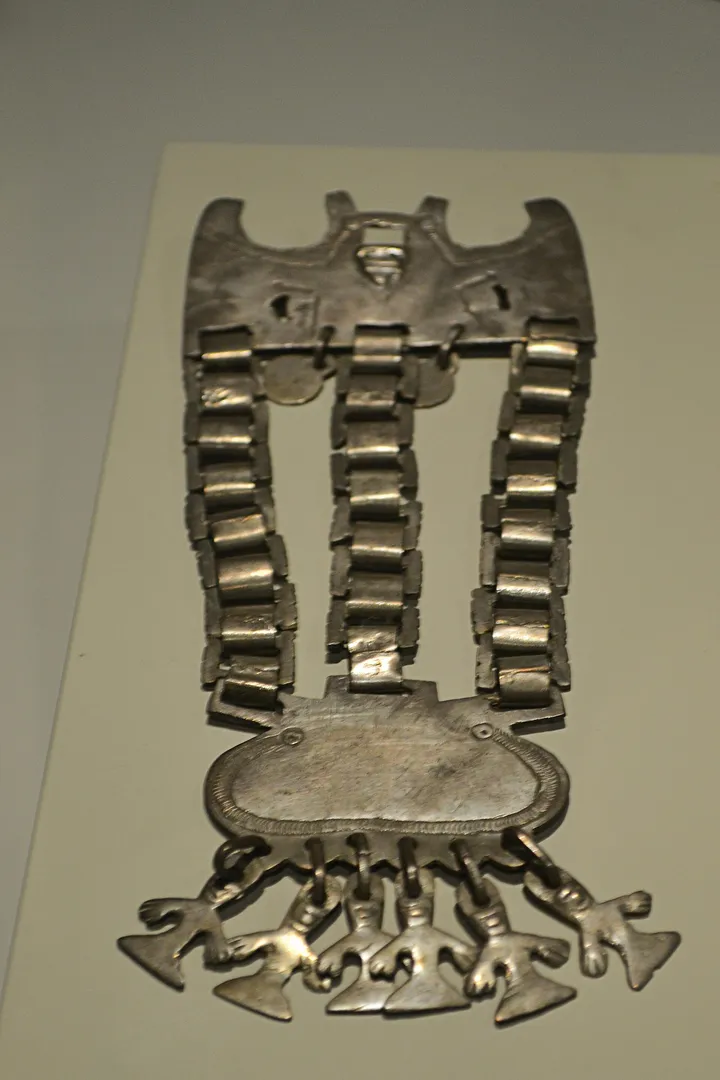
Silverwork gained importance among the Mapuche in the late 18th century. Smiths hammered and melted silver coins from the frontier trade into jewelry for women and gear for the horses of the chiefs. The craft peaked in the 19th century and declined with the occupation of the Araucanía.[9]
From Valdivia’s Santiago to independence
The conquistador Pedro de Valdivia founded Santiago on February 12, 1541, in the valley of the Mapocho River.[10] The Picunche who lived there were placed under the rule of the Spanish settlers.[1] Around 1600, the colony had no more than 5,000 Spanish settlers. It was poor, and enslaved Africans never numbered more than a few thousand.[11]
The first step toward independence came on September 18, 1810, when an open town meeting in Santiago elected a junta of local leaders. In 1817 an army under José de San Martín, with Bernardo O’Higgins among its commanders, crossed the Andes and defeated the royalists at Chacabuco on February 12.[12]
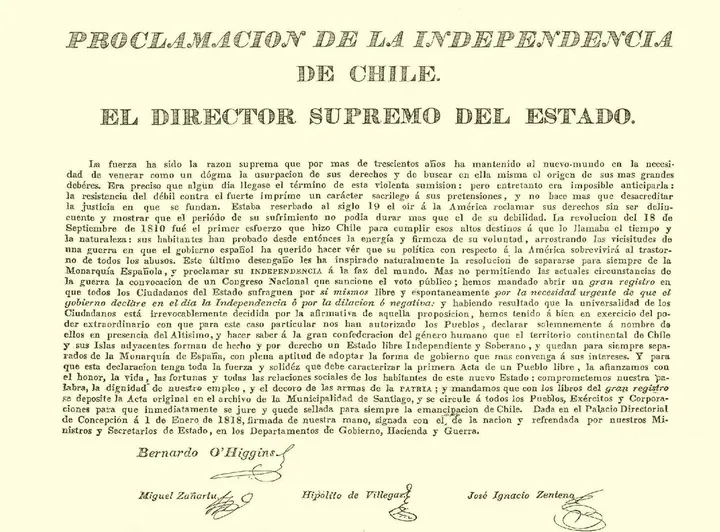
The lawyer Miguel Zañartu drafted the act of independence, which O’Higgins and his ministers signed on January 1, 1818. It was proclaimed on February 12, the first anniversary of Chacabuco.[13][12] The act declares that the continental territory of Chile and its adjacent islands “forman de hecho y por derecho un Estado libre Independiente y Soberano”, a free, independent and sovereign state in fact and by right.[14] Spain’s decisive defeat on the mainland followed at Maipú on April 5, 1818.[12]
Basques, Germans and Croats
In the 18th century, Basques formed an important part of the immigration from Spain and went mostly into trade. Landowning Creole families formed marriage ties with the newcomers, and the Castilian-Basque elite that emerged led the country after independence.[15] Their surnames and family records have a section of their own on the Basque page.
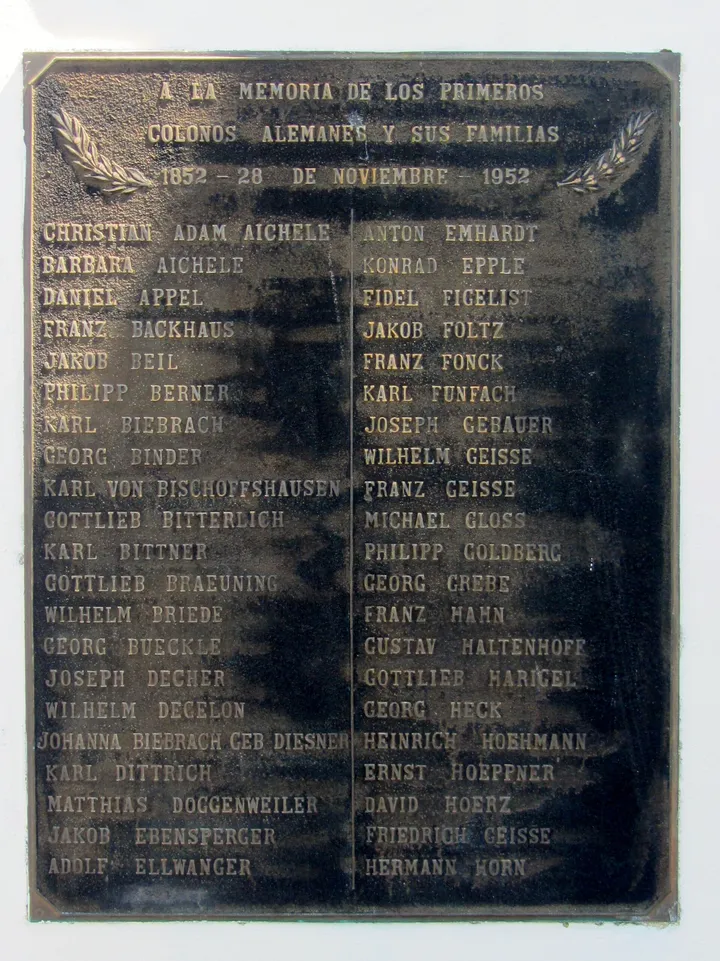
A colonization law of 1845 started the settlement of southern Chile by European immigrants. The first nine German families arrived in 1846 and settled on the Bueno River. About 700 more followed between 1852 and 1860 under the state colonization agent Vicente Pérez Rosales. In 1853 Llanquihue was declared a colonization territory, and Puerto Montt and Puerto Varas were founded in the course of the settlement. Most colonists received land, building materials, a cow, a horse, tools and seeds. Acquiring land caused disputes, partly because Indigenous communities refused to leave theirs.[16]
About 3,000 Croats settled in the far north and in Magallanes, with the largest wave between 1890 and 1914. Like other Croat emigrants, they were identified by the state they came from, as Austrians until 1915 and as Yugoslavs from then until 1990.[17]
Two surnames and the Civil Registry since 1885
By law, both parents pass on their first surname to their children. Under laws passed in 2021, parents agree on the order when they register their first child together. If they cannot agree, the order is drawn by lot before the registry officer.[18] Adults may change the order of their surnames once.[19] Patronymic surnames such as Fernández and Martínez appear on the Spanish page.
In 2009 the Civil Registry counted 355,506 people with the surname González, 270,146 with Muñoz and 203,146 with Rojas. The ten most common surnames, all of Spanish origin, covered 2.8 million Chileans.[20]
The Civil Registry has recorded births, marriages and deaths since January 1, 1885. Before that, the Catholic Church registered baptisms, marriages and deaths.[21]
A person born abroad to a Chilean father or mother is Chilean under the constitution, as long as a parent or grandparent became Chilean by birth in Chile, by naturalization or by a special law. This rule dates from a constitutional reform of 2005.[22]
Chileans in the California gold rush
Once the news of the gold discovery reached Valparaíso, ships sailing around Cape Horn to San Francisco called there for water, provisions and passengers. Chileans of all ages and classes set out for California, and they became known as “los argonautas del 49”, the argonauts of ’49.[23]
In San Francisco most of them settled near Telegraph Hill, in a district of about eight blocks now crossed by Columbus Avenue. It was called Chilecito, Chiletown or Little Chile. Others spread to some 50 settlements in counties such as Calaveras, Sonoma and Sacramento.[23]
For lack of records, the number of Chileans who made the journey is unknown. One estimate puts their number in California in 1850 at about 5,000. Most of the men worked as miners, day laborers or farmers.[23]
Chileans in the United States
Estimates for 2020–2024 from the American Community Survey put the number of residents of Chilean origin at about 33,400 in Florida, 32,400 in California and 23,500 in New York.[4]
- 1823
On January 27, the Senate confirms Heman Allen of Vermont as minister to Chile. With this step the United States recognizes the Republic of Chile.[24]
- 1848–1849
Chileans work a five-mile gulch near Mokelumne Hill, the richest placer mining area in Calaveras County. It takes its name, Chili Gulch, from them.[25]
- 1861–1865
Some Chileans enlist in California battalions that join the Union forces in the Civil War.[23]
- 1973
On September 11, the armed forces stage a coup. President Salvador Allende dies during the assault on the presidential palace, and a junta led by General Augusto Pinochet takes power.[26]
- 1980–1989
In this decade, 19,749 people who last lived in Chile become permanent residents, compared with 15,032 in the 1970s and 4,669 in the 1950s.[27]
- 1989–1990
The military government allows political exiles to return. Patricio Aylwin, elected in December 1989, takes office as president in March 1990.[26]
- 2004
The United States–Chile Free Trade Agreement enters into force on January 1.[28]
- 2014
Chile joins the Visa Waiver Program. From May 1, eligible Chilean passport holders can visit the United States without a visitor visa.[29]
- 2024
The American Community Survey estimates 226,993 people of Chilean origin in the United States. It also counts 137,579 residents who were born in Chile.[3][30]
Sources
- Encyclopaedia Britannica: Santiago, national capital, Chile
- Instituto Nacional de Estadísticas (INE): Síntesis de resultados, Censo 2024 (December 2025)
- U.S. Census Bureau: American Community Survey 2024, 1-year estimates, Table B03001, Hispanic or Latino Origin by Specific Origin
- U.S. Census Bureau: American Community Survey 2020–2024, 5-year estimates, Table B03001, Hispanic or Latino Origin by Specific Origin, by state
- Susana Eyheramendy et al.: Genetic structure characterization of Chileans reflects historical immigration patterns, Nature Communications (March 2015)
- Ricardo A. Verdugo et al.: Development of a small panel of SNPs to infer ancestry in Chileans that distinguishes Aymara and Mapuche components, Biological Research (April 2020)
- Biblioteca del Congreso Nacional de Chile: Ley 19.253, establishing rules for the protection, promotion and development of Indigenous peoples, Article 1, consolidated text (1993, amended 2023)
- Encyclopaedia Britannica: Mapuche
- Memoria Chilena, Biblioteca Nacional de Chile: Platería mapuche
- Memoria Chilena, Biblioteca Nacional de Chile: Fundación de Santiago
- Encyclopaedia Britannica: Chile, Colonial period
- Encyclopaedia Britannica: Chile, Struggle for independence
- Memoria Chilena, Biblioteca Nacional de Chile: Proclamación de la Independencia de Chile el 12 de febrero de 1818
- Proclamación de la Independencia de Chile (Concepción, January 1, 1818), signed copy, Biblioteca del Congreso Nacional de Chile, via Wikimedia Commons
- Memoria Chilena, Biblioteca Nacional de Chile: La aristocracia chilena del siglo XVIII
- Memoria Chilena, Biblioteca Nacional de Chile: Colonización alemana en Valdivia, Osorno y Llanquihue (1823–1910), Desarrollo del proceso de colonización
- Memoria Chilena, Biblioteca Nacional de Chile: Inmigración croata en Chile (1864–1930)
- Biblioteca del Congreso Nacional de Chile: Código Civil, Article 58 ter, consolidated text (as amended by Ley 21.400, December 10, 2021)
- Diario Oficial de la República de Chile: Ley 21.334, on determining the order of surnames by agreement of the parents (May 14, 2021)
- La Tercera: González, Muñoz y Rojas son los apellidos más comunes en Chile (November 15, 2009)
- Servicio de Registro Civil e Identificación de Chile: Nuestra historia, presentation at a United Nations Statistics Division workshop in Santiago (2015)
- Biblioteca del Congreso Nacional de Chile: Constitución Política de la República de Chile, Article 10, consolidated text
- Cristián Guerrero Yoacham: Notas críticas para una bibliografía chilena sobre el “Gold Rush” en California, Revista Estudios Hemisféricos y Polares 5, no. 1 (January–March 2014), via Dialnet
- Office of the Historian, U.S. Department of State: A Guide to the United States’ History of Recognition, Diplomatic, and Consular Relations, by Country, since 1776, Chile
- California Office of Historic Preservation: Chili Gulch, California Historical Landmark No. 265
- Encyclopaedia Britannica: Chile, The military dictatorship, from 1973
- U.S. Department of Homeland Security: 2019 Yearbook of Immigration Statistics, Table 2, Persons obtaining lawful permanent resident status by country of last residence, 1820 to 2019
- Office of the United States Trade Representative: Chile Free Trade Agreement
- U.S. Department of Homeland Security: DHS Announces Chile’s Designation Into the Visa Waiver Program (February 28, 2014)
- U.S. Census Bureau: American Community Survey 2024, 1-year estimates, Table B05006, Place of Birth for the Foreign-Born Population in the United States
More from The Americas
Puerto Rican 3African-American 2Canadian 2Mexican 2Grenadian 1Haitian 1Kittitian 1Native American 1