Celebrities with Canadian Roots
 Timothée ChalametGrandmother born in Brantford, Ontario
 ZendayaGrandmother born in Vancouver
No celebrity matches your search.
Canadian as a census answer
Canada’s census has asked about the origins of the population since 1871. In 2021 it recorded more than 450 ethnic or cultural origins. Up to six were counted for each person, and 35.5% of the population gave more than one. Statistics Canada describes these answers as “subjective in nature and multidimensional”. They reflect how people see themselves and what they know of their family’s heritage.[5]
The most frequent answer was Canadian, given by 15.6% of the population. In 2016, when Canadian headed the short list of examples printed next to the question, 32.3% had chosen it. The 2021 form no longer showed that list, and Statistics Canada advises against comparing the two results.[5]
Source: Statistics Canada[6]
Other North American answers include Québécois, reported by 981,640 people, and French Canadian, reported by 906,320.[6] Many origins on the list go back to later waves of immigration. In 2021, immigrants made up 23.0% of the population.[5]
First Nations, Inuit and Métis
Section 35 of the Constitution Act, 1982, affirms the existing rights of the “aboriginal peoples of Canada”, a term that includes “the Indian, Inuit and Métis peoples of Canada”.[1] Statistics Canada refers to these groups as First Nations people, Métis and Inuit. The 2021 census counted 1,807,250 Indigenous people, 5.0% of the population. Of these, 1,048,405 were First Nations people, 624,220 Métis and 70,545 Inuit. More than 600 First Nations represent their people across the country, and the census recorded over 70 Indigenous languages.[7]
The word Métis has more than one meaning. It describes communities of mixed European and Indigenous descent across Canada. In a narrower sense it refers to the Métis Nation, which arose in Western Canada around the Red River Settlement and became a political force in the 19th century.[8]
Churches ran residential schools for Indigenous children from 1831 to 1997, with the backing of the government. Their purpose was to educate and convert the children and to assimilate them into Canadian society. An estimated 150,000 First Nations, Inuit and Métis children attended them. In 2008 Prime Minister Stephen Harper apologized to former students on behalf of the government.[9]
The Jay Treaty of 1794 between Britain and the United States allowed “the Indians dwelling on either side of the said Boundary Line” to cross freely into the territories of both countries.[10] US immigration law still recognizes this right for American Indians born in Canada, limited to those with at least 50% American Indian blood.[11]
New France and the Loyalists
In 1608 Samuel de Champlain founded a settlement where Quebec City stands today. The colony grew slowly, and in 1663 it had barely more than 3,000 inhabitants, with one woman for every six men. The king then helped some 850 young women of marriageable age, the filles du roi, to emigrate. Twenty years later the numbers of men and women were about even.[12]
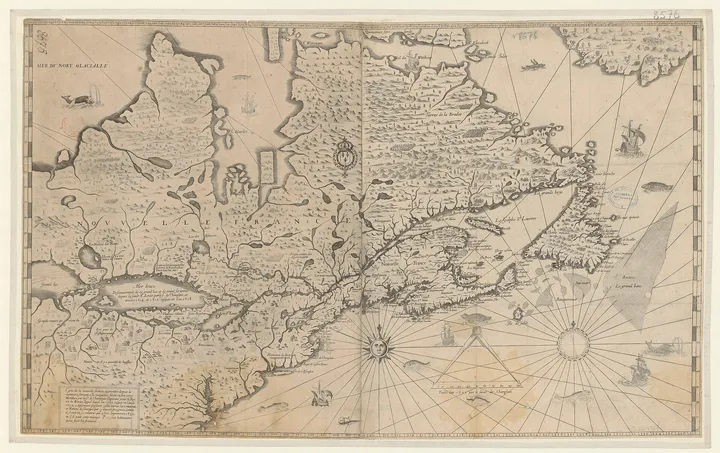
In the Seven Years’ War, about 70,000 French colonists in North America faced 1.5 million people in the British colonies. Under the Treaty of Paris of 1763, France ceded its colony to Britain. The French population stayed, and from it came the French Canadians.[12]
In 1773 the ship Hector landed 178 Scottish emigrants at Pictou in Nova Scotia. Most came from Loch Broom in Ross and were tenants escaping high rents and bad harvests. Other ships had carried Highlanders to Prince Edward Island earlier. The Hector’s voyage is still the best-known story of Highland settlement in British North America.[13]
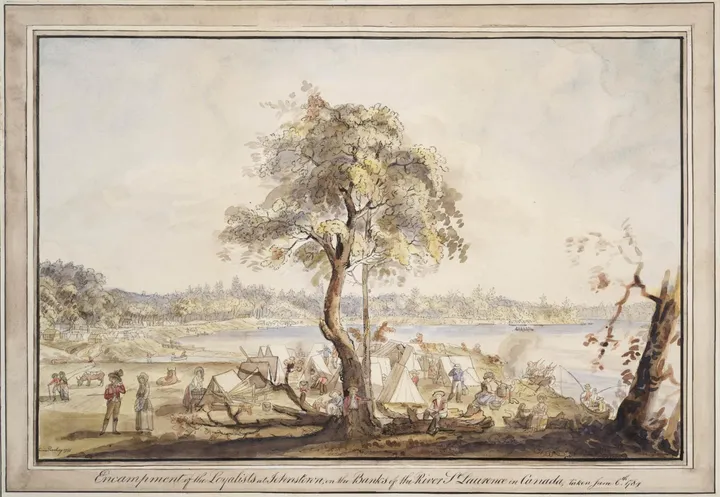
Between 80,000 and 100,000 Loyalists, colonists who had sided with Britain in the American Revolution, fled the United States. About half of them went to Canada, mainly in 1783 and 1784. More than 30,000 settled in today’s Maritime provinces, about 7,500 in present-day Ontario and about 2,000 in Quebec. Among them were some 3,500 Black Loyalists, free and enslaved. About 2,000 Indigenous allies of the British, mainly Haudenosaunee from New York, also moved north, and the Six Nations received land along the Grand River. New Brunswick was created in 1784 to govern the newcomers, and Upper Canada followed in 1791.[14]
Confederation and two official languages
On July 1, 1867, Nova Scotia, New Brunswick and the Province of Canada, today’s Ontario and Quebec, formed the Dominion of Canada.[15] In the words of its founding act, they wished to be “federally united into One Dominion under the Crown of the United Kingdom of Great Britain and Ireland”.[16] Fear of the United States helped bring the colonies together. After the Civil War the North had a large army, newspapers in the US talked of annexing Canada, and the American purchase of Alaska in 1867 added to the worry. By 1999 six more provinces and three territories had joined.[15]
The Official Languages Act came into force on September 7, 1969. It made English and French the official languages of Parliament and the federal government and required federal institutions to serve the public in either language on request.[17] Since 1982 the Charter of Rights and Freedoms has stated, “English and French are the official languages of Canada and have equality of status”.[1] In the 2021 census, French was the first official language spoken by 21.4% of Canadians and by 82.2% of the people of Quebec. Across the country, 18.0% could hold a conversation in both languages.[18]
Crossing the border
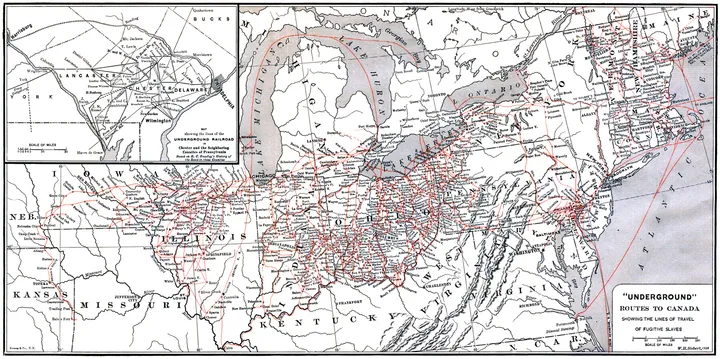
A law passed in Upper Canada in 1793 made any enslaved person who reached the province free on arrival. The Underground Railroad, a secret network of abolitionists, helped an estimated 30,000 to 40,000 freedom seekers reach British North America. Arrivals rose sharply after the Fugitive Slave Act of 1850 allowed slave catchers to pursue fugitives in the northern states. In the 1850s, 15,000 to 20,000 reached the Province of Canada. Many settled in Chatham, Windsor, Toronto and other towns of what is now Ontario.[19]
From 1861 to 1895 more people left Canada than arrived. The Canadian economy was generally depressed, and the prosperous United States drew unemployed Canadians as well as immigrants disappointed with Canada. Over the century from 1851 to 1951, about 80% of all emigrants from Canada had been born elsewhere.[20] Many Europeans also traveled to the United States by way of Canada. By the 1890s, steamship companies advertised the route to immigrants who wished to avoid US inspectors.[21] The French page tells how French Canadians moved to New England.
The American Community Survey tabulates the first two ancestries each person reports.[22] It lists Canadian and French Canadian separately and counts more residents born in Canada than people who report Canadian ancestry. French Canadian ancestry is most common in New Hampshire and Maine, where 6.8% and 6.2% of residents reported it in 2024.[3][4]
Census returns, border lists and parish registers
Library and Archives Canada holds the census returns from 1825 to 1931 and opens each census to the public 92 years after it was taken. Most counts before 1851 listed only the heads of households. Newfoundland joined Canada in 1949 and is missing from the returns.[23] The 1931 census went online on June 1, 2023, with 234,687 digitized images. It shows where people lived, which languages they spoke and whom they lived with.[24]
The St. Albans Lists of the US National Archives record immigrants who crossed from Canada into the United States between 1895 and 1954. At land border ports, immigrants born in Canada appear in them from October 1, 1906.[21]
In Quebec, parish registers record baptisms from 1621. From 1679 a copy of each register went to the local court and served as the civil record, until the government of Quebec took over civil registration in 1994.[25] The PRDH database, created at the Université de Montréal, draws on a complete transcription of the parish registers of early Quebec and covers the years 1621 to 1861.[26]
Canada and the United States
Of the US residents born in Canada, about 127,000 lived in California and 113,000 in Florida in 2024.[3]
- 1812
The United States declares war on Great Britain. Canadians defeat an American invasion of Lower Canada, and the Treaty of Ghent, signed on Christmas Eve 1814, restores the borders as they were before the war.[27]
- 1818
British and American commissioners fix the border at the 49th parallel from the Lake of the Woods west to the Rocky Mountains.[28]
- 1846
The Senate ratifies the Oregon Treaty on June 18. The border now follows the 49th parallel to the coast, and all of Vancouver Island stays on the Canadian side.[28]
- 1850
Canada is the birthplace of 147,711 US residents, 6.6% of all people born abroad.[29]
- 1894
The US Immigration Service reaches an agreement with Canadian railroads and steamship lines. From 1895, US inspectors examine immigrants bound for the United States at Canadian seaports.[21]
- 1900
Canadian-born residents total 1,179,922, and 395,126 of them are listed as French Canadians. Of all foreign countries, only Germany and Ireland are the birthplace of more US residents.[29]
- 1930
With 1,310,369 people born in Canada or Newfoundland, the number reaches its highest level in the censuses from 1850 to 1990.[29]
- 2024
About 1.6 million Americans name French Canadian ancestry and 544,354 name Canadian, 0.5% and 0.2% of the population.[4]
Sources
- Justice Laws Website, Government of Canada: Constitution Act, 1982, Canadian Charter of Rights and Freedoms, section 16, and Part II, section 35
- Statistics Canada: Canada’s population estimates, second quarter 2026, The Daily (September 23, 2026)
- U.S. Census Bureau: American Community Survey 2024, 1-year estimates, Table B05006, Place of Birth for the Foreign-Born Population in the United States, national and state data
- U.S. Census Bureau: American Community Survey 2024, 1-year estimates, Table B04006, People Reporting Ancestry, national and state data
- Statistics Canada: The Canadian census, a rich portrait of the country’s religious and ethnocultural diversity, The Daily (October 26, 2022)
- Statistics Canada: Table 98-10-0355-01, Ethnic or cultural origin by gender and age, Canada, provinces and territories, 2021 Census (October 26, 2022)
- Statistics Canada: Indigenous population continues to grow and is much younger than the non-Indigenous population, although the pace of growth has slowed, The Daily (September 21, 2022)
- Adam Gaudry: Métis, The Canadian Encyclopedia, Historica Canada (2009, last edited November 28, 2023)
- J. R. Miller: Residential Schools in Canada, The Canadian Encyclopedia, Historica Canada (2012, last edited May 8, 2026)
- The Avalon Project, Yale Law School: The Jay Treaty (November 19, 1794), Article 3
- Legal Information Institute, Cornell Law School: 8 U.S. Code § 1359, Application to American Indians born in Canada
- Jacques Mathieu: New France, The Canadian Encyclopedia, Historica Canada (2013, last edited July 9, 2021)
- J. M. Bumsted: Hector, The Canadian Encyclopedia, Historica Canada (2006, last edited May 22, 2015)
- Bruce G. Wilson: Loyalists in Canada, The Canadian Encyclopedia, Historica Canada (2009, last edited August 12, 2021)
- P. B. Waite: Confederation, The Canadian Encyclopedia, Historica Canada (2013, last edited October 29, 2019)
- Justice Laws Website, Government of Canada: Constitution Act, 1867, preamble
- Paul Laurendeau: Official Languages Act (1969), The Canadian Encyclopedia, Historica Canada (2006, last edited May 17, 2019)
- Statistics Canada: While English and French are still the main languages spoken in Canada, the country’s linguistic diversity continues to grow, The Daily (August 17, 2022)
- Natasha Henry: Underground Railroad, The Canadian Encyclopedia, Historica Canada (2006, last edited March 3, 2023)
- Anne-Marie Pedersen and Shiva S. Halli: Emigration, The Canadian Encyclopedia, Historica Canada (2006, last edited May 5, 2021)
- Marian L. Smith: By Way of Canada, U.S. Records of Immigration Across the U.S.-Canadian Border, 1895–1954 (St. Albans Lists), Prologue 32, no. 3, National Archives (Fall 2000)
- U.S. Census Bureau: About Ancestry
- Library and Archives Canada: General census guide
- Library and Archives Canada: The 1931 Census is now online! (June 1, 2023)
- Bibliothèque et Archives nationales du Québec: Guide généalogique sur les naissances au Québec
- Bibliothèque et Archives nationales du Québec: Programme de recherche en démographie historique (PRDH)
- Office of the Historian, U.S. Department of State: War of 1812–1815
- Office of the Historian, U.S. Department of State: The Oregon Territory, 1846
- U.S. Census Bureau: Campbell J. Gibson and Emily Lennon, Historical Census Statistics on the Foreign-born Population of the United States, 1850–1990, Working Paper No. 29, Table 4 (February 1999)
More from The Americas
Puerto Rican 3African-American 2Mexican 2Chilean 1Grenadian 1Haitian 1Kittitian 1Native American 1