Celebrities with Kittitian Roots
 Cole PalmerGrandfather born in Basseterre in 1953
Kittitians, Nevisians and their two islands
A Kittitian is a native or inhabitant of St Kitts, and a Nevisian one of Nevis.[5][6] According to Merriam-Webster, the word was first used in 1945, and its ending was probably modeled on Haitian.[5] This page covers ancestry from both islands. Under the constitution of 1983, “the island of Saint Christopher (which is otherwise known as Saint Kitts) and the island of Nevis shall be a sovereign democratic federal state”.[7] Nevis, the smaller, round island, lies 2 miles (3 km) southeast of St Kitts across a channel called the Narrows.[1]
Christopher Columbus sighted both islands on his second voyage in 1493. He named St Kitts Saint Christopher after his patron saint, and English settlers later shortened the name. Nevis takes its name from his description of the clouds on its peak as las nieves, “the snows”.[8] The government’s investment agency gives the Kalinago name of St Kitts as Liamuiga, “fertile island”. The highest mountain on the island, called Mount Misery in colonial times, carries that name today.[9][10] The National Archives in Basseterre take a different view and write that the names the Kalinago gave the islands “were erased from history”.[11]
A colony shared by England and France
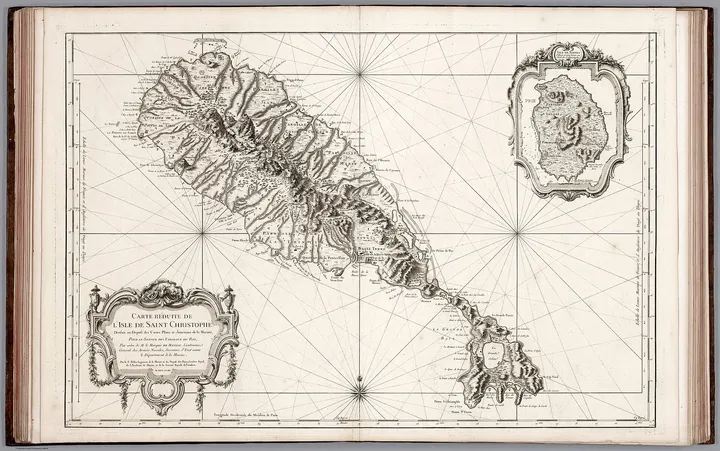
Around 1600 Kalinago people set up a community on St Kitts and on Nevis. According to the National Archives, Thomas Warner and a small group of English settlers landed at Old Road Bay on January 28, 1623.[11] Britannica calls it the first successful English colony in the West Indies.[8] Other accounts date the landing to 1624.[12][9] The investment agency calls St Kitts the “Mother Colony of the West Indies”.[9]
French privateers under Pierre d’Esnambuc found refuge on the island in 1625. A year later the English and French settlers joined forces against the Kalinago. The Kalinago leader Tegreman was killed. Those who escaped fled by sea, and only a few Kalinago remained on the island.[11][12] The site of the massacre, west of the village of Challengers, is still called Bloody Point.[12] On May 13, 1627, the settlers divided St Kitts between them. The French took both ends of the island and the English the middle.[11]
The Treaty of Utrecht gave the whole island to Britain in 1713.[8] In 1727 the seat of government moved from Old Road to Basseterre.[11] The national coat of arms shows a Carib head between the French fleur-de-lis and the English rose.[13]
Sugar, slavery and Brimstone Hill
The first enslaved Africans were brought to St Kitts in 1626, probably taken from a Spanish ship. Around 1640 de Poincy, governor general of the French colonies in the West Indies, introduced sugar cane.[11] European traders bought captives along the African coast from Senegambia to Madagascar, most of them in West Africa. By 1707 enslaved Africans outnumbered the people of European descent on St Kitts. In 1807 the island held 26,000 enslaved people and fewer than 2,000 whites.[14] In the 2022 census, 88.0% of residents were counted as being of African descent.[2]
Two genetic studies included St Kitts among eight English-speaking Caribbean islands and give figures for all eight together. In the 2013 study of 420 people, ancestry averaged 77% West African, 15% European and 7.7% Native American.[15] In the earlier study of 2007, nearly 10% of the people tested had a non-African maternal line. On the paternal side, the European share came to nearly 30%.[16]
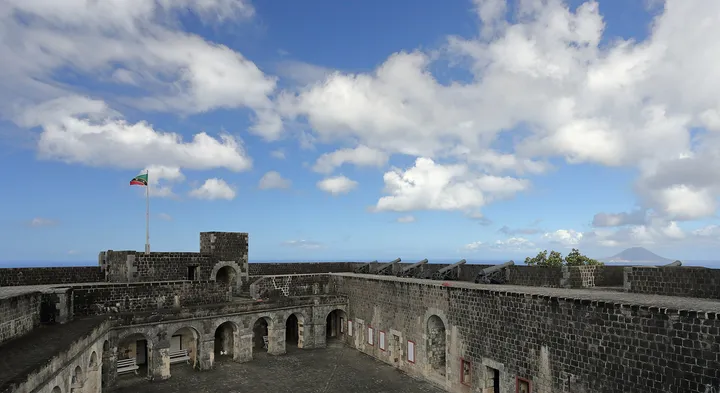
British engineers designed the fortress on Brimstone Hill, and enslaved Africans built it. The British first mounted a cannon on the hill in 1690 to drive out the French, and their garrison left in 1853.[17] French forces captured the fortress in 1782, and a treaty of 1783 returned the island to Britain.[8] UNESCO made Brimstone Hill a World Heritage Site in 1999. It calls the fortress “testimony to European colonial expansion, the African slave trade and the emergence of new societies in the Caribbean”.[17]
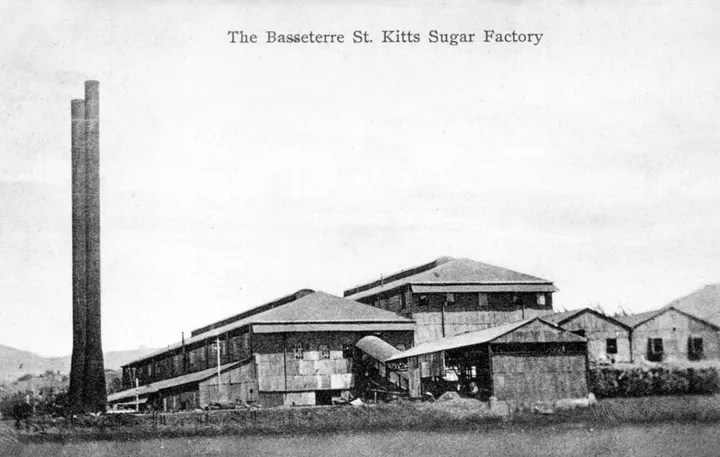
Slavery ended on August 1, 1834. A period of apprenticeship followed, another form of unfree labor for a fixed term.[18] Estate workers on St Kitts downed tools in protest. Apprenticeship ended on August 1, 1838. The Basseterre Sugar Factory opened in 1912 and shut down on July 23, 2005, which ended the sugar industry on St Kitts.[11] Tourism has since become the leading sector.[1]
Nevis and the federation
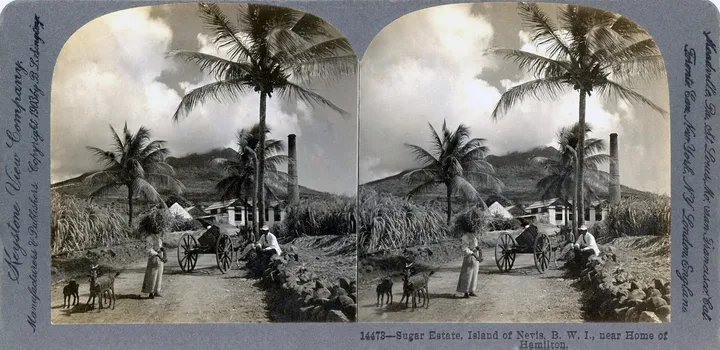
English settlers came to Nevis in 1628, and the island soon became one of the most prosperous in the Antilles.[8] Nevis later relied on small farms growing cotton and other crops. St Kitts depended almost entirely on sugar until the early 2000s.[19]
From 1882 St Kitts, Nevis and Anguilla formed a single colony with its administration in Basseterre.[19] The three islands became a state in association with the United Kingdom on February 27, 1967. Anguilla expelled the St Kitts police in May of that year, came under direct British rule in 1971 and formally left the union in 1980.[1] Nevisians have long described the relationship with the larger island as one of domination. On August 1, 1970, the government ferry Christena sank in the Narrows, and 223 people died, most of them from Nevis.[19][11]
St Kitts and Nevis became independent in 1983 as a federation in which only Nevis has its own assembly and government.[19] Under section 113 of the constitution, Nevis may leave the federation if, among other conditions, a referendum on the island approves by “not less than two-thirds of all the votes validly cast”.[7] On August 10, 1998, 61.7% voted for secession, short of that threshold. No second referendum has been held.[19]
Leaving the islands
Both islands have long seen high emigration, which has kept the population fairly stable.[1] The census of 1921 counted the lowest population on record, and the count of 1960 remained the highest until 2022.[2]
Source: Department of Statistics, St Kitts and Nevis[2]
A crisis in the sugar trade sent cane workers from St Kitts and Nevis to the growing sugar estates in the east of the Dominican Republic, along with migrants from Anguilla, Antigua and Tortola. Dominicans called them tortolos at first and later cocolos, a word that was then an insult.[20] UNESCO notes that the word is now used with pride. In 2008 it added the Cocolo dance drama, which blends African music and dance with figures from the Bible and medieval European tales, to its list of the intangible heritage of humanity.[21]
Tracing ancestors in St Kitts and Nevis
Most records in the National Archives in Basseterre date from 1728 or later. Local records of the 17th century seem to have been destroyed in the battles between the English and French. The archives hold civil registers of births from 1859 and of marriages from 1881, both up to 1930. Baptisms before 1859 are held by the churches. Certificates come from the Registrar General.[22] The archives also keep Wesleyan and Moravian marriage registers for 1845–1874, deeds, old newspapers and the slave registers.[23] Census returns and migration records are not among their holdings.[22]
The civil registers of Nevis are kept in Basseterre as well, while all land records stayed on Nevis.[22] The Nevis Historical and Conservation Society holds parish registers in its Nevis Island Archives. With Hamilton College it has digitized baptisms of St Paul’s (1824–1873), St James (1839–1877) and St Thomas Lowland (1827–1873).[24]
The first register of enslaved people on St Kitts was drawn up in 1817. Later returns recorded births, deaths, manumissions, transportation and escapes.[25] Copies for both islands, up to the returns of 1834, are held by The National Archives in Kew in series T 71.[26] The registers list names, age, sex, color, place of origin and occupation, and on rare occasions family ties.[27] The National Archives in Kew remind researchers that not all enslaved people had surnames.[28] For the archives in Basseterre, the registers are “the first documentation of a people who had previously been made to live, work and die without an identity”.[27] University College London’s Legacies of British Slavery project traces estates and their owners, so that enslaved people can be linked to the places where they lived and worked.[18]
Kittitians and Nevisians abroad
In 2021 the largest groups of people in England and Wales who were born in St Kitts and Nevis lived in Birmingham, with 1,193, and Leeds, with 711.[4]
- 1650
De Poincy, the French governor general, sends 166 men from St Kitts to St Croix and drives out the Spanish. French settlement of St Croix, today part of the US Virgin Islands, begins in 1651 with 300 colonists.[29]
- 1655
An English fleet under Admiral William Penn recruits 1,300 men on St Kitts, most of them landless or poor. The expedition fails on Hispaniola and takes Jamaica from Spain.[11]
- 1773
Alexander Hamilton, born on Nevis in about 1755, leaves the Caribbean for North America. In 1789 he becomes the first Secretary of the Treasury of the United States.[30]
- 1917
The United States takes over the Danish West Indies on March 31. In November a census of the new US Virgin Islands counts 612 residents born on St Kitts and 536 born on Nevis.[29]
- 1920
The census of the Dominican Republic counts 3,615 people from the British Caribbean islands in the sugar province of San Pedro de Macorís.[20]
- 1967
The Leeds West Indian Carnival takes to the streets for the first time. It was the idea of Arthur France, who had arrived in Leeds from St Kitts and Nevis in 1957. The organizers call it the first West Indian carnival parade organized by British Caribbeans.[31]
- 1983
St Kitts and Nevis becomes independent on September 19. People born on the islands who held British or British Dependent Territories citizenship become citizens of the new state that day.[7]
- 2011
A census counts 5,629 people in England and Wales who were born in St Kitts and Nevis, 1,730 of them in the West Midlands.[32]
Sources
- Encyclopaedia Britannica: Saint Kitts and Nevis
- Department of Statistics, Ministry of Sustainable Development: The Population and Housing Census Summary Report, St. Kitts and Nevis, 2022 Census (June 1, 2024), via CARICOM
- Office for National Statistics: Census 2021, Country of birth (extended, 190 categories), England and Wales, via the ONS API
- Office for National Statistics: Census 2021, Country of birth (extended, 190 categories), by local authority, via the ONS API
- Merriam-Webster: Kittitian
- Merriam-Webster: Nevisian
- Constitute Project: Saint Kitts and Nevis 1983 Constitution
- Encyclopaedia Britannica: Saint Kitts and Nevis, History
- St. Kitts Investment Promotion Agency: Historic Profile
- National Archives St. Kitts and Nevis, Historic St. Kitts: Mount Liamuiga, via the Internet Archive
- National Archives St. Kitts and Nevis, Historic St. Kitts: Timeline, History of St. Kitts, via the Internet Archive
- National Archives St. Kitts and Nevis, Historic St. Kitts: Bloody Point, via the Internet Archive
- Government of St. Kitts and Nevis: The National Symbols
- National Archives St. Kitts and Nevis: Enslavement, exhibition on the Registry of Slaves (2011), via the Internet Archive
- J. B. Torres, A. C. Stone and R. Kittles: An anthropological genetic perspective on Creolization in the Anglophone Caribbean, American Journal of Physical Anthropology 151 (May 2013), abstract via PubMed
- J. Benn Torres, R. A. Kittles and A. C. Stone: Mitochondrial and Y chromosome diversity in the English-speaking Caribbean, Annals of Human Genetics 71 (November 2007), abstract via PubMed
- UNESCO World Heritage Centre: Brimstone Hill Fortress National Park
- UCL Centre for the Study of the Legacies of British Slavery: Context
- Forum of Federations: André Lecours, Saint Kitts and Nevis, Secessionism and the Federal Experience, Policy Brief (July 2026)
- Humberto García Muñiz and Jorge L. Giovannetti: Garveyismo y racismo en el Caribe, el caso de la población cocola en la República Dominicana, Clío 168 (2004), Academia Dominicana de la Historia
- UNESCO Intangible Cultural Heritage: Cocolo dance drama tradition
- National Archives St. Kitts and Nevis: FAQ, via the Internet Archive
- National Archives St. Kitts and Nevis: Collections, via the Internet Archive
- Nevis Historical and Conservation Society: Genealogy Resources
- National Archives St. Kitts and Nevis: Abolition and the Creation of the Registry (2011), via the Internet Archive
- The National Archives, Kew, Discovery: T 71, Office of Registry of Colonial Slaves, Registration, with the registers of St Christopher (T 71/253–263) and Nevis (T 71/364–369)
- National Archives St. Kitts and Nevis: What the Registers Tell Us (2011), via the Internet Archive
- The National Archives, Kew: Enslaved people and slave owners, research guide
- U.S. Census Bureau: Census of the Virgin Islands of the United States, November 1, 1917 (1918)
- National Park Service, Hamilton Grange National Memorial: Alexander Hamilton Timeline
- Leeds West Indian Carnival: Our History
- Office for National Statistics: 2011 Census, QS213EW, Country of birth (expanded), via Nomis
More from The Americas
Puerto Rican 3African-American 2Canadian 2Mexican 2Chilean 1Grenadian 1Haitian 1Native American 1