Celebrities with Puerto Rican Roots
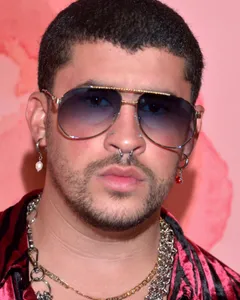 Bad BunnyBorn in Bayamón to Puerto Rican parents
 Bruno MarsFather from Brooklyn, Puerto Rican roots
 Jenna OrtegaMaternal grandfather born in Puerto Rico
No celebrity matches your search.
Three roots of Puerto Rican ancestry
Puerto Rico lies in the Caribbean, about 1,000 miles southeast of Miami.[1] Puerto Ricans descend mainly from three groups: the Indigenous Taíno, European settlers, and Africans brought to the region in the transatlantic slave trade.[5]
A 2011 study measured the mix in a census-based sample of 642 people from all parts of the island, using 93 genetic markers.[6]
Source: Via et al., PLoS ONE[6]
A 2021 study in Nature used a different method and found similar shares for Puerto Rico, with about 68% European, 18% African and 14% Indigenous ancestry.[5]
African ancestry is highest in the east of the island, at 31.8% on average, and the authors trace this pattern in part to the colonial sugar plantations. Native American ancestry varies little from one region or person to the next.[6]
The maternal line gives a different picture. A 2005 study analyzed mitochondrial DNA, which passes from mother to child, in 800 islanders chosen to represent the population. Of their maternal lines, 61.3% were Native American, 27.2% sub-Saharan African and 11.5% West Eurasian.[7] The authors of the 2011 study see in this “an excess of ancestry contribution from European males and Native American females”, a pattern common across Latin America.[6]
The Taíno and their island Borinquén
People first reached the Caribbean islands about 6,000 years ago.[5] A 2020 study in Science linked one early migration into the western Caribbean to North America.[8] The 2021 Nature study traces these first settlers to a population closest to Central and northern South Americans and disputes the link to North America.[5]
At least 1,700 years ago, farming and pottery-making people related to Arawak speakers of northeastern South America moved through the Lesser Antilles into the larger islands. They replaced more than 98% of the older lineages, and their ancestry is still present today.[5] The genome of a Taíno woman who lived in the Bahamas about 1,000 years ago points to the same origin in northern South America.[9] The Taíno of Puerto Rico called their island Borinquén, also spelled Borinkén.[1]
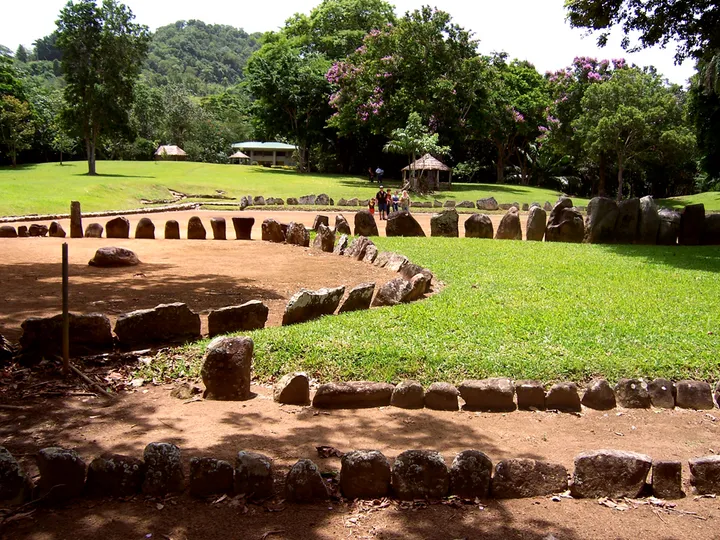
The largest Taíno ceremonial site in the West Indies lies at Caguana near Utuado, in the mountains of west central Puerto Rico. It dates from between about 1200 and 1500 and has ten ball courts lined with earth and stone, called bateys, and a ceremonial dance ground with numerous petroglyphs.[10]
How many Taíno lived on the islands is disputed. Some historical estimates for the time of contact run from hundreds of thousands to millions. From stretches of DNA shared between islands, the 2021 study estimates a far smaller population for Puerto Rico and Hispaniola. Its authors add that “the devastating impact that European colonization, expropriation, and systematic killing of Indigenous people had on Caribbean populations is indisputable.”[5]
Taíno ancestry has survived to the present. The Native American part of some present-day Caribbean genomes is closely related to the ancient Taíno.[9] The 2021 study found a previously unknown branch of the maternal lineage C1d in ancient islanders and in a present-day Puerto Rican. The authors see this as “direct evidence that Indigenous matrilineal ancestry persisted in the Caribbean since pre-contact times.”[5]
Spanish rule and African slavery
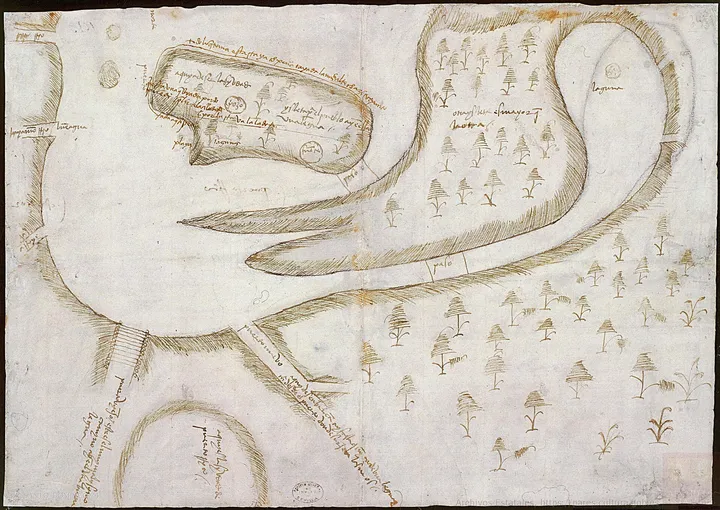
Christopher Columbus landed on the west coast of the island on November 19, 1493, during his second voyage, and named it San Juan Bautista.[11] Spain founded a permanent settlement in 1508, when Juan Ponce de León led settlers from Hispaniola.[1] Their first town was Caparra. In 1519 Rodrigo de Figueroa drew a plan for moving the city from Caparra to a new site across the bay.[12]
Spanish colonizers forced the Taíno into servitude.[1] After raids by French corsairs and several Taíno uprisings, the Spanish began to fortify San Juan, with La Fortaleza in 1537 and El Morro in 1539.[11]
Africans were brought to the Caribbean in the course of the transatlantic slave trade.[5] The African maternal lines in the 2005 study show a strong affinity to West Africa, with components from Senegambia and the Gulf of Guinea.[7] In 1867 the island had 656,328 inhabitants. The count recorded 346,437 as white and 309,891 as “of color”, a category that grouped Black people with people of mixed descent.[13]
On September 23, 1868, several hundred rebels took the mountain town of Lares and proclaimed a Republic of Puerto Rico, which declared free the enslaved people who had joined them. Spanish militia soon ended the revolt.[13] The short-lived Spanish Republic abolished slavery in Puerto Rico on March 22, 1873.[13] The owners received compensation, and the freed people had to keep working for three more years.[14]
From Spanish colony to US territory
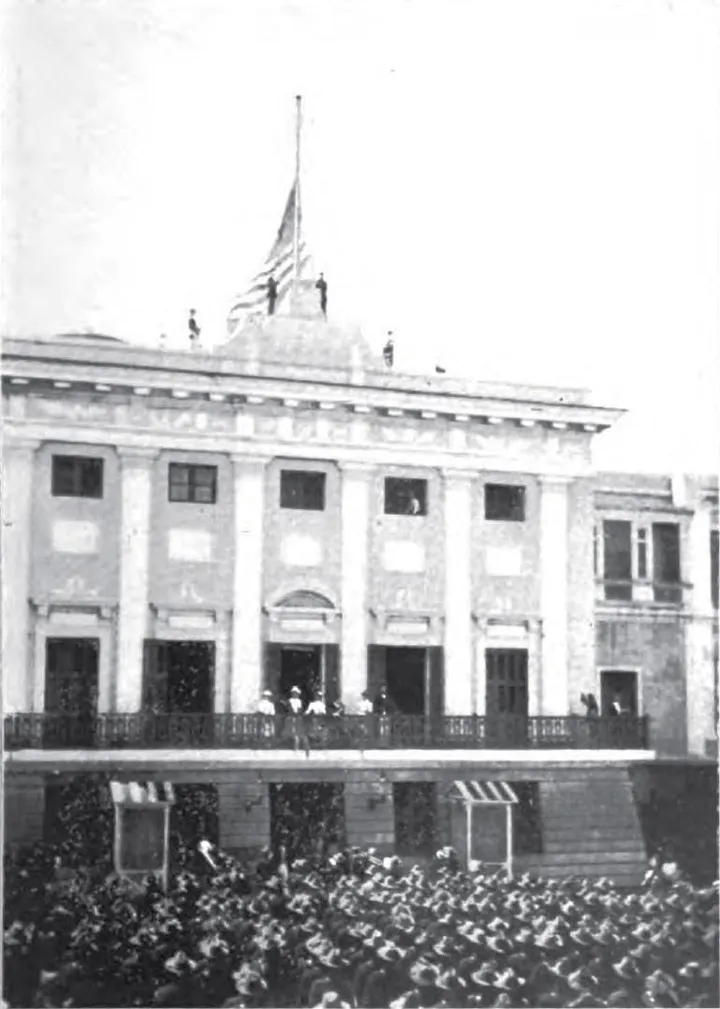
During the Spanish-American War, US troops landed at Guánica on July 25, 1898. In the Treaty of Paris of December 10, Spain ceded Puerto Rico to the United States. The US flag had already been raised over San Juan on October 18, when the last Spanish troops left.[13]
In 1900 Congress replaced military rule with a civilian government under the Foraker Act.[1] In a series of rulings known as the Insular Cases, the Supreme Court decided that territories such as Puerto Rico remained unincorporated.[15] In Downes v. Bidwell of 1901, Justice White described the island as “foreign to the United States in a domestic sense”.[16]
The Jones Act of March 2, 1917, made Puerto Ricans US citizens. Its fifth section states that they “are hereby declared, and shall be deemed and held to be, citizens of the United States”. Anyone who wished to keep their previous status could do so by sworn declaration within six months.[17]
The Elective Governor Act of 1948 let Puerto Ricans choose their own governor at the polls.[18] In 1950 Congress recognized the island’s authority over its internal affairs, and in 1952 it approved Puerto Rico’s constitution. Since then the island has been known formally as the Commonwealth of Puerto Rico,[1] in Spanish Estado Libre Asociado.[18]
What “commonwealth” means is disputed. Some see a unique status between territory and state, based on a compact that neither side can change alone. Others treat it as a traditional name, as in the Commonwealth of Pennsylvania, and hold that Congress keeps its broad powers over the territory.[1]
People born in Puerto Rico are US citizens.[1] Residents of the island do not vote in presidential elections, and their only delegate in the US House has limited voting rights.[4] Since 1967 the island has held seven nonbinding votes on its status, most recently in 2024.[4] In 2020, 52.5% of voters answered yes to the question of whether Puerto Rico should be admitted immediately as a state. Island parties have argued over the wording and turnout of some earlier votes.[1]
Language, flag and the word Boricua
Spanish is the predominant language of the island.[1] A US Army order of 1898 made English the official language of the government, and an act of 1902 allowed both languages. A law of 1991 made Spanish the only official language. Since 1993 Spanish and English have both been official again.[2]
Boricua means a Puerto Rican or a person of Puerto Rican descent. The word comes from Borikén, another spelling of the island’s Taíno name.[19] Nuyorican, first recorded in 1974, blends the Spanish nuyorquino, “New Yorker”, with Puerto Rican. It describes a person of Puerto Rican birth or descent who lives or has lived in New York City.[20]
On December 22, 1895, Juan de Mata Terreforte, a veteran of the Lares uprising, presented the flag at Chimney Hall in New York to 59 exiles who formed the Puerto Rican section of the Cuban Revolutionary Party. Its design inverts the red and blue of the Cuban flag. Three accounts name different men as the one who proposed it.[21] The Flag Law of July 24, 1952, made it the official flag of the Commonwealth and describes five alternating stripes, three red and two white, and a blue equilateral triangle with a white five-pointed star.[22] No shade of blue has ever been fixed as official.[21]
Puerto Ricans and the United States
Florida has the largest Puerto Rican population in the 50 states, with 1.3 million people in 2024, followed by New York with 995,000 and Pennsylvania with 494,000.[4]
- 1898
Spain cedes Puerto Rico to the United States in the Treaty of Paris, signed on December 10.[13]
- 1900
The Foraker Act creates a civilian government and the office of Resident Commissioner, who represents the island in Congress without a vote.[23]
- 1917
President Woodrow Wilson signs the Jones–Shafroth Act on March 2. It gives Puerto Ricans US citizenship.[24]
- 1940
The census counts 69,967 people born in Puerto Rico in the continental United States, 87.8% of them in New York City.[25]
- 1950
The number of Puerto Rico-born residents on the mainland has more than tripled, to 226,110.[25]
- 1952
Congress approves the constitution of Puerto Rico, which becomes known formally as the Commonwealth of Puerto Rico.[1]
- 1960
The census counts 615,384 people born in Puerto Rico on the mainland, 429,710 of them in New York City. Together with their US-born children, they number nearly 900,000.[25]
- 2006
By this year at the latest, more Puerto Ricans live on the mainland than on the island.[26]
- 2018
Net migration from the island to the mainland peaks at about 110,000 people, partly after hurricanes Irma and Maria struck in September 2017.[4]
- 2024
About 6.1 million Puerto Ricans live in the 50 states and D.C. Most of them, 69%, were born on the mainland.[4]
Sources
- Congressional Research Service: Political Status of Puerto Rico, Brief Background and Recent Developments for Congress, R44721, by R. Sam Garrett (June 6, 2024), via EveryCRSReport
- Puerto Rico Official Languages Act, Act No. 1 of January 28, 1993, English translation by the Office of Management and Budget (rev. August 2, 2023)
- U.S. Census Bureau: 2020 Census Apportionment Results, Table 2, Resident Population for the 50 States, the District of Columbia, and Puerto Rico (April 2021)
- Pew Research Center: Key findings about Puerto Rico, by Jenn Hatfield and Jeffrey S. Passel (February 5, 2026)
- Daniel M. Fernandes, Kendra A. Sirak et al.: A genetic history of the pre-contact Caribbean, Nature 590 (February 2021)
- Marc Via et al.: History shaped the geographic distribution of genomic admixture on the island of Puerto Rico, PLoS ONE (January 31, 2011)
- Juan C. Martínez-Cruzado et al.: Reconstructing the population history of Puerto Rico by means of mtDNA phylogeographic analysis, American Journal of Physical Anthropology (September 2005), abstract via PubMed
- Kathrin Nägele, Cosimo Posth et al.: Genomic insights into the early peopling of the Caribbean, Science (July 2020)
- Hannes Schroeder et al.: Origins and genetic legacies of the Caribbean Taino, PNAS (March 2018)
- National Park Service: National Historic Landmark nomination, Caguana Site, Utuado, by Mark R. Barnes (January 25, 1993)
- National Park Service, San Juan National Historic Site: History of San Juan
- Archivo General de Indias: Plano del asiento y del puerto de la ciudad de Puerto Rico, by Rodrigo de Figueroa (September 12, 1519), MP-SANTO_DOMINGO,1
- Library of Congress: The Changing of the Guard, Puerto Rico in 1898, by Marisabel Brás, World of 1898 research guide
- Library of Congress: Abolition of Slavery in Puerto Rico, World of 1898 research guide
- History, Art & Archives, U.S. House of Representatives: “Foreign in a Domestic Sense,” 1898–1945, Hispanic Americans in Congress
- Downes v. Bidwell, 182 U.S. 244 (1901), concurring opinion of Justice White, via Legal Information Institute, Cornell Law School
- An Act to provide a civil government for Porto Rico (Jones Act), 39 Stat. 951 (March 2, 1917), via GovInfo
- History, Art & Archives, U.S. House of Representatives: Separate Interests to National Agendas, 1945–1977, Hispanic Americans in Congress
- Dictionary.com: boricua
- Merriam-Webster: Nuyorican
- U.S. District Court for the District of Puerto Rico: The Flag of Puerto Rico, Historical Flag Project (archived June 7, 2026)
- Ley de la Bandera del Estado Libre Asociado de Puerto Rico, Ley Núm. 1 de 24 de julio de 1952, Office of Management and Budget (rev. April 15, 2024)
- Library of Congress: Foraker Act (Organic Act of 1900), World of 1898 research guide
- Library of Congress: Jones Act, World of 1898 research guide
- U.S. Census Bureau: 1960 Census, Subject Reports, Puerto Ricans in the United States, PC(2)-1D (January 1965)
- Pew Research Center: Puerto Rican Population Declines on Island, Grows on U.S. Mainland (August 11, 2014)
More from The Americas
African-American 2Canadian 2Mexican 2Chilean 1Grenadian 1Haitian 1Kittitian 1Native American 1