Celebrities with Haitian Roots
 SneakoFather born in Haiti
From Ayiti to Saint-Domingue
Haiti covers the western part of Hispaniola and shares the island with the Dominican Republic. Its name comes from Ayti, an Indigenous Arawak place-name meaning “Mountainous Land”.[6]
Christopher Columbus sighted the island in December 1492 and called it La Isla Española, the Spanish Island. The Spanish soon enslaved the Taíno and Ciboney and forced them to mine for gold. European diseases and forced labor devastated them, and by about 1600 they had all but disappeared.[7] The Puerto Rican page traces where the Taíno came from.
French settlers founded Port-de-Paix in the northwest in 1665.[7] In the Treaty of Rijswijk of 1697, Spain formally ceded the western third of Hispaniola to France, which renamed it Saint-Domingue.[8] Its sugar and coffee plantations ran on the labor of enslaved Africans, and by the 1760s it had become the most profitable colony in the Americas.[9]
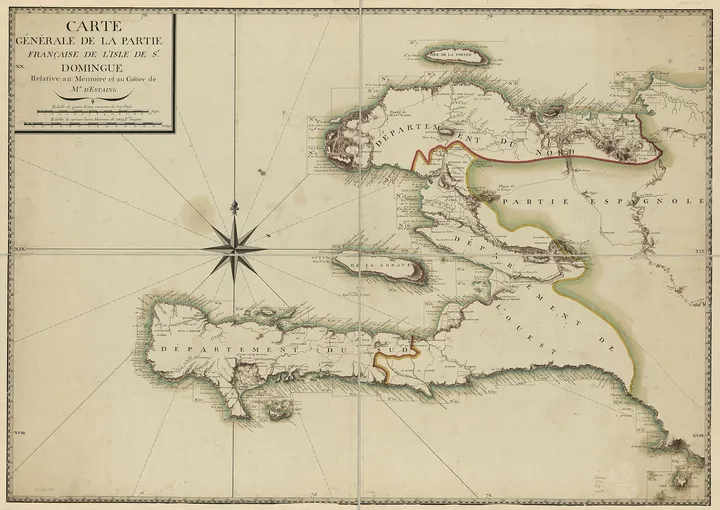
About 5,000 enslaved Africans lived in the colony in the late 17th century. On the eve of the French Revolution in 1789, its population was estimated at 556,000.[7]
Source: Encyclopaedia Britannica[7]
Many of the enslaved had been born in Africa and came from a number of West African peoples. Some escaped into the mountainous interior, where they were known as maroons. The affranchis, free people of mixed or African descent, faced discrimination from the white colonists, although some of them were wealthier than white artisans and shopkeepers.[7]
What DNA studies show
“Very little genetic data exist on Haitians,” a forensic study noted in 2012. It analyzed the maternal lines of 291 people, most of them from rural areas in the north and south of Haiti. Their African lines showed slightly more West-Central African ancestry than those of African Americans and Dominicans, and considerably less than those of Afro-Brazilians.[10] A study of the paternal lines of 123 men in Haiti, published the same year, traced 77.2% of them to Africa south of the Sahara and 20.3% to Europe.[11]
In 2013 a study of Caribbean families in South Florida included six people of Haitian descent. At 84% on average, they had the highest share of West African ancestry among the groups studied, and their Native American ancestry was too low for a closer analysis. The authors date the first mixing of Native American and European ancestry among Haitians to about 16 generations ago, in line with the arrival of Europeans in 1492. Their models show a later wave of African ancestry five to seven generations ago, strongest among Haitians and Dominicans.[12]
Revolution and independence
In May 1791 the revolutionary government in Paris granted citizenship to the wealthier affranchis.[7] On August 22, 1791, the enslaved people of northern Saint-Domingue rose in revolt.[9] In 1793 the French commissioner Léger-Félicité Sonthonax abolished slavery, and the government in Paris confirmed his decision the following year. The former slave Toussaint Louverture became a leader of the revolt. In December 1801 Napoleon Bonaparte sent his brother-in-law, General Charles Leclerc, to restore the old regime. After an armistice in May 1802 the French arrested Toussaint, who died in prison in France on April 7, 1803. On November 18, 1803, the Armée indigène, the “Indigenous Army” under Jean-Jacques Dessalines, defeated the French at Vertières.[7]
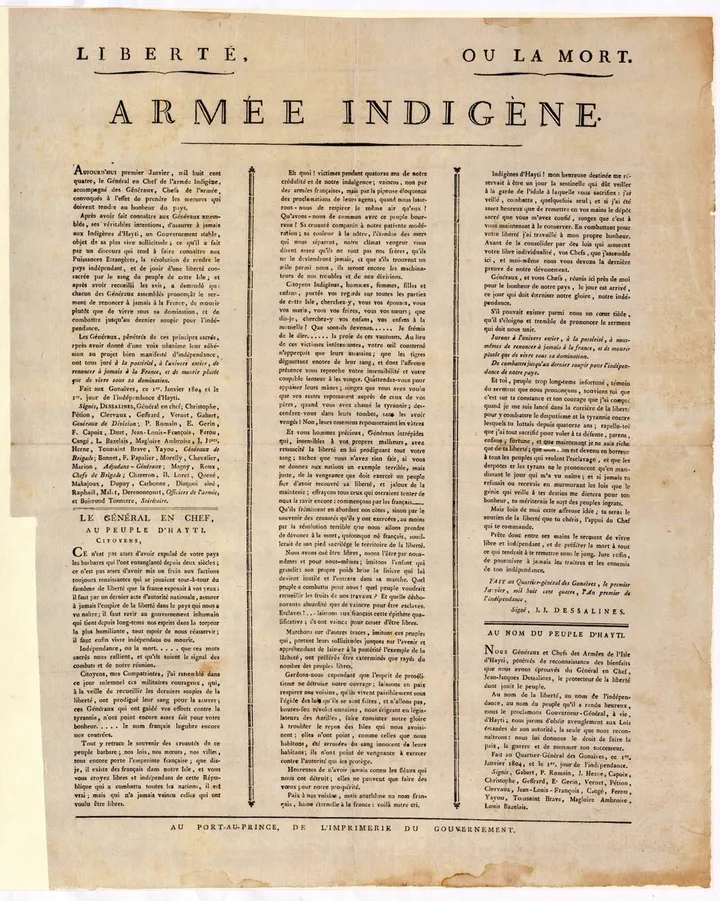
On January 1, 1804, Dessalines proclaimed independence at Gonaïves. His generals swore to renounce France forever. The proclamation, written by his secretary Louis Boisrond-Tonnerre, tells the people, “We have dared to be free, let us be thus by ourselves and for ourselves.”[3] For more than a century researchers searched in vain for a printed copy.[13] The historian Julia Gaffield found an eight-page pamphlet in The National Archives in London on February 2, 2010.[14] On a later visit she found a one-page broadside of the declaration, meant for posting in public places, among the Jamaican Admiralty records of the same archive.[13]
The blue and red flag goes back to 1803, when Haitians removed the white stripe from the French tricolor. François Duvalier replaced it in 1964 with vertical black and red stripes, and the blue and red returned on February 25, 1986.[15] The constitution sets May 18 as Flag Day.[1] The coat of arms carries the motto “L’Union fait la force”, “Union makes strength”.[15]
The price of recognition
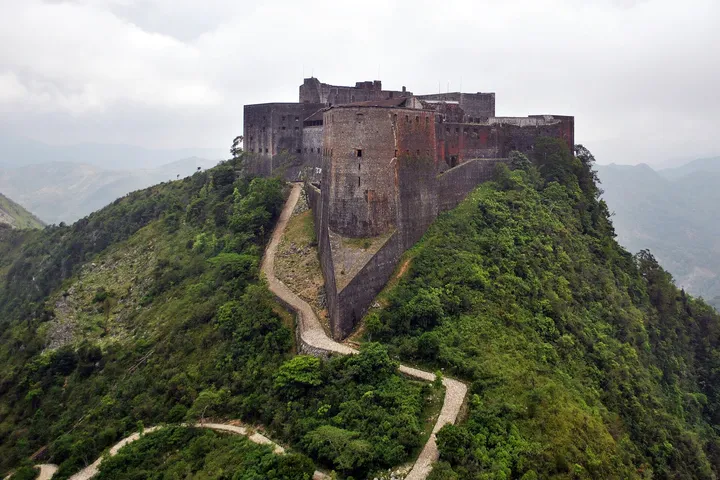
Dessalines charged his general Henri Christophe with building a fortress to protect the young state. The Citadelle Henry, 970 meters (about 3,180 feet) up on the Pic Laferrière in the north, was inaugurated in 1813. Together with the Sans-Souci Palace and the Ramiers site, it has been a UNESCO World Heritage Site since 1982.[16]
France recognized Haiti only in 1825, by a royal ordinance of Charles X dated April 17. It halved the port duties for French ships and required the inhabitants to pay 150 million francs in five yearly installments, “destinée à dédommager les anciens colons”, meant to compensate the former colonists. On these terms it granted “l’indépendance pleine et entière”, full and complete independence.[17]
French warships brought the ordinance to Port-au-Prince in July 1825, and President Jean-Pierre Boyer accepted it after three days of talks. The first installment alone came to about six times the government’s income that year, and Haiti borrowed from French banks to pay it. The indemnity and this loan became known as the “double debt”. In 1838 the sum was reduced to 90 million francs. Haiti made the last payments connected to its former slaveholders in 1888.[18]
The New York Times calculated in 2022 that Haitians paid about $560 million in today’s dollars. Had the money stayed in Haiti and grown at the country’s actual pace, it would have added about $21 billion to the economy over two centuries. With growth like that of its Latin American neighbors, the paper puts the loss at about $115 billion.[18] On April 17, 2025, the 200th anniversary, President Emmanuel Macron said the decision had placed “a price on the freedom of a young nation” (translated from French). He announced a joint commission of French and Haitian historians to examine two centuries of shared history, including the impact of the indemnity.[19]
Kreyòl, French and faith
Article 5 of the 1987 constitution reads, “All Haitians are united by a common language: Creole. Creole and French are the official languages of the Republic.” Article 213 calls for an academy to standardize Creole.[1] The Akademi Kreyòl Ayisyen was inaugurated in December 2014, and an official Kreyòl alphabet has existed since 1979. The linguist Michel DeGraff of MIT estimates that at least 95% of Haitians are fluent in Kreyòl only. Schools have traditionally taught in French, and in 2015 the education ministry and the academy agreed to expand Kreyòl teaching from kindergarten to university.[20]
In a government survey of 2017, 52% of Haitians named a Protestant or another non-Catholic Christian church, 35% the Catholic Church and 2% Vodou, and 11% did not state a preference. Many practitioners describe Vodou as a form of spirituality they practice alongside another faith, such as Catholicism. A concordat of 1860 with the Holy See gives the Catholic Church certain privileges.[21] A government decree of April 2003 officially sanctioned Vodou.[6]
Tracing Haitian ancestors
The French National Overseas Archives in Aix-en-Provence hold the parish registers of Saint-Domingue up to 1792 and its civil registers up to year XII of the revolutionary calendar, 1803–1804. The National Archives in Paris have them on microfilm, and by 2018 part of them could be viewed online. Notarial deeds from the colony cover the years 1701 to 1802.[22]
Today, local civil registry offices in Haiti record births, marriages and deaths. Each year their officers are supposed to send a copy of their registers to the National Archives of Haiti and to the Ministry of Justice. The archives keep these duplicates and issue extracts from them at their office in Port-au-Prince.[23]
Haiti and the United States
Florida is home to 569,229 people of Haitian ancestry, 45% of the national total. New York counts 185,991 and Massachusetts 85,642 (2024 estimates).[4] Of the immigrants born in Haiti, about 234,000 live in the Miami area, 165,000 in the New York area and 54,000 around Boston (2020–2024).[5]
- 1779
More than 500 men of color from Saint-Domingue, the Chasseurs-Volontaires de Saint-Domingue, fight for American independence in the Siege of Savannah, Georgia, on October 9. They are the largest unit of soldiers of African descent in the battle. A monument in Savannah has honored them since October 2007.[24]
- 1793
Fighting and a fire destroy much of Cap-Français, today Cap-Haïtien, the colony’s capital. The French navy takes refugees to Norfolk, Virginia, and many settle in Baltimore, Philadelphia and New York. Most of them are white, and many bring enslaved people with them.[9] The largest wave reaches New Orleans in 1809, after Cuba expels the refugees who had settled there.[25] Their story in New Orleans is part of the French page.
- 1824
President Jean-Pierre Boyer offers to pay the passage of African Americans who settle in Haiti, which then governs the whole island. As many as 6,000 sail from Philadelphia and other coastal cities, and fewer remain for good. Descendants of one of their settlements still live on the Samaná peninsula in today’s Dominican Republic.[26]
- 1862
The United States recognizes Haiti on July 12, 58 years after its independence.[27]
- 1915–1934
After the killing of President Jean Vilbrun Guillaume Sam in July 1915, President Woodrow Wilson sends the Marines to Haiti. A treaty gives the United States control of Haiti’s finances. The United States withdraws in 1934.[28]
- 1957–1986
From the late 1950s, professionals, artists and intellectuals from Haiti’s cities begin to settle in Boston. Repression under François Duvalier (1957–1971) and his son Jean-Claude (1971–1986) drives more Haitians into exile.[29]
- 1980–2000
The number of Haitian immigrants in the United States grows from about 92,000 to 419,000.[5]
- 2024
The American Community Survey counts 1.26 million people of Haitian ancestry and 858,650 residents born in Haiti.[4][30]
Sources
- Constitute Project: Haiti’s Constitution of 1987 with Amendments through 2012, English translation by Maria del Carmen Gress and Jefri J. Ruchti
- World Bank Open Data: Population, total, Haiti (updated October 8, 2026)
- Duke University: The Haitian Declaration of Independence, translated by Laurent Dubois and John Garrigus, in Rediscovering Haiti’s Declaration of Independence
- U.S. Census Bureau: American Community Survey 2024, 1-year estimates, Table B04006, People Reporting Ancestry, by state
- Migration Policy Institute: Andres Ayala and Jeanne Batalova, Haitian Immigrants in the United States (September 3, 2026)
- Encyclopaedia Britannica: Haiti
- Encyclopaedia Britannica: Haitian Revolution
- Encyclopaedia Britannica: Treaty of Rijswijk
- Office of the Historian, U.S. Department of State: The United States and the Haitian Revolution, 1791–1804
- Jamie L. Wilson et al.: Forensic analysis of mtDNA haplotypes from two rural communities in Haiti reflects their population history, Journal of Forensic Sciences 57 (November 2012), abstract via PubMed
- Tanya M. Simms et al.: Y-chromosomal diversity in Haiti and Jamaica, contrasting levels of sex-biased gene flow, American Journal of Physical Anthropology 148 (August 2012), abstract via PubMed
- Andrés Moreno-Estrada et al.: Reconstructing the Population Genetic History of the Caribbean, PLOS Genetics 9 (November 2013)
- Julia Gaffield: Haiti’s Declaration of Independence, Digging for Lost Documents in the Archives of the Atlantic World, The Appendix (February 5, 2014)
- Duke University: Julia’s Discovery, in Rediscovering Haiti’s Declaration of Independence (2010)
- Whitney Smith: Flag of Haiti, Encyclopaedia Britannica
- UNESCO World Heritage Centre: National History Park, Citadel, Sans Souci, Ramiers
- Royal ordinance of Charles X of April 17, 1825, reproduced in Beaubrun Ardouin, Études sur l’histoire d’Haïti, vol. 9, via Wikisource
- The New York Times: Catherine Porter, Constant Méheut, Matt Apuzzo and Selam Gebrekidan, The Root of Haiti’s Misery, Reparations to Enslavers (May 20, 2022)
- Élysée: Déclaration du Président de la République sur la relation entre la France et Haïti (April 17, 2025)
- MIT News: Peter Dizikes, 3 Questions, Michel DeGraff on Haiti’s new policy for teaching in Kreyòl (July 20, 2015)
- U.S. Department of State, Office of International Religious Freedom: 2023 Report on International Religious Freedom, Haiti
- Archives nationales: Gildas Bernard, Danièle Neirinck and Ségolène de Dainville-Barbiche, Guide des recherches sur l’histoire des familles (January 2018)
- Immigration and Refugee Board of Canada: Haïti, information sur la disponibilité des documents officiels depuis le séisme du 14 août 2021 (2022), via ecoi.net
- U.S. House of Representatives: H.Res. 909, Commemorating the courage of the Haitian soldiers that fought for American independence in the Siege of Savannah (110th Congress, December 19, 2007), via GovInfo
- 64 Parishes, Louisiana Endowment for the Humanities: Elizabeth Clark Neidenbach, Refugee Revolution (May 29, 2020)
- Penn Museum: John M. Weeks and Virginia Ramírez Zabala, The Samaná Americans, Expedition 47, no. 1 (March 2005)
- Office of the Historian, U.S. Department of State: A Guide to the United States’ History of Recognition, Diplomatic, and Consular Relations, by Country, since 1776, Haiti
- Office of the Historian, U.S. Department of State: U.S. Invasion and Occupation of Haiti, 1915–34
- Boston College, Global Boston: Haitians (updated November 7, 2023)
- U.S. Census Bureau: American Community Survey 2024, 1-year estimates, Table B05006, Place of Birth for the Foreign-Born Population in the United States
More from The Americas
Puerto Rican 3African-American 2Canadian 2Mexican 2Chilean 1Grenadian 1Kittitian 1Native American 1