Celebrities with Chinese Roots
 Keanu ReevesChinese-Hawaiian paternal grandmother
Where Chinese ancestry comes from
In 2020 researchers published genome data from 26 people who lived in northern and southern East Asia between 9,500 and 300 years ago. The two regions were genetically more distinct in the past than they are today. The authors trace this to northern East Asian ancestry that spread across the south after the Neolithic, “thereby transforming the genetic ancestry of southern China”. Neolithic people from the south show clear links to groups with Austronesian-related ancestry, which supports an origin of the proto-Austronesians in southern China.[6]
Research on Y chromosomes and mitochondrial DNA, published in 2004, found genetic evidence that Han culture spread south through the migration of people. Men played a larger part in this expansion than women.[7] Genetic differences among Han Chinese today follow a gradient from north to south. A 2009 analysis of more than 6,000 people from ten provinces found this pattern consistent with the historical migrations of the Han. Within Guangdong province, the dialect groups also differed genetically, probably because people married within their own group.[8]
China officially recognizes 56 ethnic groups, a list that goes back to a classification project begun in 1954.[9] In the 2020 census, the 55 minority groups together counted 125.47 million people.[3]
Chinese languages and the earliest writing
Yin Xu near Anyang was a capital of the late Shang dynasty (1300–1046 BC). According to UNESCO, the inscriptions on the oracle bones found there are the earliest known fully developed writing in China.[10]
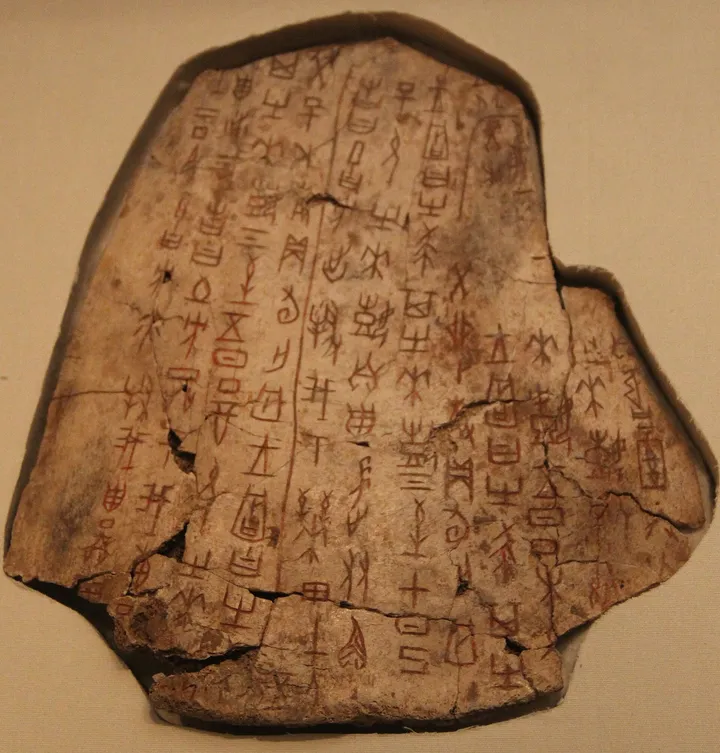
The main varieties of Chinese are popularly called dialects. Scholars usually classify them as separate languages, among them Mandarin, Wu, Min, Gan, Hakka, Xiang and Cantonese, also called Yue. Speakers of different varieties cannot understand one another, and the differences are about as large as those between the modern Romance languages.[11]
The constitution obliges the state to promote Putonghua, the common speech, throughout the country.[1] A law in force since 2001 makes Putonghua and the standardized characters the standard spoken and written forms of Chinese. More than 80% of the population can now communicate in Putonghua.[2]
From Guangdong to Gold Mountain
News of the gold discovery in California reached China, and tens of thousands of Chinese came to seek their fortune. They called California Gam Saan, Cantonese for Gold Mountain.[12] The newcomers worked first in the gold mines, then also on farms and in factories, and many helped build the railroads of the West.[13]
Labor contractors recruited railroad workers mostly in Guangdong province, especially in Siyi (Sze Yap), the four counties of Taishan, Kaiping, Xinhui and Enping. The area suffered from poverty and unrest and lay close to the port of Hong Kong. Men from the same region also went to the guano mines of Peru and the sugar plantations of Cuba. In February 1867, Chinese workers made up 90% of the workforce of the Central Pacific Railroad, which built the western part of the first transcontinental line.[14]
As their numbers grew, so did hostility from other workers.[13] In Los Angeles in 1871, a mob of about 500 people killed 18 Chinese residents.[15] In 1885 white coal miners in Rock Springs, Wyoming, killed 28 Chinese people and burned the town’s Chinatown.[16]
The Chinese Exclusion Act of May 6, 1882, was the first significant federal law to restrict immigration.[17] Its preamble states that “the coming of Chinese laborers to this country endangers the good order of certain localities within the territory thereof”. The act suspended the immigration of Chinese laborers for ten years and barred state and federal courts from admitting Chinese to citizenship.[17]
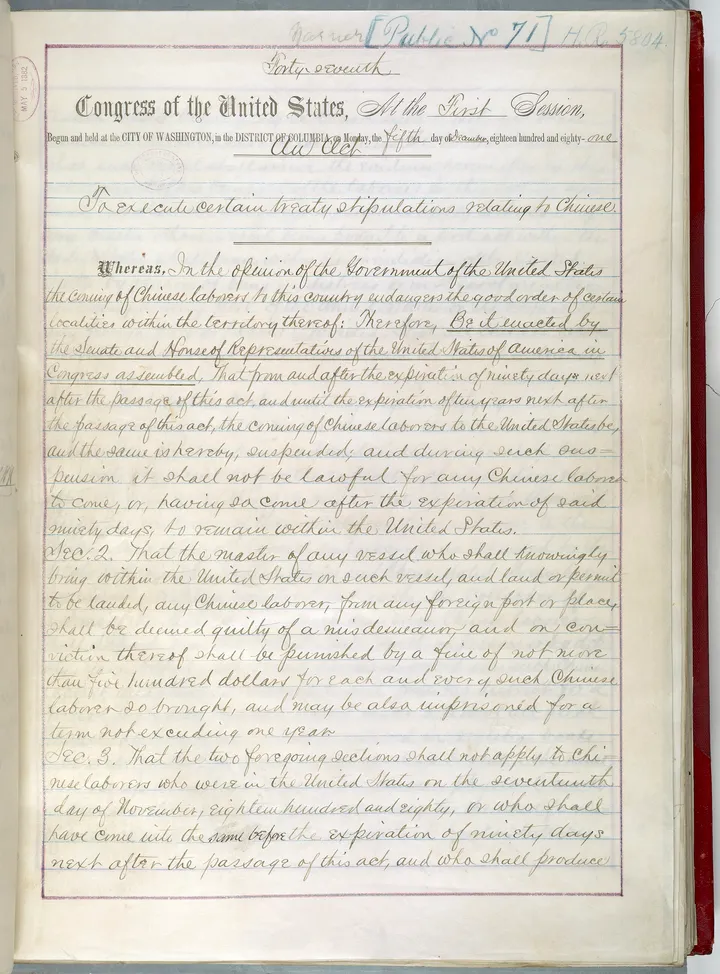
Recorded immigration from China fell sharply in the following decades.[18]
Source: U.S. Department of Homeland Security[18]
Angel Island and the paper sons
Under the exclusion laws only a few classes of Chinese could enter, among them merchants, teachers, consular officials, tourists and their families. Officials questioned applicants closely to expose any “paper son”, one “whose relationship to a U.S. resident existed only on paper”. Coaching books prepared such immigrants for the interrogations. They held facts about the family and home village of the person the immigrant was to impersonate, and they were thrown overboard once memorized.[19]
The practice spread after the earthquake and fire of 1906 destroyed all of San Francisco’s birth records. Any Chinese resident could now claim citizenship by birth and create identities of “paper children” to sell.[20]
From 1910 to 1940, many new arrivals were held at the immigration station on Angel Island in San Francisco Bay. Inspectors asked about their family history and village life and compared the answers with those of witnesses. Detention could last weeks or months, sometimes years.[21]
Detainees wrote and carved poems on the wooden walls of the barracks. Most of the poets were village men from southern China, often with little formal schooling. A former park ranger discovered the poems in 1970, and more than 200 have since been documented.[21] One of them ends with the line “Even if it is built of jade, it has turned into a cage.”[22]
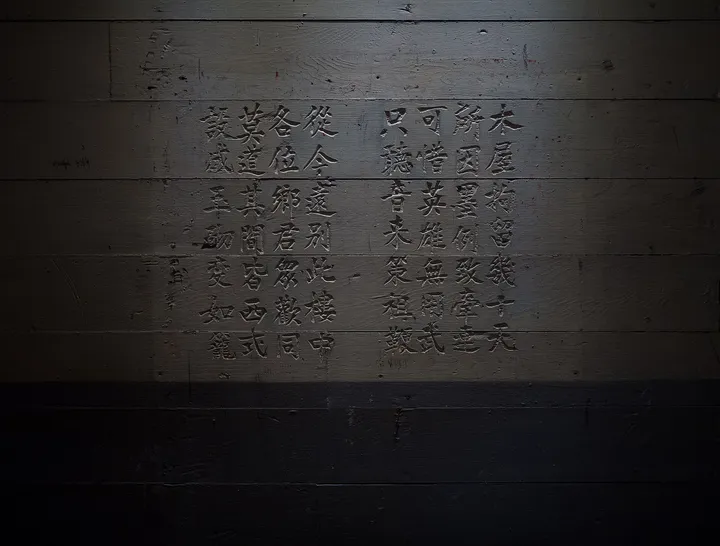
In 1956 the Immigration and Naturalization Service began to offer legal status to paper sons and daughters who confessed their illegal entry.[20]
Chinese surnames and American records
Chinese names put the family name first, and women usually keep their own surname when they marry.[23] In 2020, Wang, Li, Zhang, Liu and Chen were the five most common surnames in China. Together they accounted for 30.8% of all registered residents.[24]
In American records one person can appear under several names. Immigration officials often did not understand the order of Chinese names and sometimes reversed family and given names. They also took forms of address such as Ah or Shee for names. In Hawaii, some Chinese names were converted to Hawaiian ones by sound, such as Chung to Akuna.[25] Railroad payrolls list workers as Ah Fong, Ah Chung or Ah Lim, so very few of their real names are known.[14]
Spellings also follow the dialect. In Hawaii, the surname society founded in 1889 for people named Lum also covered the spellings Lam, Lim and Lin.[26] Pinyin, the romanization based on Beijing pronunciation, was introduced in 1956 and revised in 1958.[11]
Many Chinese American families whose ancestors arrived before World War II have learned that their surname comes from a paper identity.[27] To find an immigrant’s case file, researchers need the name used on the papers, which may differ from the real one. The name in Chinese characters helps to confirm it. The files can include interrogation transcripts, family photographs and maps of home villages in China.[25]
Chinese families in Hawaii
The Chinese called Hawaii Tan Heung Shan, the Sandalwood Mountains, after the sandalwood trade that began as early as 1792.[26] In 1852 the British ship Thetis brought 175 field hands and 20 domestic servants from China, recruited for the sugar plantations. Most members of Hawaii’s first permanent Chinese community were Cantonese from the Chungshan district in the Pearl River Delta, and about a quarter were Hakka.[28] Of an estimated 46,000 Chinese who arrived before annexation, probably two-thirds to three-fourths started out on sugar or rice plantations.[26]
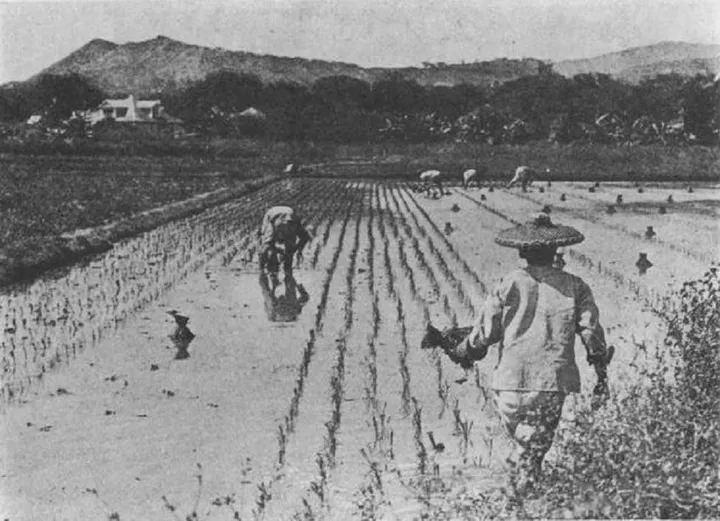
Few Chinese women came to Hawaii, and some men married Hawaiian women.[28] Before 1900, an estimated 1,200 to 1,500 Chinese men started families with Hawaiian or part-Hawaiian women, especially in rural areas and small towns. Most of their children identified more closely with their mothers’ relatives.[26]
Annexation in 1898 brought the US exclusion laws to Hawaii and ended the pioneer era of Chinese migration to the islands.[26] “There shall be no further immigration of Chinese into the Hawaiian Islands,” the joint resolution of annexation declares, except as the laws of the United States allow.[29] The clause was repealed together with the other exclusion laws on December 17, 1943.[30]
Chinese in the United States
About 35% of Chinese Americans live in California. The metro areas of New York, Los Angeles and San Francisco have the largest Chinese communities.[5]
- 1865
Large numbers of Chinese from communities in California begin work on the Central Pacific Railroad. Soon shiploads of workers recruited in Guangdong follow.[14]
- 1869
On May 10 the Central Pacific is linked with the Union Pacific Railroad. Many Chinese workers stay on to build other railroads from California to New York.[14]
- 1888
The Scott Act bars Chinese who visit China from returning to the United States, even long-term legal residents.[13]
- 1892
The Geary Act extends exclusion for ten years. Every Chinese resident must register and obtain a certificate of residence or face deportation.[17]
- 1943
An act of December 17 repeals the exclusion laws. A quota of 105 immigrants a year remains, and Chinese born abroad win the right to seek naturalization.[17][30]
- 1965
The Immigration Act ends the national origins system. From July 1968, immigration from outside the Western Hemisphere is limited to 170,000, with no more than 20,000 from any one country.[17]
- 2012
The House of Representatives unanimously passes a resolution condemning the Chinese Exclusion Act, a year after the Senate.[17]
- 2020
Chinese Americans form the largest Asian group in the census, with 5.2 million people who identify as Chinese alone or together with another group. People who identify as Taiwanese are counted separately.[4]
Sources
- The State Council of the People’s Republic of China: Constitution of the People’s Republic of China, Articles 19 and 143, English translation (November 20, 2019)
- The State Council of the People’s Republic of China, from Xinhua: China revises law on standard spoken, written Chinese language (December 27, 2025)
- National Bureau of Statistics of China: Main Data of the Seventh National Population Census (May 11, 2021)
- U.S. Census Bureau: 2020 Census Detailed Asian Population (September 2023)
- Pew Research Center: Carolyne Im, Facts about Chinese in the U.S. (May 1, 2025)
- Melinda A. Yang et al.: Ancient DNA indicates human population shifts and admixture in northern and southern China, Science (July 2020)
- Bo Wen et al.: Genetic evidence supports demic diffusion of Han culture, Nature (September 2004)
- Jieming Chen et al.: Genetic structure of the Han Chinese population revealed by genome-wide SNP variation, American Journal of Human Genetics (December 2009)
- University of California Press: Thomas S. Mullaney, Coming to Terms with the Nation, Ethnic Classification in Modern China (2010)
- UNESCO World Heritage Centre: Yin Xu (inscribed 2006)
- Encyclopaedia Britannica: Søren Christian Egerod, Chinese languages
- California State Parks: California State Parks and Partners Celebrate Opening of Gam Saan Trail to Marshall Gold Discovery State Historic Park (February 15, 2022)
- Office of the Historian, U.S. Department of State: Chinese Immigration and the Chinese Exclusion Acts
- Chinese Railroad Workers in North America Project, Stanford University: Key Questions
- Los Angeles Public Library: Kelly Wallace, Forgotten Los Angeles History, The Chinese Massacre of 1871 (May 19, 2017)
- WyoHistory.org, Wyoming State Historical Society: Tom Rea, The Rock Springs Massacre (November 8, 2014)
- National Archives: Milestone Documents, Chinese Exclusion Act (1882)
- U.S. Department of Homeland Security: 2019 Yearbook of Immigration Statistics, Table 2, Persons obtaining lawful permanent resident status by region and selected country of last residence, 1820 to 2019
- National Archives: A Chinese Exclusion Act Coaching Book, Prologue 40, no. 1 (Spring 2008)
- Angel Island Immigration Station Foundation: Paper Sons and Daughters (October 31, 2023)
- Smithsonian Folklife Festival: Ying Diao, Echoes of History, Chinese Poetry at the Angel Island Immigration Station (May 3, 2017)
- Angel Island Immigration Station Foundation: Poetry Finder, Room 111, North Wall, poem 135 in the translation of Him Mark Lai, Genny Lim and Judy Yung (December 2, 2024)
- UK Home Office, HM Passport Office: China, Knowledge Base profile (updated July 31, 2026)
- Xinhua via China News Service: 你的名字、我的姓氏,藏有几多故事? on the Ministry of Public Security’s 2020 national name report (February 9, 2021, in Chinese)
- National Archives: Waverly B. Lowell, Chinese Immigration and the Chinese in the United States, Reference Information Paper 99 (1996)
- Clarence E. Glick: Sojourners and Settlers, Chinese Migrants in Hawaii, University Press of Hawaii (1980), via ScholarSpace, University of Hawaiʻi
- NPR, Code Switch: Hansi Lo Wang, Chinese-American Descendants Uncover Forged Family Histories (December 17, 2013)
- Eleanor C. Nordyke and Richard K. C. Lee: The Chinese in Hawaiʻi, A Historical and Demographic Perspective, Hawaiian Journal of History 23 (1989)
- U.S. Statutes at Large, vol. 30, p. 751: Joint Resolution to provide for annexing the Hawaiian Islands to the United States (July 7, 1898)
- U.S. Statutes at Large, vol. 57, p. 600: An Act to repeal the Chinese Exclusion Acts, to establish quotas, and for other purposes (December 17, 1943)