Celebrities with Filipino Roots
 Bruno MarsMother born in the Philippines
 Hailee SteinfeldGreat-grandfather from Bohol
 Olivia RodrigoGreat-grandfather emigrated as a teen
 SneakoFilipino mother
No celebrity matches your search.
Where Filipino ancestry comes from
The Philippines is an archipelago in Southeast Asia. Its islands fall into three main groups: Luzon in the north, the Visayas in the center and Mindanao in the south.
People have lived on the islands for tens of thousands of years. A genetic study published in 2021 compared DNA from 1,028 people in 115 indigenous communities. Its authors conclude that the islands were “populated by at least five waves of human migration”.[5] The first to arrive were the ancestors of the Negrito peoples, such as the Ayta of Luzon. They were followed by groups related to today’s Manobo, Sama, Papuans and Cordillerans.[5]
The last three waves arrived between 15,000 and 7,000 years ago, while sea levels were rising.[6] The ancestors of the Cordillerans split from the indigenous peoples of Taiwan at least 8,000 years ago.[5] For a long time researchers assumed that language, ways of life, culture and people moved together as a single unit. Mattias Jakobsson, the senior author, says the study “debunks a view that has dominated research on human history”. New groups reached the Philippines more than 7,000 years ago, and “it was these groups that took the Austronesian languages with them.” Farming followed about 3,000 years later.[6]
A second study by the same team found that the Ayta Magbukon of Luzon carry the highest level of Denisovan ancestry in the world, inherited from an extinct group of archaic humans.[7] “Compared with Australians and Papuans, the Negritos’ Denisovan ancestry was up to 46 per cent higher,” says the lead author Maximilian Larena. Jakobsson explains why the Ayta Magbukon kept so much of it: “some groups, such as Ayta Magbukon, interbred only a little with the people who later migrated to the islands.”[8]
Peoples and languages
In the 2020 census, about one in four Filipinos named Tagalog as their ethnicity.[9]
Source: Philippine Statistics Authority[9]
The constitution makes Filipino the national language. Filipino and English are the official languages, and the regional languages serve as auxiliary official languages in their regions.[1]
Trade and faith before Spain
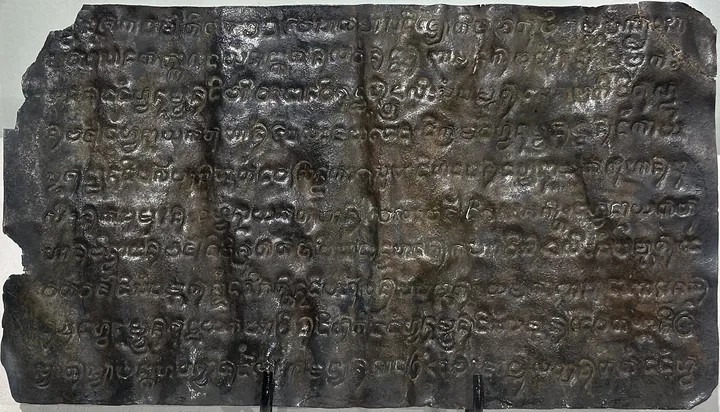
The oldest known document written in the Philippines is a copper plate from the year 900, found in the province of Laguna southeast of Manila. It is written in Old Malay and certifies that a family was cleared of a debt.[10]
Chinese ceramics found on the islands go back as far as the Tang dynasty. The earliest written reference to the Philippines appears in the History of Song, a Chinese chronicle, and dates to 971. Spanish chroniclers later called the Chinese traders Sangleys, a name that probably comes from the Minnan words siong lai, “frequently coming”.[11]
In the far south, Islam took hold long before the Spanish arrived. A 2013 law declared the Sheikh Karimul Makhdum Mosque on Simunul in Tawi-Tawi a national historical landmark. The law gives 1380 as the year it was built and counts it among the oldest mosques in the country.[12]
Spanish rule and Filipino surnames
The Spanish explorer Ruy López de Villalobos named the islands after Prince Philip, later King Philip II of Spain, during his expedition of 1542–1546.[13] Spain ruled the Philippines from 1565 until 1898.[14][15]
Converting the islands to Catholicism was a main aim of Spanish rule from its start in 1565. Many converts kept their older beliefs and blended them with the new faith, and saints took the place of the spirits of nature and of ancestors.[16] In the 2020 census, 78.8% of Filipinos named Roman Catholicism as their religion and 6.4% named Islam.[17]
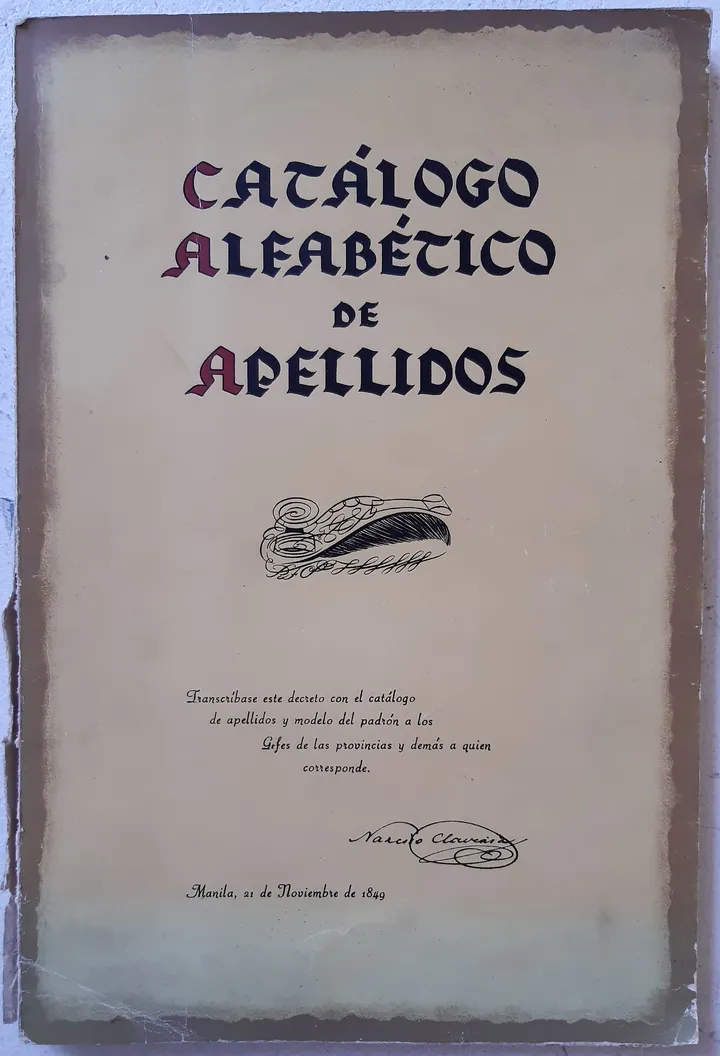
In 1849 Governor-General Narciso Clavería ordered a system of family names for the colony. The surnames came from a list of Spanish names and indigenous words for plants, animals, minerals and places.[18] Many Spanish surnames in Filipino families go back to this decree, so on their own they say little about Spanish ancestry. The 2021 genetic study points the same way. It found a low level of West Eurasian ancestry in only a few lowlanders, fewer than 1% of everyone tested, and the authors see “a limited genetic legacy of Spanish colonization”.[5]
Under Spanish rule, Chinese men and Filipino women had children known as Chinese mestizos. Many of their descendants took Hispanicized surnames such as Roxas, or turned the full name of the family patriarch into a single surname, such as Ongpin. José Rizal and Emilio Aguinaldo, two leaders of the reform movement and the revolution, both had partial Chinese ancestry. The mestizo families became part of the mainstream population, and ethnic Chinese today make up an estimated 2% of all Filipinos.[11]
The flag and independence
The flag was displayed in Kawit, Cavite, on June 12, 1898, when the revolutionaries declared independence from Spain.[19] The declaration explains each symbol. The white triangle stands for “the distinctive emblem of the famous Society of the ‘Katipunan’”,[20] the secret society that began the revolution in 1896.[19] The eight rays of the sun stand for the eight provinces that declared a state of war when the uprising began: Manila, Cavite, Bulacan, Pampanga, Nueva Ecija, Bataan, Laguna and Batangas. In 1898 the three stars stood for “Luzon, Mindanao, and Panay”.[20] Today they represent Luzon, the Visayas and Mindanao.[19]
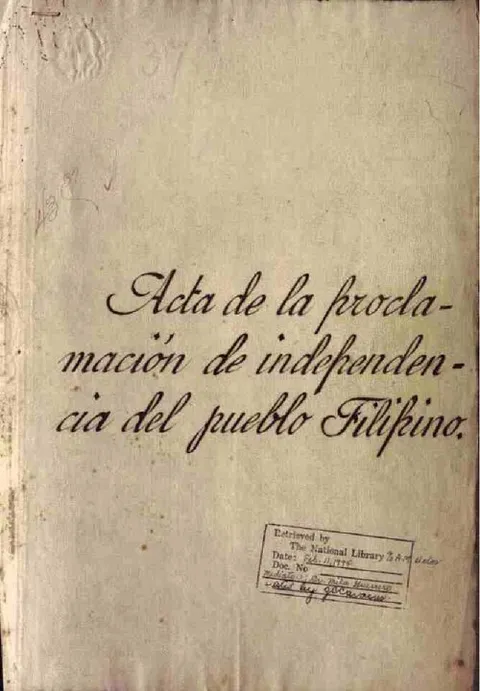
The declaration says the colors blue, red and white were chosen “commemorating the flag of the United States of North America”.[20] On February 4, 1899, fighting broke out between American and Filipino forces.[15]
In peacetime the blue stripe is on top. In time of war the flag is flown upside down by law, with the red stripe on top.[21]
Filipinos in the United States
California has the largest Filipino community in the US, with 1.6 million people, followed by Hawaii with 310,000.[4]
- 1565
Spain begins its colonial rule over the islands.[14]
- 1587
Filipino sailors on a Spanish galleon land at Morro Bay, California. It is the earliest documented Filipino presence in what is now the continental United States.[22]
- 1898
Spain cedes the Philippines to the United States in the Treaty of Paris. Until 1934, Filipinos travel to the US as American nationals.[15][23]
- 1906
The first 15 sakadas, contract workers for Hawaii’s sugar plantations, arrive on the SS Doric on December 20. About 120,000 follow by 1934.[24]
- 1934
The Tydings–McDuffie Act sets the path to independence. Filipinos arriving in the US now count as aliens, with a quota of 50 a year. Hawaii’s plantations keep recruiting workers until 1946.[23]
- 1946
The Philippines becomes an independent republic on July 4.[14]
- 1965
Larry Itliong and the Agricultural Workers Organizing Committee lead 1,500 Filipino farmworkers on strike against the grape growers around Delano, California.[25] In the same year the Immigration and Nationality Act ends the national quotas.[23]
- 2009
Congress recognizes October as Filipino American History Month.[22]
- 2020
The census counts 4.4 million people who identify as Filipino, alone or together with another background. They are the third-largest Asian group in the US, after Chinese and Indian Americans.[3]
Sources
- Official Gazette: The 1987 Constitution of the Republic of the Philippines, Article XIV
- Philippine Statistics Authority: 2020 Census of Population and Housing, population counts (July 2021)
- U.S. Census Bureau: 2020 Census Detailed Asian Population (September 2023)
- Pew Research Center: Filipinos in the U.S. Fact Sheet (May 1, 2025)
- Maximilian Larena et al.: Multiple migrations to the Philippines during the last 50,000 years, PNAS (March 2021)
- Uppsala University: Largest-ever DNA mapping study of the Philippines (March 24, 2021)
- Maximilian Larena et al.: Philippine Ayta possess the highest level of Denisovan ancestry in the world, Current Biology (August 2021)
- Uppsala University: Philippine ethnic group has most Denisovan DNA (August 13, 2021)
- Philippine Statistics Authority: About one in every four household population has Tagalog as ethnicity, 2020 Census of Population and Housing (July 2023)
- Elsa Clavé and Arlo Griffiths: The Laguna Copperplate Inscription, Tenth-Century Luzon, Java, and the Malay World, Philippine Studies 70, no. 2 (2022)
- Michael L. Tan: From Sangley to Tsinoy, Changing Identities among Ethnic Chinese in the Philippines, Public Policy vol. XI, UP Center for Integrative and Development Studies
- Republic Act No. 10573, declaring the Sheikh Karimul Makhdum Mosque a National Historical Landmark (May 24, 2013)
- Official Gazette: About the Philippines
- The National WWII Museum: July 4, 1946, The Philippines Gained Independence from the United States (July 2, 2021)
- Office of the Historian, U.S. Department of State: The Philippine-American War, 1899–1902
- Library of Congress, Federal Research Division: Philippines, A Country Study, Religion, Historical Background
- Philippine Statistics Authority: Religious Affiliation in the Philippines, 2020 Census of Population and Housing (2023)
- UCLA Center for Southeast Asian Studies: Looking for Clavería’s Children, on the history of Philippine naming systems (May 14, 2008)
- National Historical Commission of the Philippines: The Philippine Flag, Symbol of our Sovereignty and Solidarity
- Act of the Proclamation of Independence of the Filipino People (June 12, 1898), translated by Sulpicio Guevara, National Historical Commission (1972), via Wikisource
- Official Gazette: Republic Act No. 8491, Flag and Heraldic Code of the Philippines (February 12, 1998)
- Congress.gov: H.Res. 780, Filipino American History Month (111th Congress, 2009)
- National Archives: Immigration from Asia and the Pacific, 1870s to 1950s
- Hawaii State Legislature: Act 7 of 2015, Sakada Day
- National Park Service: Larry Itliong