Celebrities with Georgian Roots
 Ilia TopuriaGeorgian parents, mother from Abkhazia
A country between the Caucasus and the Black Sea
Georgia is a country in the South Caucasus at the eastern end of the Black Sea, bordered by Russia, Azerbaijan, Armenia and Turkey.[5] Georgians call themselves Kartveli and their country Sakartvelo. The English name comes from Gorj, the Persian name for them.[6]
Fossils from Dmanisi show that early humans of the genus Homo lived outside Africa around 1.8 million years ago.[7] DNA from two men who lived in western Georgia about 13,300 and 9,700 years ago, found in the Satsurblia cave and the Kotias Klde rock shelter, belongs to a distinct ancient lineage of Caucasus hunter-gatherers. It split from the lineage of western European hunter-gatherers about 45,000 years ago and from the ancestors of the first farmers about 25,000 years ago. The Yamnaya herders of the steppe, who moved into Europe around 3000 BC, owed a significant share of their ancestry to this lineage. Its traces remain in people of the Caucasus today and reach as far as Central and South Asia.[8]
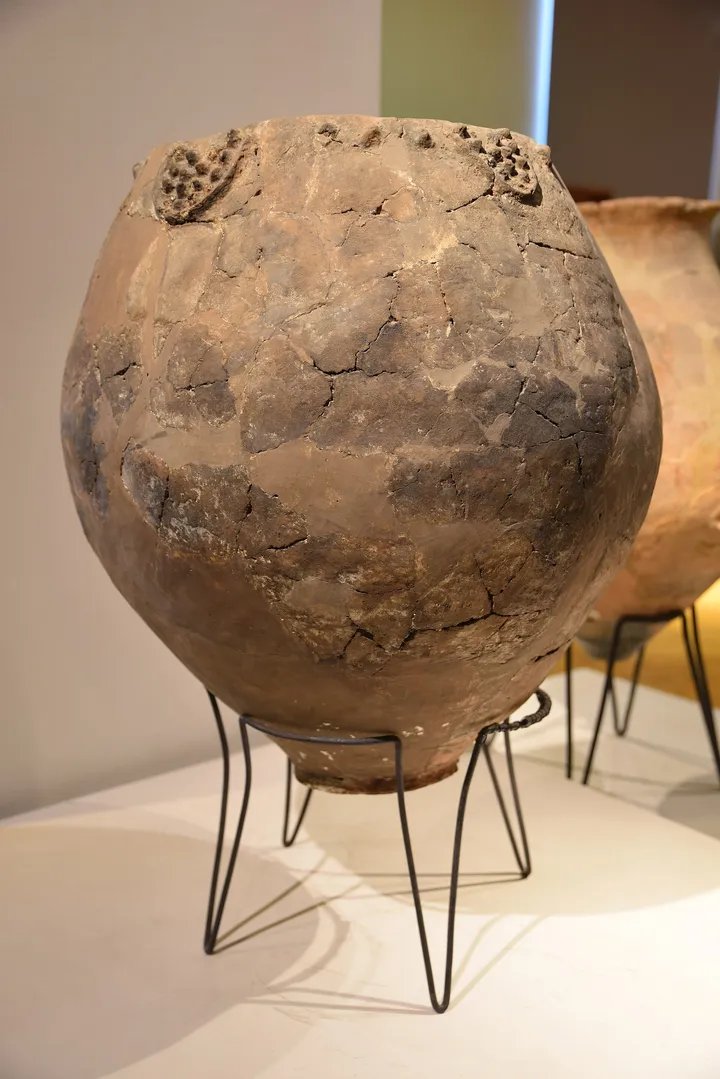
At Gadachrili Gora and Shulaveris Gora, two Neolithic villages about 50 kilometers south of Tbilisi, residues in clay jars point to wine. The authors of a 2017 study date the finds to about 6000–5800 BC and call them “the earliest biomolecular archaeological evidence for grape wine and viniculture from the Near East”.[9] Georgian wine is still fermented in the qvevri, an egg-shaped clay vessel that is sealed and buried in the ground for five to six months. According to UNESCO, which recognized the method as intangible cultural heritage in 2013, most farmers and city dwellers make their wine this way.[10]
Kartvelian languages and three scripts
Georgian, Mingrelian, Laz and Svan make up the Kartvelian, or South Caucasian, language family. Only Georgian has an old written tradition, and speakers of the other three languages use it for writing.[11] Svan, at home in the high valleys south of Mount Elbrus, split off from the others at an early stage.[12][11] Mingrelian is spoken along the Black Sea coast of Georgia, Laz on the same coast in Georgia and in neighboring Turkey.[13][14] In the 2024 census, 85.1% of the population named Georgian as their mother tongue.[2]
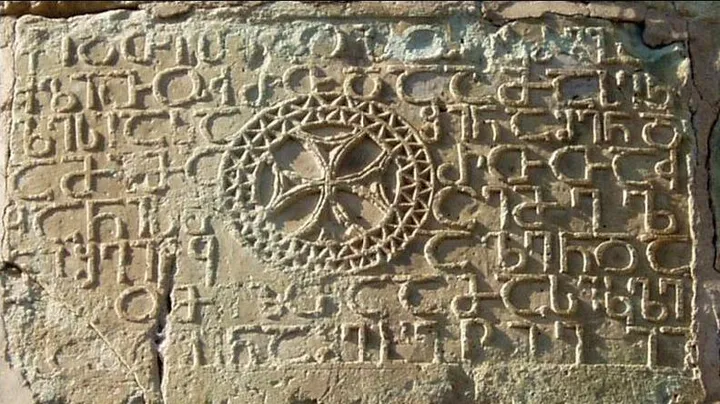
The oldest dated Georgian inscription found in Georgia records that the church of Bolnisi Sioni in Kvemo Kartli was completed in 493 or 494. Older dated Georgian inscriptions survive in the Holy Land.[15][16] Bolnisi’s letters belong to Mrgvlovani, also called Asomtavruli.[16] The order of its letters follows the Greek alphabet, which points to a Greek model.[17] Nuskhuri and then Mkhedruli developed from Mrgvlovani, the oldest of the three Georgian scripts, and all three are in use today.[18]
Mkhedruli is the script of schools and of everyday writing. It originally had 40 letters, and seven of them have since fallen out of use.[17][18] The two older scripts live on mainly in the Georgian Orthodox Church, in psalms, hymns and on icons. When UNESCO inscribed the three writing systems in 2016, its committee described this living culture as “practised by the great majority of the Georgian population as an important part of their cultural identity and self-expression”.[18]
Kingdoms, empires and independence
Georgians adopted Christianity early in the 4th century through the mission of Saint Nino.[19] The census of 2024 counted 82.0% of the population as Orthodox Christians and 11.1% as Muslims.[2] A Georgian kingdom was at its strongest from the 10th to the 13th century.[5] The Ottoman Empire and Safavid Iran partitioned the country in the 16th century. Shah Abbas I of Iran, who ruled from 1587 to 1629, deported many thousands of Christians from the region to distant parts of his empire.[20]
King Erekle II of Kartli and Kakheti accepted Russian suzerainty in the Treaty of Georgievsk of 1783, in return for a guarantee of his kingdom’s independence. In 1801 Emperor Alexander I incorporated Kartli and Kakheti into the Russian Empire. Imereti followed in 1810 and Abkhazia in 1864. In a series of wars up to 1877–78, Russia also took Batumi and the Ottoman-held lands in the southwest.[20]
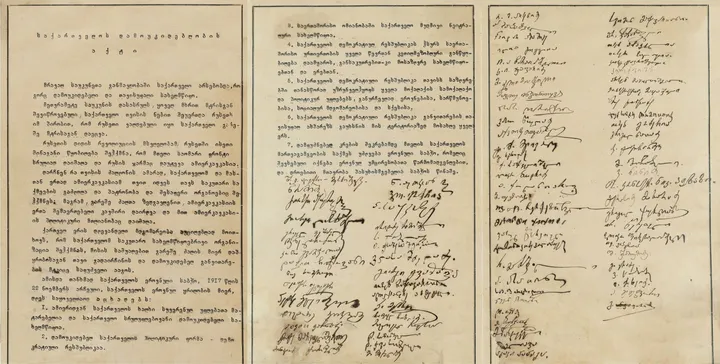
On May 26, 1918, the Georgian National Council declared independence.[21] The act promised all citizens civil and political rights “without distinction of nationality, religion, social position, or sex”.[22]
The Allies recognized Georgia in January 1921. Within a month the Red Army entered the country on the orders of two Georgian Bolsheviks, Joseph Stalin and Grigory Ordzhonikidze, and installed a Soviet government.[20] Georgia became a union republic of the Soviet Union in 1936. It declared sovereignty on November 19, 1989, and independence on April 9, 1991.[5]
Abkhazia and South Ossetia
Abkhazia lies in the northwest of Georgia and South Ossetia in the north.[5] Georgia’s 2024 census did not cover either region.[2] Soon after Georgia became independent in 1991, heavy fighting between Ossetian and Georgian forces drove thousands of people from South Ossetia. Russia helped broker a ceasefire in 1992.[23] According to the UN observer mission, the conflict in Abkhazia began with social unrest and attempts by the local authorities to separate from Georgia. It escalated into armed clashes in the summer of 1992, when the Georgian government sent 2,000 troops there. Abkhaz forces took Sukhumi on September 27, 1993. The fighting displaced hundreds of thousands of civilians, most of them Georgians.[24]
In August 2008, fighting in South Ossetia grew into hostilities between Georgia and Russia that spread to Abkhazia. Georgia and Russia then signed a ceasefire brokered by France.[23] On August 26, 2008, Russia recognized both regions as independent.[25] Under a Georgian law passed that October, Georgia regards them as territories occupied by Russia.[26] The UN General Assembly adopted a resolution in June 2025 by 107 votes to 9, with 49 abstentions. It recognizes the right of all displaced people and refugees to return to their homes “throughout Georgia, including in Abkhazia and the Tskhinvali region/South Ossetia”.[27][28] Georgia’s agency for displaced persons had 300,439 people registered as internally displaced in January 2026.[29]
Georgian communities abroad
Shah Abbas I settled a large group of Georgians and Armenians in Fereydan, west of Isfahan, probably in 1603–1605. By 1810 these Georgians had become Muslims. An account from 1896 put them at 2,500 households, about 15,000 people, and in the early 20th century most of them still spoke Georgian.[30] Georgian is spoken today in many villages of the Isfahan region, in parts of Azerbaijan and in northeastern Turkey.[17]
About 496,000 people born in Georgia lived in other countries in mid-2024, according to UN estimates. In 1990, when Georgia was still a Soviet republic, Russia had about 657,000 residents born there. Greece already had about 36,000, while Italy had 145 and Spain eight.[31]
Source: UN Population Division, International Migrant Stock 2024[31]
Surnames and church registers
Most Georgian Christians have surnames ending in -dze, “son of”, or -shvili, “child of”. Names ending in -dze first appear in the 13th century and those in -shvili in the 14th, and the early ones were not necessarily passed on. Until the 19th century, no law in Georgia required a hereditary surname. The medieval poet Shota Rustaveli had none, and one man of the late 17th century appears in documents under three last names, two formed from the names of his father and grandfather and one from his family.[32]
The ending -eli forms surnames from place names. Among Georgian Jews, -shvili is even more common. It ends 92% of the 379 surnames documented for them in the 1800s and 1900s.[32]
The Central Historical Archive of the National Archives of Georgia holds church registers from 1819 to 1921 that record who was born, married or died in each parish. Some years are missing because certain volumes never reached the archive. An online finder shows which villages are covered for which years.[33] Regional and local archives keep household books, filled in by village councils every three and later every five years. They list each member of a household with a date of birth.[34]
Georgians in the United States
In the five-year estimates for 2020–2024, New York had about 12,900 of the roughly 31,000 US residents born in Georgia, followed by California with about 5,000 and New Jersey with about 2,900.[4]
- 1892
A troupe of horsemen from Guria in western Georgia joins Buffalo Bill’s Wild West in England. On June 25 they ride for Queen Victoria at Windsor.[35]
- 1893
The riders come to the United States for the World’s Columbian Exposition in Chicago. For more than thirty years Georgians perform in American shows and circuses, billed as Russian Cossacks.[35]
- 1900–1920
Small numbers of Georgians arrive, among them men avoiding conscription in World War I, revolutionaries who escaped tsarist prisons and workers looking for jobs on California’s railways.[36]
- 1921
The Red Army invades Georgia in February. During the 1920s a few hundred exiles reach the United States from Europe, among them former officers, officials and aristocrats.[36]
- 1948–1953
Another group arrives after World War II, many of them former prisoners of war. They come under the Displaced Persons Act of 1948 or later under the Refugee Relief Act of 1953.[36]
- 1973–1974
The first ten families of Georgian Jews arrive. Larger groups follow in 1978–1980 and the mid-1980s, and most of the 5,000–6,000 settle in Queens, New York.[36]
- 1991
The United States recognizes Georgia’s independence on December 25. Diplomatic relations follow on March 24, 1992, and the embassy in Tbilisi opens on April 23.[37]
- 2024
The American Community Survey counts 35,886 US residents who were born in Georgia.[3]
Sources
- Constitute Project: Georgia’s Constitution of 1995, revised 2018, Article 2
- National Statistics Office of Georgia: Main Results of the 2024 Population and Agricultural Census (June 22, 2026)
- U.S. Census Bureau: American Community Survey 2024, 1-year estimates, Table B05006, Place of Birth for the Foreign-Born Population
- U.S. Census Bureau: American Community Survey 2020–2024, 5-year estimates, Table B05006, Place of Birth for the Foreign-Born Population, by state
- Encyclopaedia Britannica: Georgia
- Encyclopaedia Britannica: Georgia, People
- David Lordkipanidze et al.: A complete skull from Dmanisi, Georgia, and the evolutionary biology of early Homo, Science 342 (October 2013)
- Eppie R. Jones et al.: Upper Palaeolithic genomes reveal deep roots of modern Eurasians, Nature Communications 6 (November 2015)
- Patrick McGovern et al.: Early Neolithic wine of Georgia in the South Caucasus, PNAS 114 (November 2017)
- UNESCO Intangible Cultural Heritage: Ancient Georgian traditional Qvevri wine-making method (inscribed 2013)
- Encyclopaedia Britannica: Kartvelian languages
- Encyclopaedia Britannica: Svan language
- Encyclopaedia Britannica: Mingrelian language
- Encyclopaedia Britannica: Laz language
- University of Exeter, Architecture and Asceticism: Bolnisi
- Georgian Encyclopedia, I. Abashidze Main Scientific Editorial Office: Bolnisi Inscriptions
- Encyclopaedia Britannica: Georgian language
- UNESCO Intergovernmental Committee for the Safeguarding of the Intangible Cultural Heritage: Decision 11.COM 10.B.13, Living culture of three writing systems of the Georgian alphabet (2016)
- Encyclopaedia Britannica: Georgian Orthodox church
- Encyclopaedia Britannica: Georgia, Turkish and Persian domination
- National Archives of Georgia: Document of the Week, Independence Act of Georgia
- Act of Independence of Georgia (May 26, 1918), English text from Democratic Republic of Georgia, 1919–1921, Three Historic Documents (Tbilisi, 1991), via Regionalism Research Center
- Encyclopaedia Britannica: South Ossetia
- United Nations Peacekeeping: UNOMIG, United Nations Observer Mission in Georgia, Background
- President of Russia: Statement by President of Russia Dmitry Medvedev (August 26, 2008)
- Legislative Herald of Georgia: Law of Georgia on Occupied Territories, No. 431 (October 23, 2008)
- United Nations General Assembly: Resolution 79/292, Status of internally displaced persons and refugees from Abkhazia, Georgia, and the Tskhinvali region/South Ossetia, Georgia (June 3, 2025)
- United Nations General Assembly: Official Records, 74th plenary meeting, A/79/PV.74 (June 3, 2025)
- United Nations Secretary-General: Status of internally displaced persons and refugees from Abkhazia, Georgia, and the Tskhinvali region/South Ossetia, Georgia, A/80/729 (May 4, 2026)
- Pierre Oberling: Georgia viii. Georgian communities in Persia, Encyclopaedia Iranica (December 15, 2001)
- United Nations Department of Economic and Social Affairs, Population Division: International Migrant Stock 2024, Table 1
- Alexander Beider: Surnames of Georgian Jews, Historical and Linguistic Aspects, Genealogy 7 (2023)
- National Archives of Georgia: Parish register finder
- National Archives of Georgia: Catalogue of household records
- Irakli Makharadze, Buffalo Bill Center of the West: Georgian horsemen in the Wild West show, Points West (June 18, 2021)
- Program on Georgian Studies, Davis Center, Harvard University: A Heritage Remembered, A History of the Georgian Diaspora in the US, About
- Office of the Historian, U.S. Department of State: Georgia, recognition and diplomatic relations